

- MoD hints HMS Venturer delivery “by the end of the decade”
- Type 31 costs up; build sequence issues and a long acceptance-to-service gap persist
- Further delays would deepen the frigate shortfall as Type 23s retire
Officials at the UK Ministry of Defence (MoD) appear to have stated that the delivery of the new Type 31 frigates under construction for the Royal Navy could slip further to the right.


Currently undergoing fitting out at Babcock’s Rosyth shipyard, HMS Venturer is the lead ship of five planned Type 31 frigates. The class was conceived as a cost-effective way to boost Royal Navy frigate numbers, which now number just a mere handful amid a surface combatant crisis.
However, manufacturer Babcock recently announced an additional £140m ($188.5m) cost for the programme, detailing that some aspects of vessels were being built out of sequence.
The cost increases are unwanted, but concerns will rise if commentary from MoD officials that indicate a delivery delay come to fruition.
“The first Type 31 frigate, HMS Venturer, is scheduled to be handed over to the Royal Navy by the end of the decade,” said Luke Pollard, UK Minister for Defence Readiness, on 4 June.
It is understood that talks are ongoing to try and shorten the period between vessel acceptance and its in-service date, down from the current 24-month process.
However, shipbuilders are also contracted to deliver a platform at a specific point, meaning that there is little flexibility in terms of acceptance and entry into service.
What are the UK frigate timelines?
HMS Venturer was thought likely to be handed over later in 2026 or early-2027 to undertake sea trials. It is unknown why a vessel at a state of such construction maturity could be delayed to the end of the decade.
It could be the current, highly secretive, UK regime does not want to offer timescales for platform delivery, with officials routinely opting to decline answering parliamentary questions due to what they consider to be national security concerns.
Alternatively, the imminent publication of the UK Government’s long delayed and overdue Defence Investment Plan (DIP) could offer another answer, should the current £28bn funding gap for existing defence programmes remain unfilled.
Should the Treasury offer a compromise figure for the DIP, then the MoD will fall back into its time-served tactic of pushing programme timelines to the right in order to generate short-term savings but inevitably leading to longer-term costs.
For the Type 31 programme, delaying handover of HMS Venturer and subsequent vessels could provide initial savings as part of a compromise deal.
A distinct downside would be the effective ending of the Royal Navy’s frigate force, which currently numbers just five Type 23 warships.
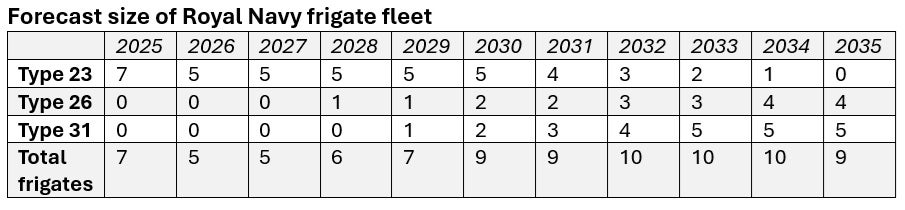
Forecasting UK Royal Navy frigate numbers, should the Type 31 indeed be pushed right as suggested by Pollard, then the service will, at best, limp on with its Type 23 all through 2026 and 2027, before the possibility of the first of the Type 26 frigates is introduced into service.
However, with Norway being slotted into the UK’s Type 26 build, the Royal Navy will see a delay in its own deliveries. Given this, the mid-2030s could actually see a reduction in frigate numbers once again as the last of the Type 23 platforms, likely HMS St Albans, is retired.
It should be noted that at no point in the next decade does the Royal Navy reach the previously stipulated baseline minimum 13 frigates in its fleet. Indeed, with the Type 26 programmes likely due to be capped at just six hulls, the Royal Navy’s new maximum will be just 11 vessels.
Additional reporting from John Hill.


