

- Poland’s Type 31-derived Miecznik (ORP Wicher) floated out faster than the UK’s HMS Venturer
- Miecznik is more heavily equipped (Mk41 VLS, sonar) while the UK Type 31 is initially a lighter patrol-fit with upgrades possible later
- Babcock wants deeper UK–Poland cooperation, especially on sustainment and ‘Hybrid Navy’ concepts
The successful launch of Poland’s first-in-class Miecznik frigate, which is based on the UK’s own Type 31 design, marked the conclusion of a 925-day-long period from the date the keel was laid down until it touched water.


Being produced domestically through the PGZ–MIECZNIK consortium, Poland will build at least three vessels, with five additional hulls as future options. The current expected cost of Poland’s frigate programme is around PLN 15bn (~$4bn).
It is notable the Polish programme delivered the first warship into the water more quickly than that achieved by Babcock’s UK shipyard, which took around 220 days longer (or over seven months), with the UK’s first-in-class Type 31 HMS Venturer having its keel laid on 26 April 2022, before floating out on 14 June 2025.
Senior Babcock officials had previously commented to Naval Technology that the build of the first vessel in any warship class can take longer than subsequent hulls.
However, outfitting has continued apace since HMS Venturer was floated out, with installation of key structures and sensors, weapon systems, and other equipment over the past 12 months.
It is thought that HMS Venturer will be ready to undertake initial sea trials before the end of 2026.
Poland’s first Miecznik frigate, christened ORP Wicher, appeared to be in a more advanced state of initial outfitting upon being launched compared to its UK cousin, potentially indicating that the period required before its own sea trials can begin could again beat the UK’s own timeline.
Specifically, this included sensor masts, rudders, and propellers, compared to the first-in-class Type 31.
Type 31 vs Miecznik : how they compare
The lead vessels of the UK Type 31 and Poland’s Miecznik classes share a common base design and indeed are broadly similar in areas such as propulsion and combat management systems.
However, there are notable differences in sensor and weapons capability, with ORP Wicher and its future sister vessels expected to be fitted as frontline frigates, rather than the UK’s light or patrol configuration.
Some of the information below is based on assessments of available imagery, rather than publicly revealed data.
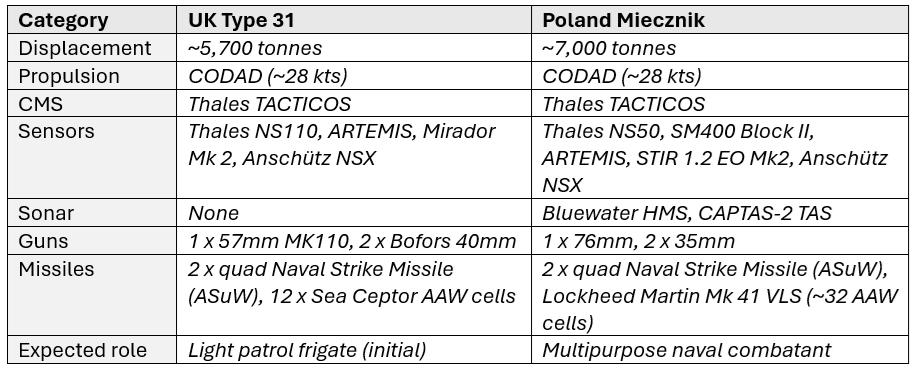
By most metrics, the Polish Mieczniks are more capable vessels than their UK counterparts, which admittedly are being developed to a different price point.
It has previously been reported that the UK’s Type 31 are planned to retrofit the Mk 41 VLS during a future capability insertion period, offering a significantly enhanced missile loadout.
However, the lack of any sub-surface detection or prosecution capability will have to be offset by future uncrewed USV/UUV payloads, potentially carried in amidships.
The lack of a hull-mounted sonar for the UK Type 31 frigates is a capability loss compared to the five general purpose variant Type 23 warships formerly operated by the Royal Navy, which were equipped with Thales’ Sonar 2050, later upgraded to the 2150 system.
This trait of UK warships designs being more capably outfitted by overseas customers can also be seen with the Type 26 frigate, with Canada and Australia making more out of their respective iterations than will be delivered to the Royal Navy.
What next after Miecznik?
Present at the rollout of ORP Wicher were senior officials from UK shipbuilder Babcock, whose AH140 design has formed the basis for Poland’s Miecznik class and Indonesia’s own frigate programme.
Speaking to Babcock’s own media team at the event, Nick Hine, marine chief executive at Babcock and former Royal Navy Second Sea Lord, provided insight into the potential direction the UK-Poland naval partnership could take in the years ahead.
Initially, this would see Babcock assist Poland and shipbuilder PGZ to “get into the sustainment game”, in order to fully maintain their own frigates, Hine said.
However, there apparently is ambition to expand the partnership to introduce Poland to the UK’s so-called Hybrid Navy concept, which depending on perspective is either a revolutionary naval industrial plan or a cost cutting exercise.
“I think this would be a real benefit to Poland, Nato, and the UK,” Hine told Babcock’s in-house media at the ORP Wicher rollout.


