

- Type 32 stalled: announced in 2020, later pitched as an MCM “mothership,” but still only a concept
- Commitment fading: 2025–26 answers stress a “hybrid navy” and Type 26/31, with Type 32 largely absent
- At risk of being cut/duplicated: Funding pressures and MCM work on RFA Lyme Bay could make Type 32 unnecessary, pending the DIP
Once conceived as a way to help boost the Royal Navy’s minimal surface combatant fleet, the Type 32 frigate was announced in 2020 with some hope that the service could plan for a future where aspiring for the bare minimum need not be the norm.


The concept evolved into a likely plan to see it act as a mothership for the service’s autonomous mine countermeasure (MCM) capability, desperately needed considering the rapid drawdown of the Hunt– and Sandown-class MCM vessels.
In the years since Type 32 announcement, it had cropped up periodically in parliamentary questions, in answers to MPs keen to understand more about a programme upon which so much was promised but so little known.
Consistently, governments of the day reiterated that the Type 32 was in concept stage.
However, since 2023, queries have reduced, with just three recorded in 2024 and four the following year, as government answers in April, October, November, and December of 2025 appearing to stop short of full commitment to the programme.
“The Royal Navy is making substantial progress towards deploying autonomous systems alongside crewed platforms to increase the lethality of the fleet and deliver the SDR recommendations,” a UK Government official said in October last year, name checking the new Type 26 and Type 31 frigates but notably failing to mention Type 32.
Come November, and the Ministry of Defence was “continuously evaluating its capabilities” as the Royal Navy transitions towards a so-called “hybrid navy, delivering a mixed fleet of crewed and uncrewed vessels”.
Crucially, these were to be delivered through “faster, smarter procurement and enabled by modular, reconfigurable technology and scalable platforms to increase mass and effect”, according to the UK Government.
By December, little had changed, with Luke Pollard, Minister for Defence Readiness, stating that the Royal Navy was “transitioning towards a hybrid navy”, which would be delivered through “faster, smarter procurement and enabled by modular, reconfigurable technology and scalable platforms to increase mass and effect”.
In 2026 the most recent, and only Type 32 response is from 17 February, with an MoD official stating that “all platform choice decisions will be made as part of the Defence Investment Plan”.
The programme, technically in a concept stage, is in a state of limbo, pending the outcome of the aforementioned Defence Investment Plan, which has been delayed since Autumn 2025.
It is thought that significant cuts will be required of the UK Armed Forces amid a funding gap between current planned expenditure and what the UK Treasury is willing to commit.
If the Type 32, in its concept phase, is intended to act as a mothership for MCM capabilities, the basic conversions currently being done to RFA Lyme Bay, ostensibly a landing platform dock ship used for amphibious assault operations (which the Royal Navy has since abandoned), could render the programme obsolete.
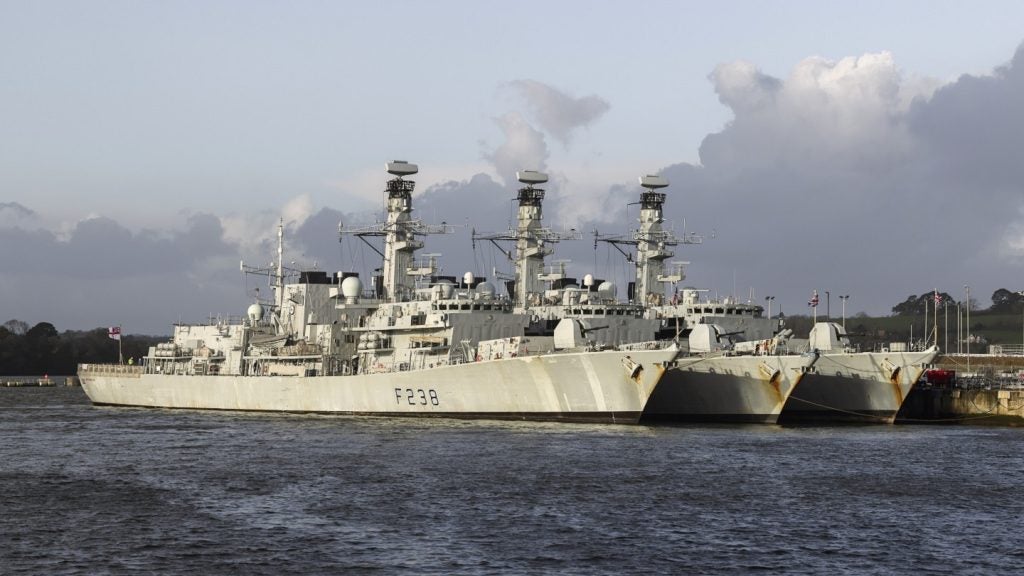
These responses are all the more relevant given that the Royal Navy’s frigate fleet has now reduced to just five available warships. Indeed, the frigate fleet could be down to just four vessels, with Type 23 frigate HMS Richmond widely expected to be decommissioned in 2026.
Defence Investment Plan this week?
The ongoing power struggle in the UK Government, with factions within the ruling Labour party looking to overthrow Prime Minister Keir Starmer, look set to push the incumbent administration to publish the long-delays Defence Investment Plan (DIP) this week.
Reports circulated over the weekend, including from The Telegraph, that Starmer is set to make a landmark speech this week to outline the DIP and secure additional funding, thought to be around £18bn, to protect key defence programmes.
This could in theory include the Type 32 frigate, though with the programme still conceptual and a maritime industrial pipeline that appears to be prioritising other requirements (see John Hill’s recent exposé on uncrewed systems), this appears a forlorn hope.


