
The UK and China found themselves playing the same game in recent weeks as both countries sought to demonstrate their respective purported and provable naval power via the medium of regional port visits by their frontline aircraft carriers.
This saw the UK Royal Navy’s Queen Elizabeth-class aircraft carrier HMS Prince of Wales head to Singapore, a former British colony, at the end of June as a headline element of the six-month deployment into the Indo-Pacific region.
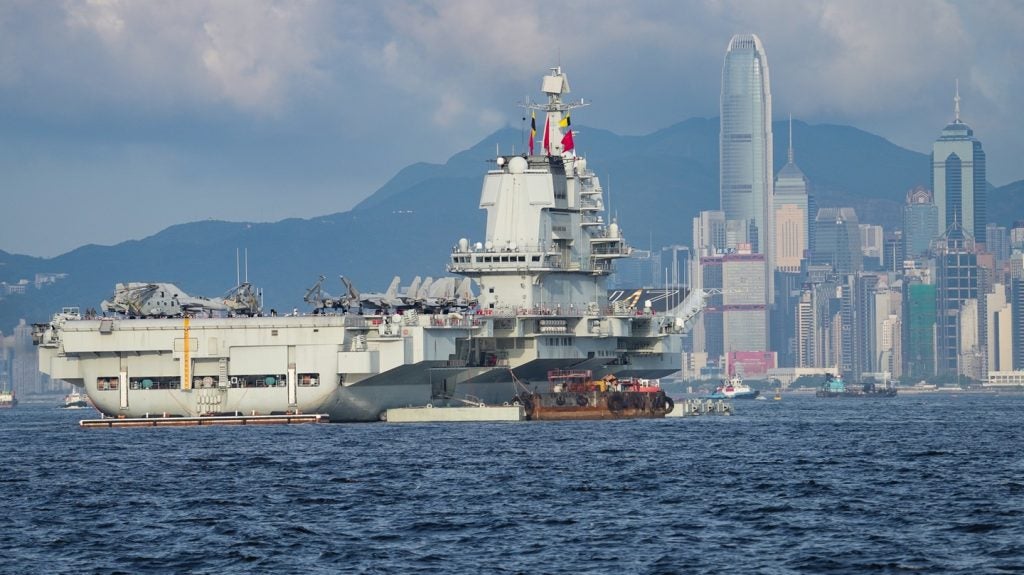
China’s People’s Liberation Army Navy (PLAN) aircraft carrier Shandong similarly headed to Hong Kong, formerly a British colony and now a special administrative region of China, in the early days of July for a five-day visit, wowing crowds according to the Global Times state-run news outlet.
Both the UK’s and China’s visits are part of the harder edges of military soft-power projection, touring friendly or allied states. Although outwardly an interesting coincidence, the arrival of the aircraft carriers in former British colonies is notable.

A late-June UK Royal Navy news release announcing the visit stated that HMS Prince of Wales was greeted by “cheering youngsters” at Singapore’s Marina Bay cruise terminal, as part of a wider series of events during the port visit that gave thousands of Singaporeans the opportunity to tour the aircraft carrier.
While the UK carrier was accompanied by a number of its escort vessel, other Nato warships attached to the Prince of Wales Carrier Strike Group visited Indonesia and Malaysia during the same period.
Meanwhile, China’s Xinhua outlet claimed that 30,000 Hong Kongers visited Shandong and its escorts at Stonecutters Island/Ngong Shuen Chau naval base in the territory.
What about the UK’s ‘China audit’?
Relations with China have been complex, with incidents such as Huawei’s ordered removal from key areas of the UK’s 5G telecommunications infrastructure in 2020 and the effective nationalisation of the China-owned British Steel in 2025 two examples of recent fractious ties.
Of the Huawei decision, all of its hardware must be removed from the UK’s 5G network by 2027.
Beijing also reacted furiously to the recent passage of a Royal Navy’s patrol vessel through the Taiwan Strait, a strategic body of water between the mainland and what it considers to be a breakaway province.
However, a much greater diplomatic land/naval mine is waiting just around the corner, following the UK’s decision not to publish the new ‘China audit’, which sought to determine an economic and diplomatic path forward in ties between the two countries.

In a heavily redacted statement to the UK House of Commons on 24 June, UK Foreign Secretary David Lammy said the audit described “a full spectrum of threats” faced by the UK from China, citing “espionage and cyber-attacks” to the “repression of Hong Kongers”.
However, despite opposition, the UK government will not publish the audit, with Lammy fearing that disclosing details could “undermine” future initiatives.
“The UK’s approach to China will be founded on progressive realism: taking the world as it is, not as we would wish it to be. Like our closest allies, we will cooperate where we can and we will challenge where we must,” Lammy said at the time, apparently drawing no difference in outlook between China and allies in Europe or the United States.
China: a partner or problem?
There have, however, been indications in previous documents of the UK’s planned stance on China, informed by the completed audit. The newly released National Security Strategy (NSS) includes references to the audit having influenced its conclusions, positing that “global commons” were being “contested by major power like China and Russia”.
Risks include espionage, interference in the UK’s democracy, and the undermining of the country’s economic security, the NSS states, but which also goes on to refer to China as an “important partner” in the country’s education and private sectors.
Clearly, the issue of UK-China ties is complex, with very few clear-cut areas based on mutual understanding. London and Beijing are supporting opposite sides in the Ukraine-Russia war, and the UK is seeking to bolster its Commonwealth ally Australia through the trilateral AUKUS programme, in collaboration with the United States.

The other side of the coin is financial, with the UK in dire need of additional revenue streams to prop up its economy. Trade with China will be sought – Prime Minister Keir Starmer is thought to be drawing up plans for a visit to Beijing, - but will come at a cost: expect access to key research institutions to be demanded in return, and concessions for Chinese students.
All of which makes the visits of their respective aircraft carriers to newly acquired or former colonies that much more important, when taken in the wider context of ties between the two nations.
The additional passage of HMS Spey through the Taiwan Strait seems at odds with a UK government that publicly appears eager to accommodate China, cautious at risking offending the new superpower on the block.