

• The MoD has awarded Babcock an up-to15-year Gateway Agreement to overhaul nuclear submarine support, replacing short-term FMSP extensions
• The contract follows severe maintenance backlogs that left all five active Astute attack submarines stuck in port simultaneously during summer 2026
• Official statements say the incentive framework only “should” speed up delivery, falling short of a firm legal commitment to restore fleet availability


The award by the UK Government of an £8.7bn ($11.4bn) contract to Babcock to upgrade Royal Navy submarine readiness and availability could be the last chance for the country to bring its nuclear maintenance capability back onto an even keel.
Announced on 26 November, the Gateway Agreement is planned to create around 5,500 new roles and upgrade key infrastructure and is intended to, in the planned words of UK Defence Secretary Wes Streeting who is expected to announce the deal at a speech at HMNB Clyde, “get our subs out of the docks and into the sea faster”.
The award follows the previous Future Maritime Support Programme (FMSP), which also went to Babcock and ran from 2021 to March 2026. At that point, a short-term, six-month bridging extension to the FMSP was awarded to Babcock, followed by another two-month extension, to avoid a maintenance capability gap.
This short-termism over the summer coincided with an acute availability crisis for the UK Astute-class nuclear attack submarine (SSN) force, when all five boats were in port awaiting a range of maintenance.
In doing so, the UK was unable to deploy an SSN for several weeks, a capability gap that likely required US or French support to cover the loss and perform patrols around the GIUK gap and protect the UK’s nuclear deterrent.
Coming from a starting point of zero availability over the summer of 2026, it can only be hoped that the award will enable the UK to fulfil, at a minimum, its own national security tasks, even before it looks towards what it can meaningfully contribute to Nato in the subsurface domain.
However, contained in the published UK Government release are references to a “new contractual framework” that delivers “incentives for faster delivery”, which offers hope but no firm commitment to increased availability as it caveats that this measure “should [mean UK submarines] spend less time in maintenance”.
The “should”, compared to a definite “will”, represents the distance between a legally binding operational guarantee, and an aspirational commercial framework.
In addition, the reference to “incentives for faster delivery” points towards a target-cost, incentive-fee model, rather than a firm-fixed-price availability contract.
There is no also viable alternative to Babcock’s Devonport facility, which is the sole nuclear refit yard in the UK. Babcock, for its part, has engaged in a long-term upgrade to its nuclear refit facilities at the site.
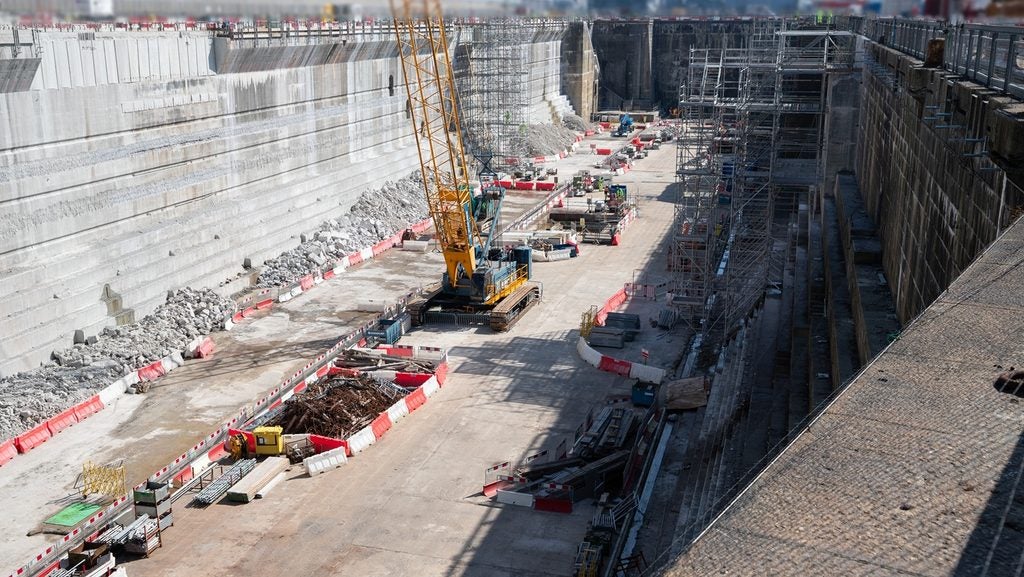
In early November, the company revealed that it had moved into the main construction phase of its 10 Dock redevelopment programme at its Devonport facility.
Babcock is also supporting elements of the Clyde Transformation Programme (CTP), the largest element of the UK MoD’s wider £26bn ‘Project Royal Oak’ investment across the Royal Navy’s three principal submarine bases.
Bottlenecks and backlogs
Over the past two years (late 2024 to November 2026), the UK Royal Navy’s nuclear-powered submarine fleet has experienced severe availability bottlenecks and maintenance backlogs.
The Vanguard-class ballistic missile submarine (SSBN) force itself is stretched to breaking point, with one boat recently concluding a 217-day patrol, far in excess of the usual 90-day stint.
The extended patrol will have been caused by availability issues impacting the other Vanguard-class SSBNs, exemplified by the delayed seven-year long LIFEX programme to HMS Vanguard in 2023, that included a refuelling of its nuclear reactor.
In 2024, HMS Victorious began its own LIFEX programme, which once completed will be followed by Boat 3, HMS Vigilant.
It is also uncertain that the UK’s nuclear deterrent is even viable, following catalogued failures of its last two test-firings of its Trident II D5 ballistic missiles, most recently in 2024.
Is the UK still capable of nuclear?
In December 2025 the former director of nuclear policy at the UK Ministry of Defence, Rear Admiral Philip Mathias, said in an interview The Telegraph, that UK was no longer capable of running its nuclear submarine programme following years of mismanagement, with the fleet suffering from “shockingly low availability” amid a “huge failure” in the management of key personnel.
At the time, Mathias urged the UK Government to withdraw from the AUKUS pact with Australia and the United States and questioned the commitment to build 12 new SSNs for the Royal Navy, highlighting ongoing delays to both the delivery of Astute-class attack submarines and to the development of Dreadnought-class ballistic submarines.
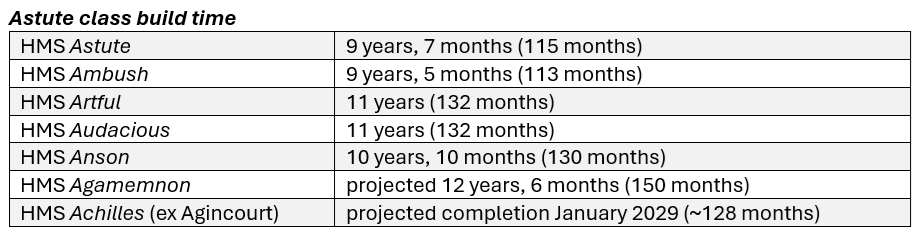
HMS Agamemnon, the sixth of a planned seven Astute-class SSN fleet, took 13 years to go from keel laying to departing for sea trials, a new, and unwanted, record for a UK submarine build.
The likelihood of the UK’s ability to build its future 12-strong SSN fleet was also highlighted in extensive analysis by Naval Technology, with the UK seeking to develop a drumbeat of one new SSN delivered every 18 months.
It is inconceivable that the current average of a 10-year build cycle for an SSN can be improved by such an extent, even with the planned investment into submarine manufacturing at Barrow-in-Furness.


