

- Ukrainian naval drones sank the Russian corvette Merkury in Benghazi, Libya
- The strike demonstrated Ukraine’s long-range maritime strike capability
- The attack prompted condemnation from the UN mission in Libya
The loss of a Russian Project 20381 corvette in a Ukrainian drone attack in the Libyan port of Benghazi in the southern Mediterranean will deprive the Russian Navy of a capable surface and subsurface warfare combatant.
Reports emerged on 22 November that Ukrainian personnel had conducted a naval raid using uncrewed surface vessels, targeting Russian military and commercial shipping in the region.

Discover B2B Marketing That Performs
Combine business intelligence and editorial excellence to reach engaged professionals across 36 leading media platforms.
The result: one lost Project 20381 corvette, commissioned into service as ‘Merkury’ in May 2023, and the second vessel of the class to be damaged or destroyed by Ukrainian forces following a drone attack on the Boikiy in June while it was drydocked in Kronstadt.
“I received detailed briefings on the operation’s steps yesterday and today – the targets we set were achieved. It all took place off the coast of Libya. Our warriors deployed seven Ukrainian-made naval drones,” posted Ukrainian President Volodymyr Zelenskyy on the X social media platform.
Steregushchiy-class corvette
The Project 20381 is an upgraded variant of the Project 20380 corvettes, also known as the Steregushchiy class, built for the Russian Navy. Up to 12 Project 20380/1 corvettes will be delivered, of which at least one (Merkury) and likely two (Boikiy) have been lost in combat.
Displacing around 2,200 tons fully loaded, the Project 20380 corvettes measure a little over 104m in length with a beam of 13m, or 11.6m at the waterline. By way of comparison, the Steregushchiy’s are slightly larger than the UK Royal Navy’s Batch 2 River-class offshore patrol vessels, which are 90m in length and displace 2,000 tons.
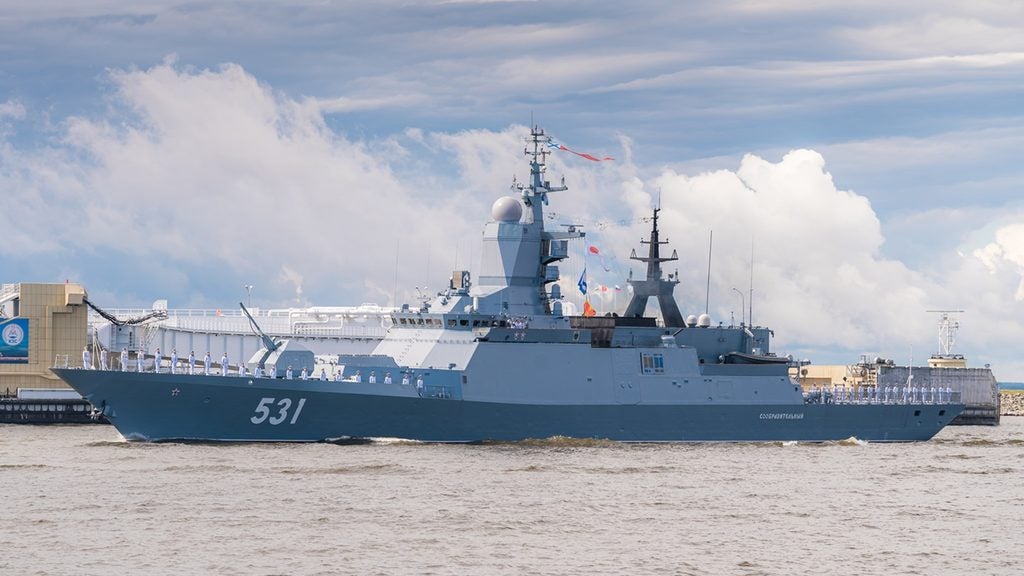
However, the Project 20380(1) corvettes are well-equipped in terms of combat firepower for ships of their size, featuring 1 x 100mm/130mm main gun, up to 3 x close-in weapon systems (CIWS) for point defence, 2 x quad-cell Kh-35 subsonic anti-ship missile launchers, and 2 x four-tube 330mm anti-submarine torpedoes.
The Project 20381 variants swap out one CIWS mounted between the main gun and the bridge for a 12-cell Redut vertical launch system that can quad-pack 9M100 anti-air missiles, which have an intercept range of around 15km.
The usual crew complement for the class is around 90 personnel, with the class often tasked with maritime security and naval presence operations around Russia’s Mediterranean interests.
Ukraine’s Sea Baby and international reaction
The Ukrainian USVs are understood to be the Sea Baby design, potentially the upgraded 2025 platform that can equip a 2,000kg explosive payload, and operate at ranges of up to 1,500km.
Given the location of Benghazi, it is probable that Ukraine used a commercial shipping vessel as a mothership to launch the operation, rather than use Nato’s European territory, which would be a significant escalation of the near five-year-old war with Russia.
However, the attack has drawn condemnation from parties that might otherwise be supportive of Ukraine’s military operations against an aggressor state in Moscow.
The UN stabilisation mission to Libya, UNSMIL, issued a statement expressing its “serious concern” over the attack at Benghazi port, stressing that the country’s territorial integrity and sovereignty “must be respected”.
In addition, a Russian dry cargo vessel in the Mediterranean was also struck by Ukrainian USVs, part of a continuing trend of attacks against commercial shipping, with another incident occurring in the Baltic.


