

- The Trump-class battleships will be the largest surface combatants developed for the US Navy for decades
- Nato’s 1166 STANAG designator system allows for battleship classes, under the suffix ‘BB’
- Risks that new class of warship could fall victim to stunted development of DDG1000 destroyers
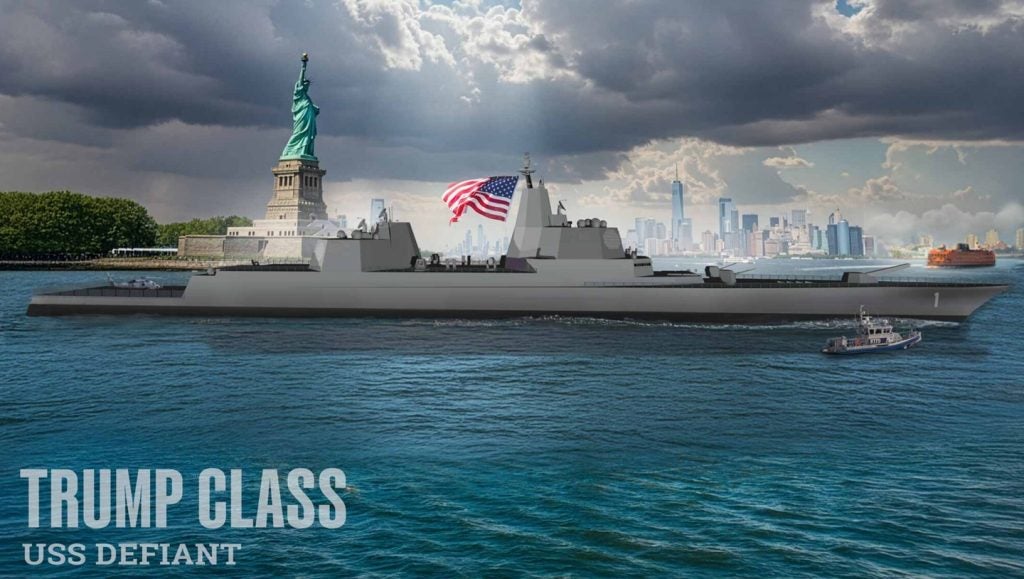
The US Navy’s future Trump-class large surface combatants – designated battleships by the namesake president – will dominate the service’s conventional naval capability for the next generation, if current plans lead to a future reality.


But the question is, are they really battleships? They are, after all, a class of ship that will now be built instead of the planned DDG(X), which in turn would replace the US Navy’s outgoing Ticonderoga-class cruisers.
The US Navy removed the last of its battleships in 1992 with the decommissioning of the Second World War-era Iowa-class warship, USS Missouri.
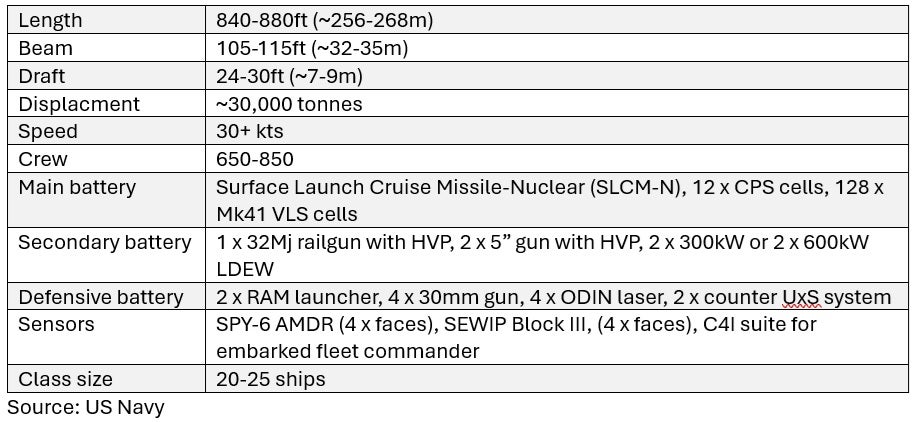
Schematically, the Trump class and the DDG(X) are different beasts: the former intended to displace around 30,000 tonnes, the latter, around 15,000 tonnes.
While there are no set international rules that are used to classify one type of ship from another, Nato established its STANAG 1166 designator system intended to categorise warships into types, depending on capabilities, to better structure alliance naval activities.
Drawing on Nato’s own Military Agency for Standardisation (MAS), STANAG 1166 provides combat type designators for surface and subsurface vessels, split between combatant and non-combatant types.
For combatant naval vessels, a suffix is created that delineates the platform’s general mission set, aligned with its capabilities. For example, a guided missile frigate, such as the recently axed Constellation class, would be given the suffix FFG, ostensibly an evolved ‘FF’ but fitted with one or more guided missile systems.
Nato’s MAS provides similar designators for battleships, which should be given the BB suffix, described as being a “capital surface ship designed for surface action with a reasonable compromise between speed, protection, and armament, which may include guided missiles”.
So far so good, as US President Donald Trump envisioned Trump-class warships would be the largest surface combatants in the US Navy, theoretically falling into the term ‘capital ship’.
Trump-class battleships: specifications
Should the BB designator still count?
While Nato’s MAS provides the BB designator, positioned at the top of its list of “principal naval surface combatants”, the other suffix classes are broken down in far greater variety and detail.
For example, there are seven distinct designators for cruisers, which in general are “cruiser type ships of 140 metres or more”, to include the CA (cruiser, gun), CC (cruiser, general), CG (cruiser, guided missile), CH (cruiser, helo capable), CGH (cruiser, guided missile, helo capable), CGN (cruiser, guided missile, nuclear powered), and CGHN (cruiser, guided missile, helo capable, nuclear powered).
There are 12 designators for aircraft carrier, starting with CV and continuing through all the various types of capability that a vessel carrying aircraft might have fitted and integrated. The most common surface combatant, the frigate and destroyer, are provided seven and six designators respectively by the MAS, depending on equipment and mission role.
There is no such breakdown for the BB designator, indicative perhaps of this being more of a legacy classification given that ‘battleships’ have not been constructed by Nato navies, or any navy for that matter, since the 1940s.
Rather, the largest surface combatants have been designated cruisers, such as the US Navy’s Ticonderoga CGs (~10,000 tonnes) or the preceding Virginia-class CGNs (~12,000 tonnes).
Indeed, the term cruiser has similarly fallen by the wayside, with destroyers, such as the Arleigh Burke Flight III DDGs, now displacing as much as the Ticonderoga CGs.
Notably, the foreshortened DDG1000 Zumwalt-class programme delivered three, 16,000-tonne ‘destroyers’, even though they are by some distance longer than the Ticonderoga cruisers (193m vs 170m) and displace significantly more tonnage.
Analysis of the Trump class
According to the US administration, the new battleships will “stand as the centrepiece” of the US Navy’s Golden Fleet initiative, coming in at “triple the size” of an Arleigh Burke DDG.
Its “massive magazines” and “massive frame” will provide “superior firepower” through larger magazines, and the capability to launch Conventional Prompt Strike (CPS) hypersonic missiles and the Surface Launch Cruise Missile-Nuclear.
“Now when a conflict arises, you’re going to ask us two questions: where is the carrier, and where is the battleship,” stated John C. Phelan, Secretary of the Navy.
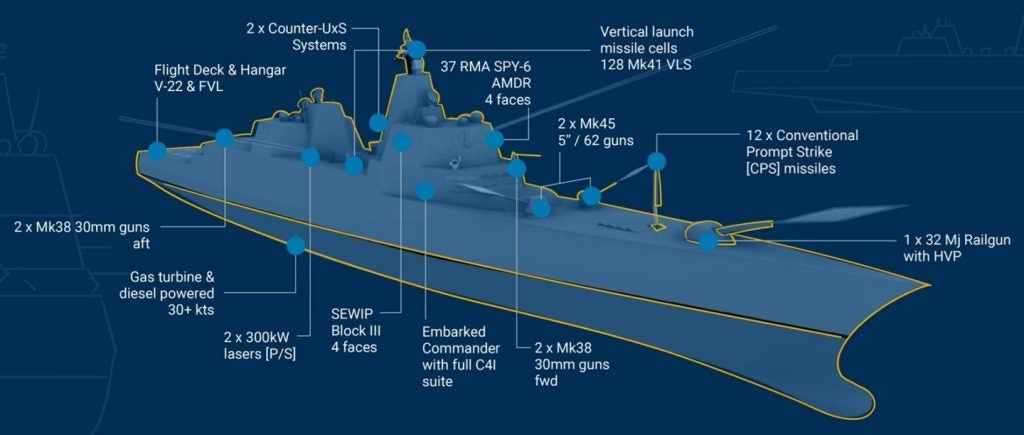
Much of the capability of the Trump-class battleships is drawn from existing systems, such as the radar, ‘secondary’ guns (2 x Mk45 5” naval guns), 128-cell Mk41 VLS, AN/SPY-6 air and missile defence radar, SEWIP Block III, and the conventional combined gas and diesel (COGAD) propulsion configuration.
Also notable is the inclusion of two so-called ‘Counter-UxS systems’, likely a reference to directed energy weapons.
However, the integration of 12 CPS missiles, fitted forward of the secondary guns, is possibly a risk, given that CPS is described by manufacturer Lockheed Martin as ‘a hypersonic boost-glide missile development and test program [sic]’.
Testing of the CPS continued through 2024 and 2025, with a May serial last year marking the first launch of the missile utilising the US Navy’s cold-gas launch system, a significant development.
The CPS is due to be tested in a naval capacity, notably, on the first of the DDG1000 destroyers, the USS Zumwalt, which will be represent a key milestone to the planned integration of the system into the future Trump-class battleships.
Also worth noting is the mention of the Surface Launch Cruise Missile-Nuclear (SLCM-N), a programme that the previous Biden administration attempted to cut from defence funding but was instead kept in the budget authorisation by Congress. The SLCM-N is formed through the integration of the W80-4 nuclear warhead onto the Tomahawk cruise missile, offering a lower-yield nuclear deterrent.
Committed funding ramped up significantly since 2024 and the return of President Trump, who had been a backer of research into an SLCM-N programme during his first term in the 2010s. It is expected that the system will achieve IOC around 2034.
The biggest technological risk is likely to come from the main gun, a 32Mj ‘railgun’, a type of weapon that fires projectiles using electromagnetic energy out to ranges of up to 320km. The US Navy was developing such a system, again for integration onto the DDG1000 class, but this was halted in 2021.
It is thought that a 32Mj railgun could propel specially designed hypervelocity projectiles (HVP) at speeds of up to Mach 7. The US already have a functioning HVP, able to be fired from extent 5” naval guns, albeit at slower speeds.
Given all the above factors, the Trump class is deliverable, at least, in theory. The patchy record of US naval manufacturing and multiple failures in naval design and development, could yet prove to be the biggest obstacle for US President Donald Trump’s namesake capital ship aspirations.


