

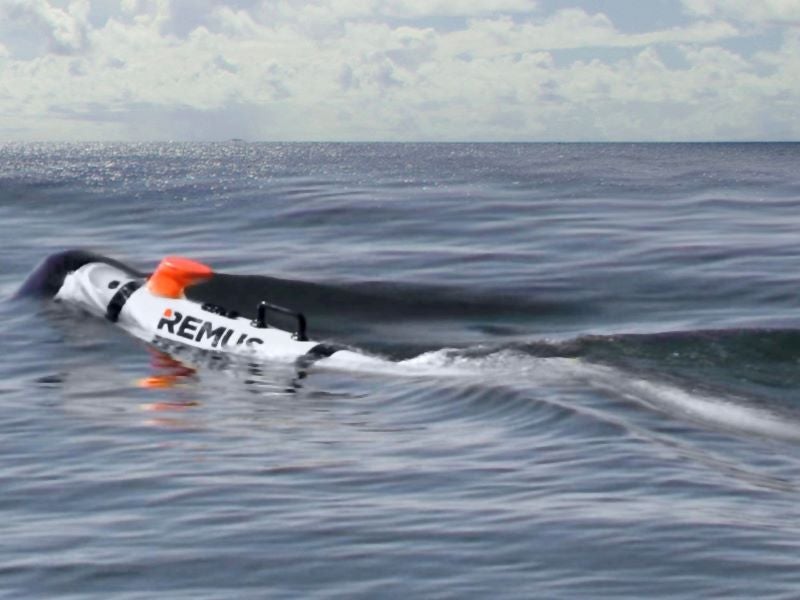
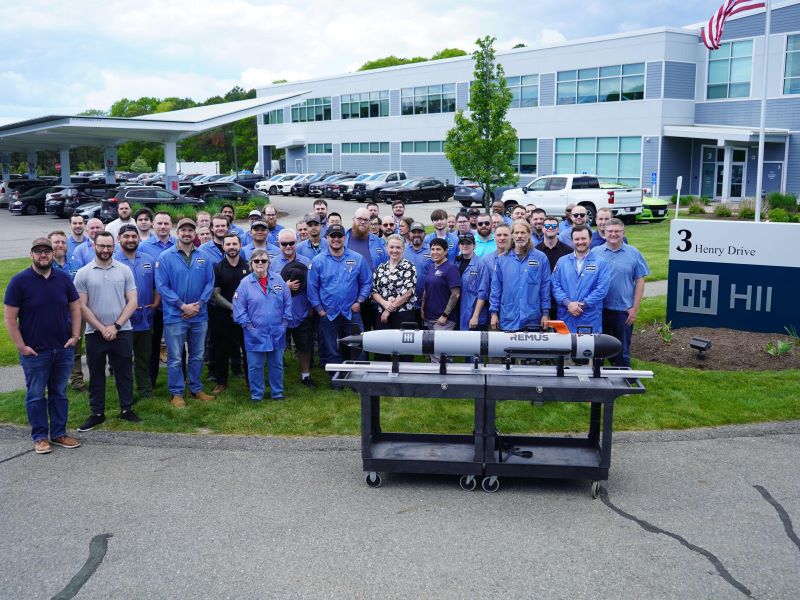
The REMUS 130 is an unmanned underwater vehicle (UUV) developed by Huntington Ingalls Industries (HII), a US-based military shipbuilder.
The UUV is the third generation of HII’s REMUS 100 series and is aimed at operators who want the established service life associated with REMUS UUVs, alongside the open-architecture and modular approach seen on the REMUS 300 and REMUS 620.
Recommended White Papers

Recommended Buyers Guides

HII unveiled the REMUS 130 at Oceanology International 2024 in London in March 2024.
The first REMUS 130 unit was delivered to an unnamed US ally in June 2026.
REMUS 130 design and features
The REMUS 130 UUV has a diameter of 19cm (7.5in) with an overall length of 2.03m (80in) and weighs approximately 48.5kg (107lb).
Based on the same technology platform as the REMUS 300, it combines modularity with updated onboard systems, enabling fleet interoperability and modification to suit a wide range of operational roles.
It is managed through Odyssey™, a cross-domain asset management suite intended to support collaborative autonomy across missions and platforms.
The vehicle uses modern electronics plus integrated navigation and communications, with open, modular interfaces intended to accept wet or dry payloads, including user-developed options.
Mission planning and post-mission review are carried out using Vehicle Interface Program (VIP) software. External interfaces include gigabit ethernet and vehicle power and charging at 110/220V. Safety features include ground fault detection, leak detection, an RJE International emergency locator beacon and health status monitoring.
Auxiliary equipment includes a Ranger and towfish, a ruggedised laptop and hub box, a transit case with shock absorbent mounting, a lightweight wheeled cradle and a vehicle maintenance cradle, as well as operations and maintenance spares.
Navigation and communications suite
The REMUS 130 uses an iXblue Phins C3 inertial navigation system, supported by a Garmin commercial GPS or an optional GB-Gram Military GPS. It also incorporates long baseline (LBL) positioning and Doppler velocity log (DVL)-aided dead reckoning.
Communications options include a Woods Hole Oceanographic Institution micromodem 2.0 high-frequency acoustic link operating at 20kHz–30kHz, 2.4GHz Wi-Fi and an optional Iridium connection. When fitted with Iridium, an encrypted Iridium dial-up and an SMS modem are supported, with the customer supplying the SIM card.
Antennas cover GPS, Wi-Fi and Iridium, and the mast arrangement also includes LED status indicators plus a visible and infrared recovery locating strobe.
Additional navigation support is provided by a Teledyne 300kHz phased array DVL with a 200m bottom lock capability. Mission oversight and tracking are supported through Ranger and VIP software via towfish communications, allowing monitoring as well as re-direct, loiter and abort commands.
Payload and sensors details
The sonar fit includes a Marine Sonics MK II Arc Scout side scan sonar operating at 900/1800kHz dual frequency, with resolution up to 5cm and a swath up to 160m.
Additional sensors include a Neil Brown Ocean Sensors conductivity and temperature sensor and a TE Connectivity depth sensor.
Data is stored on a 1TB removable solid-state hard drive, with optional spare drives and a data docking station available.
Optional payloads include an HD colour stills camera and a Kraken Aquapix MINSAS 60 interferometric synthetic aperture sonar with bathymetry, offering a constant resolution of 3cm × 3cm with real-time processing and a swath of up to 236m.
Environmental sensing options include the Seabird Scientific Eco Puck Triplet. The platform can also be equipped with a hardware development kit and software development kit to support third-party payload integration, with additional software options including SeeByte SeeTrack and Neptune, REmote CONtrol and Reflection post-mission analysis tools.
Other supporting items available include LBL transponders, a surface communications station, an extra hard drive and docking station and an external battery charger, while power options include nickel-metal hydride batteries.
Propulsion and performance
Propulsion is provided by a direct drive direct current brushless motor with an open three-blade propeller, while yaw and pitch control are handled through cruciform fins.
The UUV can also be equipped with adaptable power solutions including blind‑mate end caps that enable rapid battery swaps in the field.
REMUS 130 can operate at speeds of more than four knots (2.1m/s) and is depth rated to 100m (330ft).
The UUV has an endurance of ten hours with standard sensors active, and a maximum range of 55km (29 nautical miles), based on operations at three knots.
Mission capabilities
The REMUS 130 is intended for mine countermeasures missions such as conducting autonomous standoff surveys using side-scan sonar to support port and harbour clearance operations in waters up to 100m deep.
The UUV can also be used for search and recovery by launching from vessels of any size and surveying extensive areas in a single sortie. Using accurate navigation and side-scan sonar, it enables the detection and localisation of objects such as crashed aircraft and wrecked vessels.
Additionally, the UUV can be used for rapid environmental assessment and for specialist tasks including marine archaeology and commercial work in offshore oil and gas and the renewables sector.
