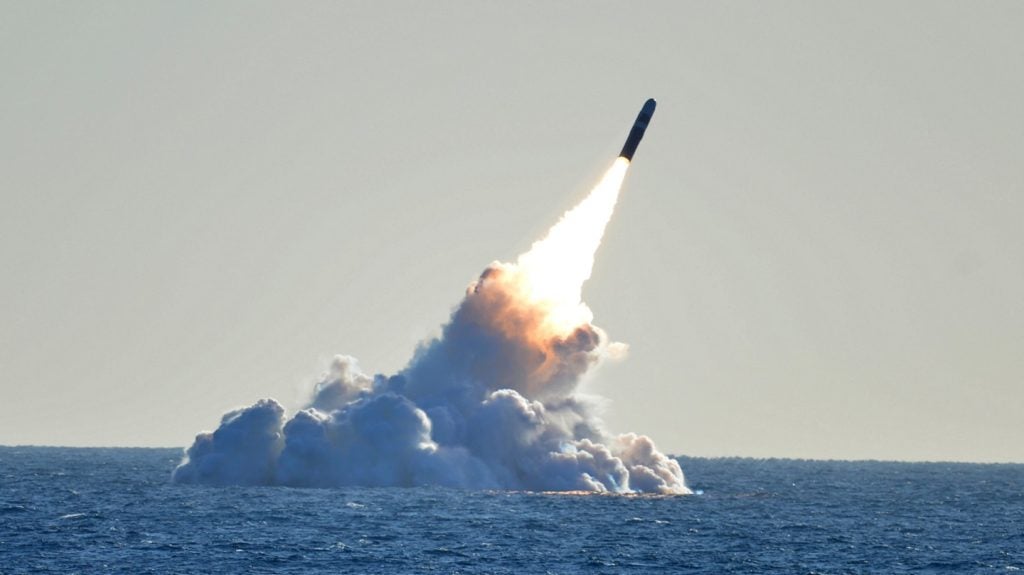
The US Navy has looked to secure its nuclear weapons delivery capability following a multi-million-dollar contract award to US defence prime Lockheed Martin for the design of the next-generation Trident II D5 ballistic missile.
Announced in late-January, the $383m cost-plus-incentive-fee and cost-plus-fixed-fee modification to an existing contract will see Lockheed Martin further the development of the Trident II Strategic Weapons System (SWS) D5 missile.
The current generation Trident II D5 is used by both the US Navy and UK Royal Navy, equipped in the Columbia-class and the Dreadnought-class nuclear-powered ballistic missile submarines.
Under the contract modification, Lockheed Martin will design the upgraded missile, called the Trident II D5 Life Extension 2 (D5LE2). The missile will be carried aboard Columbia-class SSBNs through to 2084, Lockheed Martin stated.
"The second life extension of the Trident D5 missile will enable the United States and United Kingdom, through the Polaris Sales Agreement, to maintain credibility deterring evolving threats," said Jerry Mamrol, vice president of Fleet Ballistic Missiles at Lockheed Martin.
The current D5 missile, built and upgraded by Lockheed Martin, is currently aboard US Ohio-class and UK Vanguard-class SSBNs.
To aid the development of the next-gen Trident, Lockheed Martin is breaking ground on an approximately 225,000 square foot facility in Titusville, Florida, to produce components for the D5LE2 submarine-launched ballistic missile. The facility is anticipated to be ready for operations in 2027.
In 2023, Lockheed Martin, alongside the Charles Stark Draper Laboratory, clinched contracts totalling $4.4bn aimed at fortifying the Trident II strategic weapon system. The UK also committed over £800m ($1bn) to a service life extension programme for the Trident II D5 intercontinental ballistic missiles (ICBMs).
The UK’s Trident failures
The confirmation the UK will receive the D5LE2 ballistic missile follows reported test launch failures of the in-service variant in 2024 and 2016, which raised questions about the country’s nuclear deterrent capability.
The cause of the failures was not disclosed, with the then Conservative defence secretary Grant Shapps merely mentioning an “anomaly” that was "event specific".
Continuing, Shapps said the Trident missile system remained "the most reliable weapons system in the world", having completed more than 190 tests.
Trident tests are conducted without associated nuclear weapons, intended only to determine the delivery capability. Nuclear weapons tests are outlawed under the 1996 Comprehensive Nuclear-Test-Ban Treaty (CTBT).