

To some, the decision by the US administration to cancel the Constellation-class frigate programme and replace it with the new FF(X), based on the US Coast Guard’s Legend-class cutter, will be welcomed as the right decision, albeit perhaps made late.


To others, it will deliver a less capable platform to US Navy service, compared to what the Constellation class would have provided. Might it even be a repetition of the ill-fated Littoral Combat Ship (LCS) experiment?
Indeed, such were the troubles with Constellation, that it promoted Naval Technology to posit in 2024 whether it could share the same fate as the LCS.
What is almost certain, however, is that FF(X) will be delivered far sooner than was expected for the Constellation class, with the first Legend-derived frigate due in the water by 2028. Delivery of the USS Constellation is not due before 2029, despite construction starting in 2022, with just the first two warships being completed in the curtailed programme.
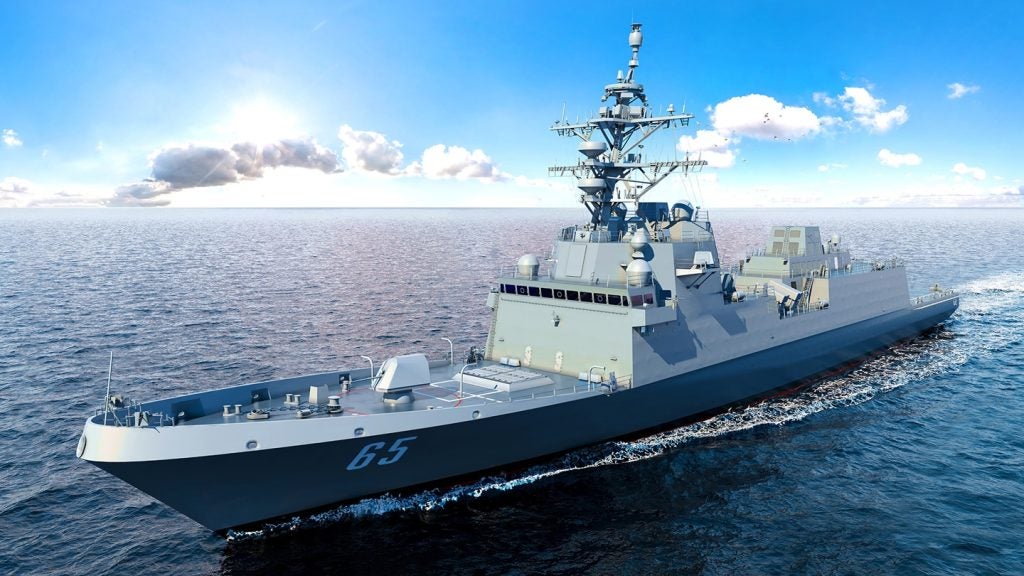
The FF(X) will also be more numerous, with a requirement of 68 small surface combatant warships by 2054, compared to the Constellation class’s planned 20 hulls.
It is no also secret the Constellation class suffered with delivery problems, with significant delays to production as a result of concurrent design and manufacturing.
Key for the FF(X) is the desire to utilise an existing design (the Legend cutter) and ship systems to deliver quickly, ostensibly to try and bridge the growing gap between the US Navy’s and China’s surface combatant force.
“To deliver at speed and scale, I’ve directed the acquisition of a new frigate class based on HII’s Legend-Class National Security Cutter design: a proven, American-built ship that has been protecting US interests at home and abroad,” said John C. Phelan, Secretary of the Navy, said on 18 December last year, announcing the FF(X) programme.
Phelan notably added that in order to expand the production base, the FF(X) frigates will be acquiring initially using a lead yard, expanding this with a competitive follow-on strategy for multi-yard construction.
“Shipyards will be measured against one outcome: delivering combat power to the fleet as fast as possible,” Phelan said.
Admiral Daryl Caudle, US Chief of Naval Operations, said at the time that, crucially, “we know how to build it now”, of the FF(X) design.
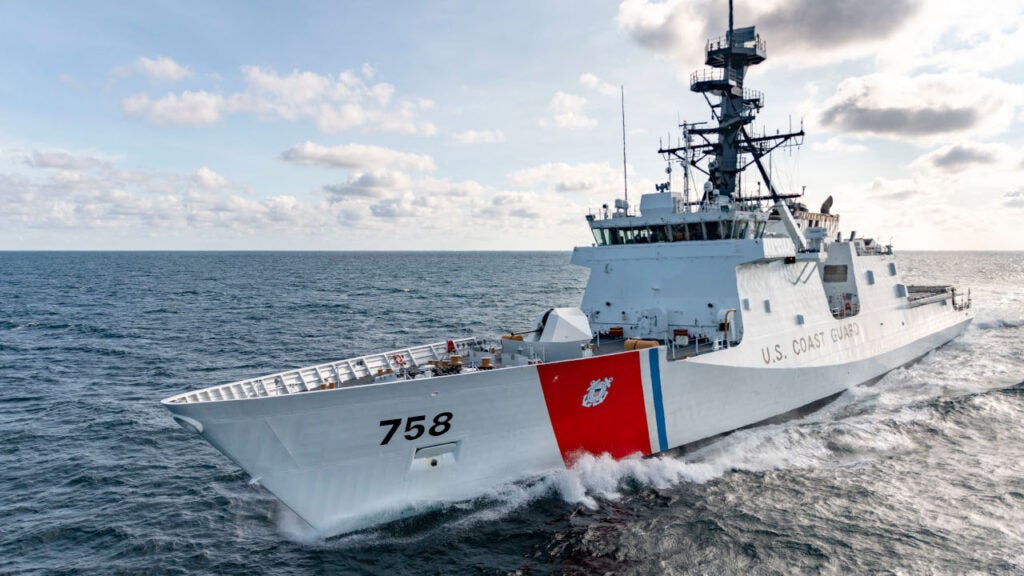
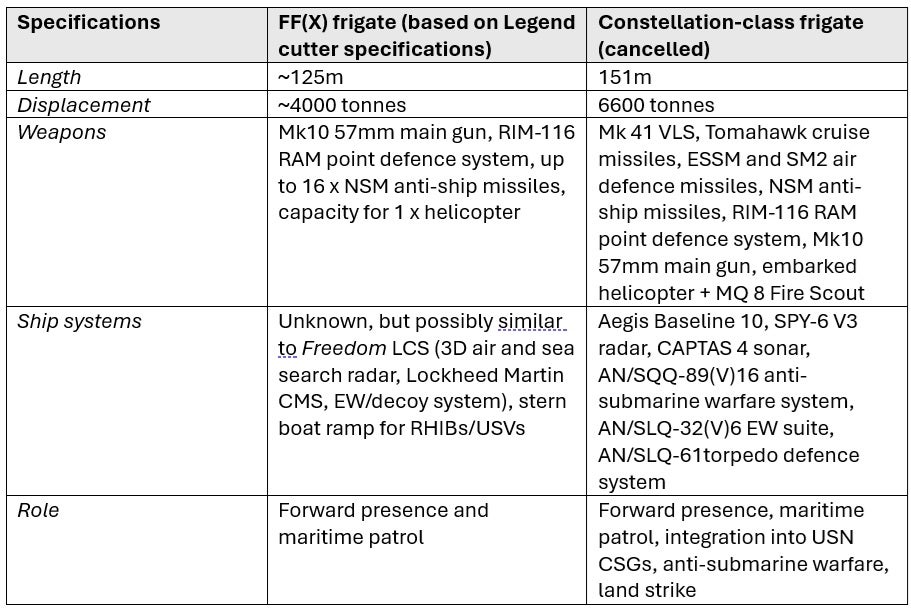
The FF(X), when delivered, will be more of a sea presence platform, able to protect itself as a light frigate, but lacking the stand-off strike and area defence capability the Constellation class would have provided.
In terms of integration into US Navy Carrier Strike Groups, the FF(X) will also be of little use, with carrier screening to be provided by the Flight II and Flight III Arleigh Burke-class DDGs.
Comparison – FF(X) vs Constellation frigate
Analysis of the FF(X)
Although few details of the FF(X) have been revealed, other than through some outlets in the US such as TWZ, analysis of the US Navy rendering does provide some clues to the new frigate.
Notable is the adaption of the Legend cutter design to incorporate a stern boat ramp, a far more effective way of deploying onboard RHIBs and USVs, as well as a raised deck space just fore of the bridge, allowing for future integration of a small VLS or directed energy weapon.
In many respects, the FF(X) appears a crossover between the Legend cutter design with some of the capabilities of the Freedom Littoral Combat Ships. A key criticism of the LCS ships is that they are unable to operate in contested environments, unlike the larger Constellation frigates.
Available space also appears limited, with future ‘Flights’ likely just having the forward raised platform to integrate new systems. This FF(X) is very much a ‘presence’ vessel, intended to fly the flag in permissive or non-combat environments, rather than be tasked to operate where missiles and drones are likely to fly.
Another factor will be the cost, with the FF(X) likely being far less expensive to acquire than the over $1bn Constellation frigates.
Deploying such platforms into the European sphere could free up DDGs, such as those based in Rota, into the Indo-Pacific region. However, the Trump administration’s distaste for European security obligations could see the FF(X) tasked to bolster surface warships numbers to counter China rise in the Western Pacific.


