

- Navantia UK debut its 75-metre-long Large Autonomous Surface Vessel (LASV75)
- The modular autonomous surface vessel is geared toward Royal Navy requirements for a hybrid force structure
- The service has already purchased medium-sized USVs this year, but have yet to induct any larger systems
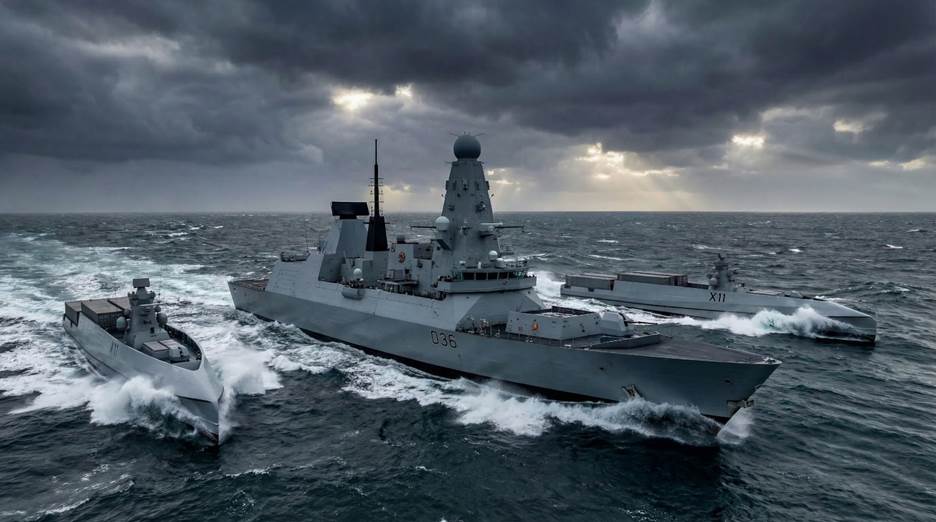
Navantia UK unveiled a new concept for a Large Autonomous Surface Vessel, according to a press release issued yesterday (19 May).
As the name suggests, the LASV75 has a length of 75 metres, a beam of 11.8 metres and system displaces 1,000 tonnes. The system is a modular hull, integrating containerised modules – including naval guns – on the deck while a mast hosts a number of sensor configurations.
Go deeper with GlobalData


Discover B2B Marketing That Performs
Combine business intelligence and editorial excellence to reach engaged professionals across 36 leading media platforms.
The company is currently working with the supply chain, ascertaining lead times for main equipment and systems, to confirm production timelines.
In this case, the offering is geared toward the UK Ministry of Defence, which has embraced a hybrid navy doctrine comprising a mix of crewed and uncrewed platforms. But the timely debut of the LASV75 comes just as rumours, peddled by The Telegraph last week, suggest the long-awaited Defence Investment Plan (DIP) is expected to be released imminently.
Shipbuilders pivot to uncrewed vehicle orders
Navantia UK, a subsidiary of the Spanish state-run company of the same name, purchased the historic Belfast shipbuilder Harland & Wolff in January 2025, which has been tasked with the construction of three Fleet Solid Support Ships since 2023.
The parent company also came to own three smaller yards as part of the acquisition: Appledore (Devon), Methil (Fife) and Arnish (Isle of Lewis).
Yesterday, Navantia also announced plans to inject £157m (~$210m) across its UK sites.
The funding will support the adoption of digital design tools across its four yards to accelerate and automate naval projects. Navantia claim these measures will bring down the time for designing and building a large naval vessel by up to 30%.
This update demonstrates how UK shipbuilders are pivoting to a new market for uncrewed vehicle orders, which one UK Minister affirmed would provide an alternative to traditional crewed warships during the steel-cut of the third Type 31 frigate at Rosyth Shipyard.
Today, orders for uncrewed systems are all the more significant since Sweden – whose Government considered the UK’s Type 31 design, prompting Babcock to display the Swedish flag during the rollout of the frigate at Rosyth in February – has instead selected Naval Group’s FDI design for its future Luleå-class frigates.
Why does size matter?
The Royal Navy has already begun to induct its first USVs this year with the purchase of 20 medium-sized (8.4 metre length) K3 Scout USVs from the British supplier Kraken in March.
These initial units will be used by the Royal Marines and the Coastal Forces Squadron, though the service does not specify their responsibilities beyond “operations, training and development acitivites.”
There does not currently appear to be a breakdown of the future uncrewed fleet based on size. Naval Technology approached the UK Ministry of Defence for clarification, but the department would not directly respond to this point.
Nevertheless, larger USVs offer a greater range of capabilities for the navy operations, with the ability to integrate mounted naval guns, as Navantia has done with the LASV75. But smaller systems will operate with a reduced signature, which decreases the likelihood of enemy detection, making them more suitable for passive intelligence, surveillance and reconnaissance missions.
With new technologies come new design priorities, as the UK’s naval engineering company BMT has found.
The company are pursuing a new construction method that the global head of innovation and research, Jake Rigby, told this reporter last year is embodied in its MODUS concept unveiled at DSEI 2025.
BMT’s new family of medium and large USVs will deliver “role‑optimised platforms” instead of costly multipurpose platforms. This design driver is said to influence hull form, internal arrangement, systems architecture and maintenance philosophy.
The company would argue that this approach, which would customise hulls to mission criteria, markedly differs from Navantia’s concept, which is intended to perform many roles based on its modularity.


