

- Raytheon will supply SeaRAM for the first three Royal Australian Navy Mogami-class frigates under an MHI contract
- First time SeaRAM is integrated on an RAN ship; it provides terminal missile/air defence using RIM-116 missiles
- Work is in Kentucky; deliveries start late 2028, with the first frigate due by Dec 2029
Raytheon has been awarded a contract by by Mitsubishi Heavy Industries (MHI) to provide SeaRAM missile-based ship point defence systems in support of Australia’s SEA3000 general purpose frigate programme.


Announced in an 11 May release, Raytheon, a business of RTX, stated that it would supply SeaRAM for the first three vessels of a potential 11-ship class for the Royal Australian Navy (RAN), based on the Japanese Mogami-class frigate design.
The Mogami frigates, currently in service with the Japanese Maritime Self Defence Force (JMSDF) will replace the RAN’s current Anzac-class vessels. This will be the first time the RAN will integrate the SeaRAM system onto one of its warships.
Barbara Borganovi, president of Naval Power at Raytheon, said SeaRAM service to “extend the defensive reach” of a ship beyond close-in weapon systems ranges.
“By integrating SeaRAM on the Royal Australian Navy’s new surface combatants, Australia gains a proven, highly effective terminal air and missile defence layer for its future fleet,” Borganovi said.
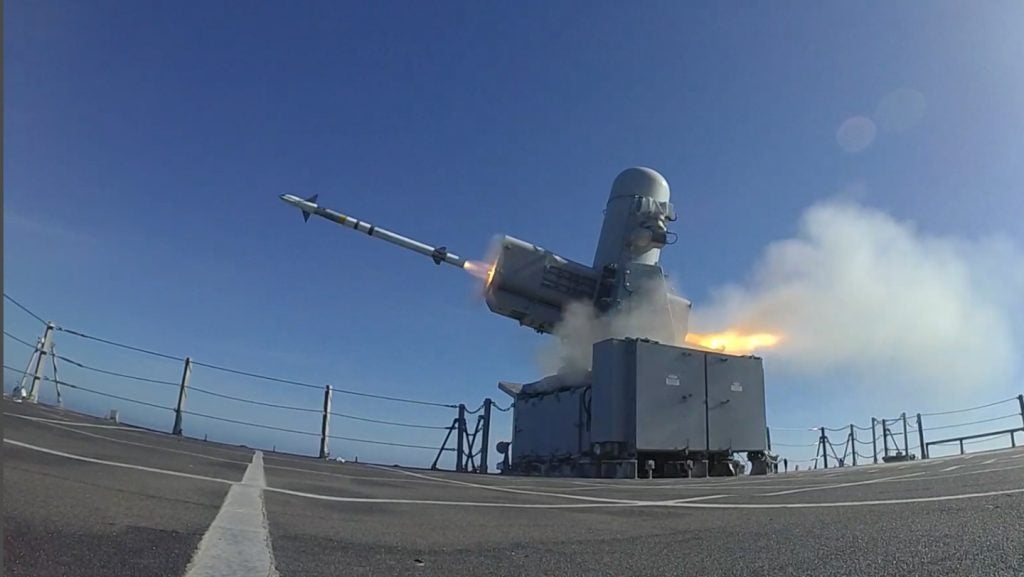
SeaRAM combines the Phalanx Close in Weapon System (CIWS) with the RIM-116 Rolling Airframe Missile (RAM) to provide autonomous terminal defence against cruise missiles and other advanced airborne threats.
Work on this contract will take place in Louisville, Kentucky. Deliveries are expected to begin in late 2028. According to MHI, the first of the RAN’s Mogami-class frigates will be delivered by December 2029.
Exact capabilities of the SeaRAM point-defence system are undisclosed, but Raytheon states that the system is intended to offer defence against supersonic and subsonic threats including cruise missiles, drones, and helicopters.
The development of the system sees the replacement of the Phalanx’s 20mm gun with an up-to-11-cell RIM-116 RAM missile launcher. Described as an “affordable capability upgrade”, the SeaRAM fits the same footprint and power requirements as the Phalanx CIWS, and with minimal modification.
The SeaRAM is thought effective against airborne targets are range of up to 10km. The same system is widely used by US Navy warships, including the future FF(X) frigate.
Australia’s Mogami-class frigates
Australia’s acquisition of the Mogami-class frigates resulted from the decision to cut its UK-derived Type 26 design Hunter-class frigate programme from nine ships to six and reinvest the funds into up to 11 lower-specification frigates.
Following competition, a downselect between MHI’s Mogami design and the German MEKO A-200 platform was announced in 2024, with the decision to opt for the former coming in 2025.
The cost for the first three vessels, although not formally disclosed, is thought to be up to A$10bn ($6.5bn). In comparison, the first three Hunter-class destroyers look set to cost around A$7bn per vessel, roughly double the Mogami design.
The upgraded Mogami-class vessels are equipped for anti-submarine warfare, self-defence, land and maritime strike, and force protection. The vessels have a displacement of 6,200 tonnes, measuring 142m in length.
Powered by combined diesel and gas propulsion (CODAG), the frigates are capable of reaching speeds exceeding 30 knots and operating at ranges up to 10,000 nautical miles.
The RAN’s Mogami-class frigates will be equipped with a 32-cell vertical launch system that can equip surface-to-air and ground attack missiles, a 127mm naval main gun system, the potential to field the Naval Strike Missile, as well as the newly announced SeaRAM point defence system.


