

- The UK Royal Navy is teetering on the brink of unviability, with ageing frigates and fleet now cut to the marrow
- The UK Government is considering swapping out Royal Navy Type 26 frigate slots to Norway
- One solution to get more hulls in the water is through a third batch of River-class OPVs, with the Batch 2 vessels a proven design
The UK Royal Navy, despite what one might read in press releases and government statements, is in the depths of the most profound crisis as surface ship numbers continue to plummet and poor availability of those that remain mean little presence of UK warships on the high seas.



In addition, the promise of new ships in the Type 26 and Type 31 frigates will not be realised for some years, with the latest revelation that the UK Government could offer Norway some of the scant slots available for Type 26 manufacture, at the expense of the Royal Navy.
Doing so would further reduce a Royal Navy currently at risk of being able to effectively patrol and secure its own maritime EEZ, let alone project any meaningful power without the assistant of the US and European allies.
Indeed, a case could be made arguing the UK Government has given up on the Royal Navy as it continues to strip back frigate numbers to low-single figures and retiring its amphibious assault capability.
Defence is viewed by the UK Government as a multinational endeavour, with parliamentary responses and official press releases littered with comments about “combined” UK and Norwegian Type 26 fleets, pointing to the recently agreed Lunna House deal as the example of shared and collective defence interests.
Meanwhile, the sight recently of the Royal Navy trumpeting an “intercept” of a Russian missile corvette in the English Channel in recent weeks by two ageing Batch 1 River-class OPVs would be laughable if not for the capability mismatch that existed between the two parties.
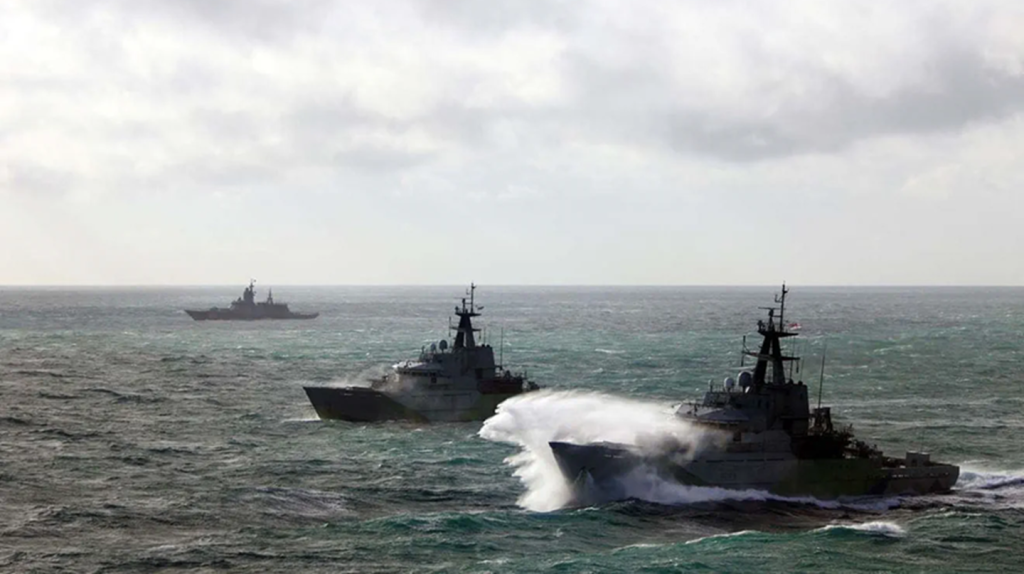
Outside of the use of the world intercept, which denotes the actual stopping of the Russian ship legally entitled to transit an internationally recognised transit corridor, the Batch 1 OPVs are each over 20 years old and primarily fisheries patrol vessels. Their armament is minimal.
That no Royal Navy frigate was on hand to perform the “intercept” is potentially telling, with the few that remain in UK service either literally tied up in maintenance, or else hard-pushed covering duties such as anti-submarine warfare and protecting the UK’s strategic deterrent. It is increasingly common for the ‘Fleet Ready Escort’ role to be performed by the fisheries patrol squadron.
In addition, the latest development in the UK’s sorry naval condition as officials consider offering Norway slots into the Type 26 build programme would see the historic lack of surface ship numbers persist for years, potentially decades, longer.
Indeed, commentary from UK officials appear to suggest that London is beginning to consider that Norwegian Type 26 frigates are as good at performing UK national security roles as Royal Navy assets, with comments about a “combined force” operating in the GUIK Gap following the Lunna House agreement.
The Norwegian Ministry of Defence did not respond to queries from Naval Technology regarding the planned order number, nor whether their warships would be a “combined force” as claimed by the UK Government.
There is every chance the coming Defence Investment Plan will continue the UK Governments hollowing out of UK Armed Forces capabilities, through money saving actions like extending build timelines and cutting orders. Swapping out UK Type 26 frigates for Norwegian orders would offer an attractive proposition for those in Main Building.
There is also uncertainty among UK officials in knowing how many Norwegian frigates will be ordered, mentioned five or six, depending on which Hansard response from 4 January was read.
However, recent Norwegian media reports have indicated that Oslo could cut its order to just three vessels.
Is a Batch 3 OPV the right fit?
What the Royal Navy needs is hulls in the water, and ships not so sophisticated that they spend an inordinate amount of time broken down or undergoing maintenance. Capability has to be balanced with having a basic presence, because an absence provides neither of the desired metrics.
Could a Batch 3 River-class OPV build offer a viable naval solution, performing the “intercept” and maritime patrol functions the Royal Navy’s surface fleet is increasingly being reduced to?
Manufacturer of the River-class, UK defence prime BAE Systems, is busy with the Type 26 programme, with its Scottish shipyard on the Clyde busy. Capacity is tight, but while it is uncertain it is by no means guaranteed a dock could not be available to build a Batch 3 OPV.
Elsewhere, in order to expedite delivery, manufacturer of a Batch 3 programme could also be outsourced to Harland & Wolff in Belfast and Appledore, currently awaiting delivery of the first blocks of the new Fleet Solid Support ships being built in Spain.
The previous Batch 2 OPVs were delivered at intervals of three years, partly extended in order to keep the BAE Systems shipyards active ahead of the start of the Type 26 programme. Given the mature design of the Batch 2, this could be compressed by months for each vessel.
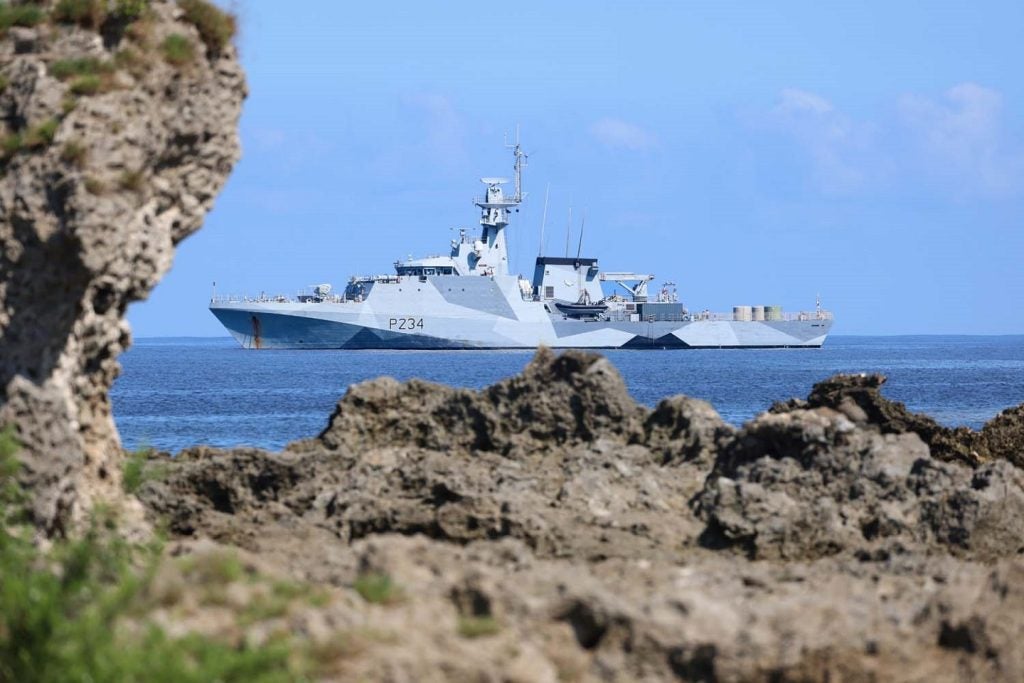
With this, a new Batch 3 OPV programme of five hulls – the first three replacing the worn-out Batch 1s of HMS Tyne, HMS Severn, and HMS Mersey – could be delivered between mid-2028 and mid-2032.
Displacing around 2,000 tonnes and measuring over 90m in length, the Batch 2 River class are corvette-sized platforms, particularly if extended as conceived in a previous submission for the Type 31 frigate programme. Equipment fits could be limited to increasing firepower to a 57mm or 40mm main gun, both of which are due to be fitted to the Type 31 class coming into service, offering commonality across ship types to ease maintenance.
Containerised capabilities could be embarked on the rear landing deck, an area theoretically reserved for landing (but not embarking) rotary assets. These containerised modules could comprise small rotary UAVs to increased maritime surveillance, or autonomous surface and subsurface systems to monitor undersea infrastructure.
Maintaining a similar structure with incentivised contracts for contractors to ensure ship availability – the forward-deployed Batch 2 OPVs have an extremely high availability rate – could ensure a more visible presence at sea, rather than moored alongside.
The Batch 2 Rivers are leaned crewed, requiring around 45 personnel, and offer a more accommodating naval experience, deployed for a few weeks at a time, rather than months. Simple but capable sensors, uprated for the 2020s from the original SharpEye and 4100 2D radars, enable local area surveillance.
Capable of reaching 25kts, compared to the barely 20kts of the Batch 1 OPVs, the Batch 2 design is better able to maintain pace through different sea conditions.
Royal Navy crisis: recognising the reality
In effect, the River-class Batch 3 proposal recognises the UK is no longer a combined, coherent, top tier European navy, having become two-tiered through mismanagement by respective governments.
Defence officials have previously said the Royal Navy was at a “credible” level, a claim that borders on unbelievable.
At the top tier of UK naval assets sit the aircraft carriers (expect one to be mothballed in the DIP), fewer but still high-end surface assets like the T45 and Type 26, with the middle-to-lower capabilities performed by the Type 31 frigates and the River-class OPVs.
The less said about the UK’s subsurface fleet the better, with aspirations to increase the number of attack submarines even more ‘fantasy fleet’ than a Batch 3 River-class OPV proposition.
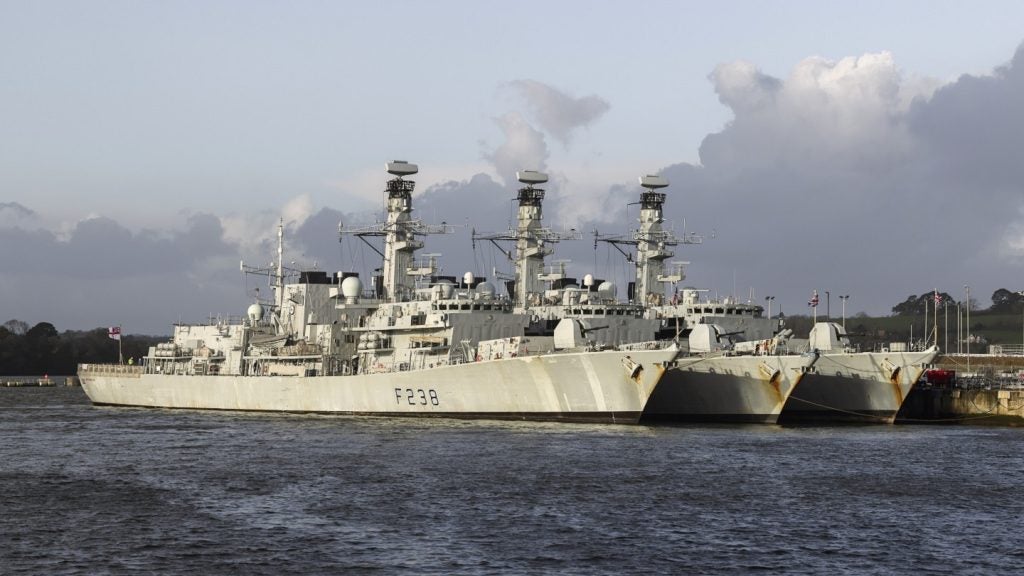
The top-tier assets would be committed to pan-European and Nato fleets, such as proposed through Lunna House and the periodic ‘UK’ (read European/Nato) carrier strike groups.
This provides the secondary tier assets, like the Batch 2 and Batch 3 OPV, the Type 31 frigates, and the few remaining RFA platforms, tasked with the maritime patrol function and operations outside of high-end conflict.
Costs would be manageable – the five Batch 2 OPV were bought under a £635m ($862.9m) deal in the mid-2010s – and achievable for under £1bn in current prices, included additional 40mm or 57mm main guns.
However, it is likely the UK Government will continue its draw-down of naval capabilities, plugging the fewer, high-end assets into wider multinational deployments. It is expected another Type 23 frigate will depart this year, with no immediate replacement, along with more cuts to other assets and a slowdown of UK Type 26 deliveries.



