
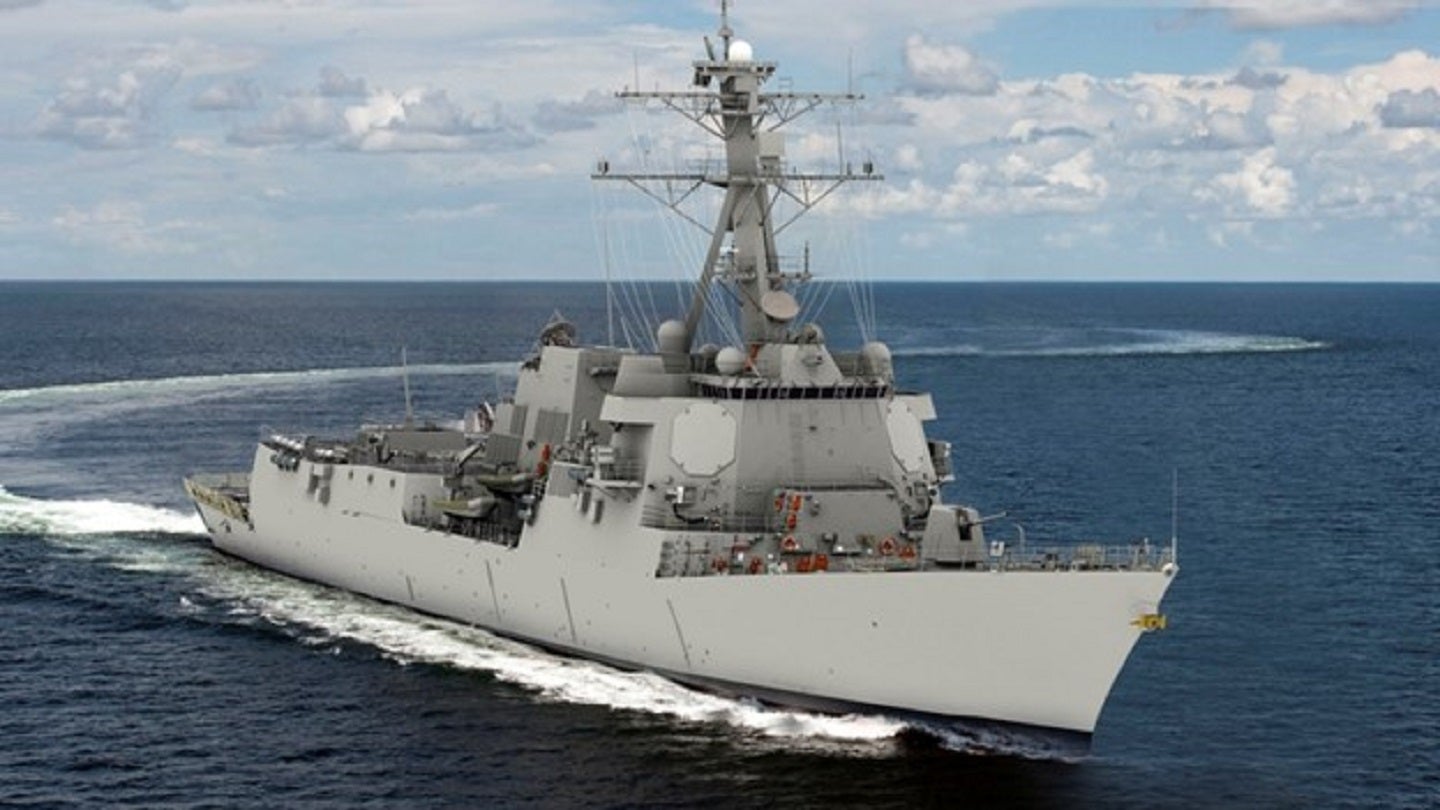
Last month, the US Department of Defense (DoD) secured contracts for the construction of ten new flight III Arleigh Burke-class (DDG 51) destroyers.
The timeframe for the vessels will see HII’s Ingalls Shipbuilding division construct seven destroyers – two in 2023, one in 2024, two in 2025, one in 2026, and one in 2027.

Discover B2B Marketing That Performs
Combine business intelligence and editorial excellence to reach engaged professionals across 36 leading media platforms.
Within the same period General Dynamics Bath Iron Works (BIW) will also build three units – one ship per fiscal year in 2023, 2024, and 2026.
In a contract update on 6 September, the DoD disclosed the cost for the construction programme totalling $14.58bn; although no cost breakdown between the two contractors was provided.
These contracts include options for engineering change proposals, design budgeting requirements, post-delivery availabilities on the awarded firm multi-year ships and options for construction of additional DDG 51 class ships.
Growing force structure
With the growing military posture of China’s Navy testing the power of neighbouring states in the South China Sea as well as the American-led ‘Rules Based Order’, a Congressional Research Service report, published on 5 September, suggested that the US Navy’s FY2024 five-year shipbuilding plan includes a total of 55 ships, or an average of 11 per year.
Given a 35-year average surface life for Navy ships (a planning factor assuming all ships will be kept in service to the end of their service lives), an average shipbuilding rate of 11 ships per year, if sustained for 35 years, would increase the size of the Navy to 385 ships over a 35-year period (i.e., by the 2060s).
“It’s right to say that the US is contemplating force size – and maintaining a larger fleet of Arleigh Burke ships is part of the answer,” affirmed GlobalData Defence analyst, James Marques.
Cost breakdown – looking at what we know
Improvements over the previous flights include hangars for two SH-60B / F LAMPS helicopters, new combat system software, an enlarged flight deck, the Evolved SeaSparrow missile, the Kingfisher mine detection sonar, the Kollmorgen optronic sight, and an upgrade of the Aegis radar systems.
These kinds of subsystems are critical to the construction of ships, especially for a time that values new capabilities and emerging technologies as we consider the fast-moving pace of naval warfare.
Integrating these systems onboard the new DDG 51s will make up half of the construction programme. Financially, the cost of the hulls will cost around $1bn, the same amount will be needed for the next-generation systems.
The Navy’s current procurement of the flight III DDG-51 design incorporates a significant change—a new radar, called the SPY 6 radar (and prior to that, the Air and Missile Defense Radar, or AMDR), that is more capable than the SPY-1 radar installed on CG-47s and earlier DDG-51s.
Not only will the new flight II fleet need next-gen systems but also maintenance of previous systems, particularly the Aegis ballistic missile defence (BMD), which has been a prominent weapon system for Arleigh Burke destroyers.
In fact, another Congressional Research Service report, published on 28 August, on America’s Aegis BMD indicated that “[t]he number of BMD-capable Aegis ships has been growing over time. [The Missile Defense Agency’s] FY2024 budget submission states that “by the end of 2024, there will be 53 total BMD capable [Aegis] ships requiring maintenance support.”


