

- USS Fort Worth will be stripped for parts to support remaining Freedom-class LCS
- The ship served mainly in trials and avoided retirement in 2022
- US Navy is cutting the class and funding upgrades for survivors
The recently decommissioned Freedom-class Littoral Combat Ship (LCS) USS Fort Worth will be stripped for parts to help sustain the remaining few vessels of the type still in US Navy service, bringing a close to a relatively long service life compared to many of its sister ships.


Commissioned in 2012, USS Fort Worth (LCS 3) was one of the first four LCS to be introduced into service, acting more as a test and trials vessel. The vessel was single-crewed, and as such was not part of the operational fleet.
The vessel survived a previous attempt to take her out of commission in 2022, before ending a 12-year stint with the US Navy in late July.
Naval Technology understands that the US Navy will now disassemble the USS Fort Worth and utilise its reusable equipment to support active LCS still in the fleet.
It is thought that there is no intention to explore a sale of Fort Worth, with freed-up funding to be redirected towards the remaining vessels in the class to enable upgrades, such as the integration of the Naval Strike Missile.
The LCS class consists of two variants, Freedom and Independence, built by two industry teams. The odd-numbered Freedom-class LCS variants are built in Marinette, Wisconsin, with Austal USA leading the even-numbered Independence-variant team in Mobile, Alabama.
Freedom-class LCS have suffered in service
The procurement of the LCS programme was planned to see the introduction of 52 vessels split evenly between the two variants, but this was continuously scaled back.
A number of Freedom variant vessels have been decommissioned from US Navy service after just a handful of operational years, such as the USS Sioux City (less than five years), USS Little Rock (less than six years), and USS Detroit (less than seven years).
In an August 2023 contract notice it was revealed that the USS Wichita (LCS 13) would undergo a diesel engine replacement programme, just four years after it entered service.
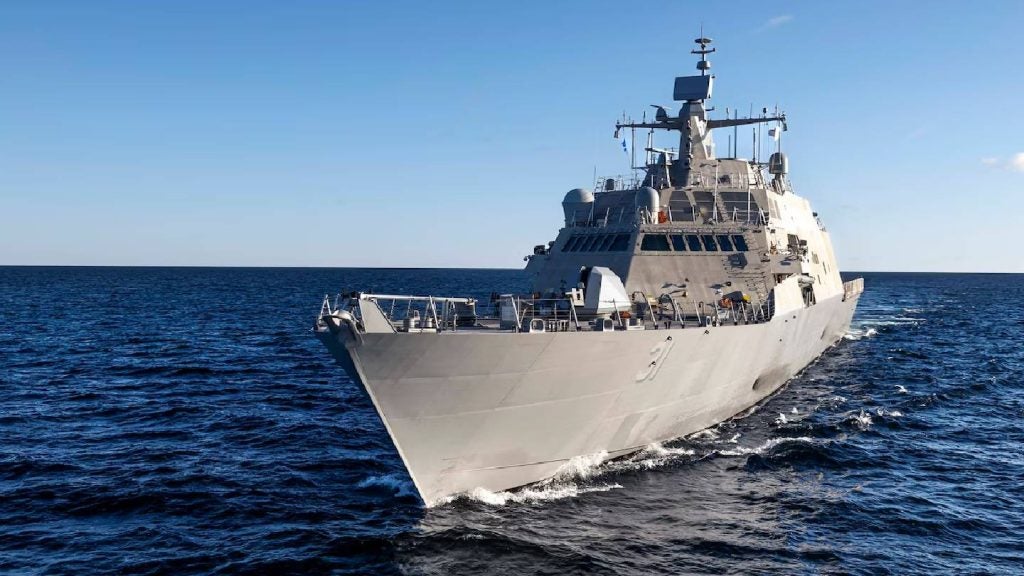
It is understood that the Freedom variants have particularly struggled on operations, suffering from excessive fuel consumption and stability issues.
The 2019 Congressional Research Service report stated that the LCS programme had been “controversial” due to “past cost growth, design and construction issues with the first LCSs”, with “concerns” about the class’s survivability, armament, and whether it would be able to perform its stated mission set effectively.
The US Navy concluded the production and delivery of its Freedom-class LCS programme with the commissioning of the final vessel, USS Cleveland, in May.


