

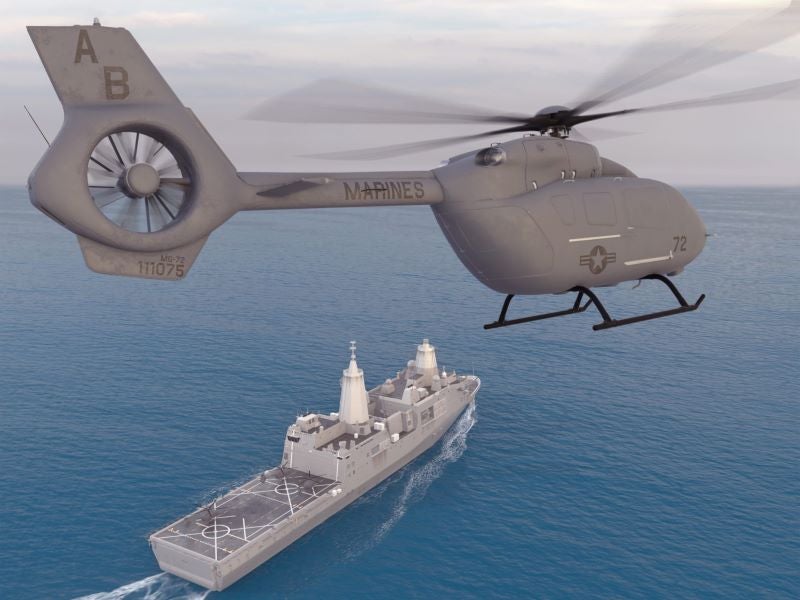
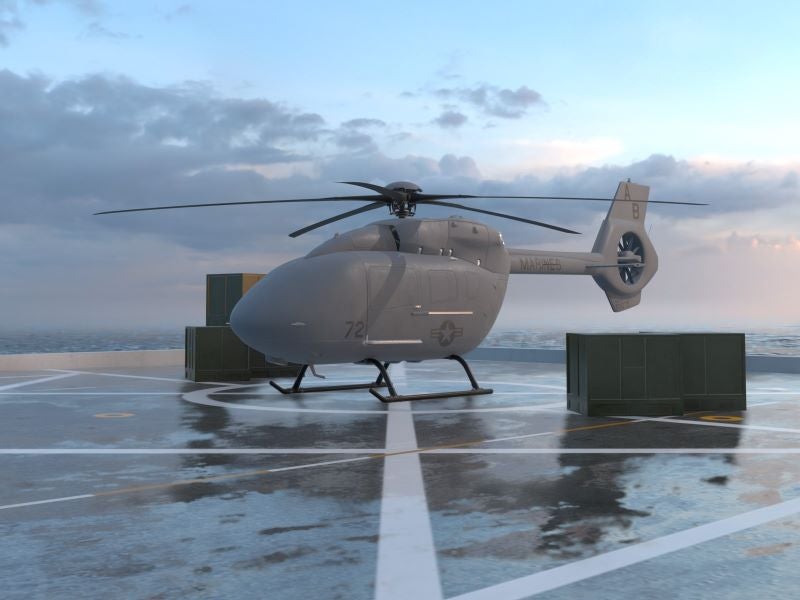
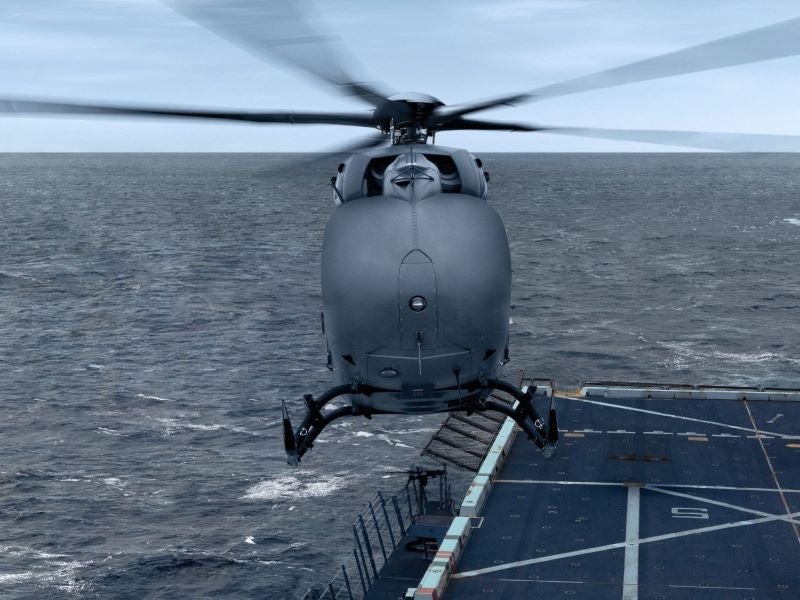
The MQ-72C Lakota Connector is an unmanned helicopter under development by Airbus US Space and Defense (Airbus).
The aircraft draws on the H145 family of helicopters and the UH-72 Lakota light twin-engine helicopter, a platform widely used in commercial, public service and military roles worldwide.
Recommended White Papers

Recommended Buyers Guides

The platform is intended to quickly move mission-critical payloads including standardised containers and munitions over operationally relevant distances.
The MQ-72C’s unmanned design is aimed at enabling operations in contested anti-access environments, supported by a broader support and supply ecosystem associated with the underlying helicopter family.
MQ-72C Lakota Connector development
The MQ-72C Lakota Connector is being developed in support of the US Marine Corps (USMC) Aerial Logistics Connector (ALC) programme.
Managed through the Naval Aviation Systems Consortium Other Transaction Agreement (OTA), the programme is part of wider US Department of Defense work on sustaining logistics in distributed operating environments, including scenarios involving peer or near-peer adversaries.
The Naval Air Systems Command awarded a Phase I OTA agreement for the ALC programme to Airbus in May 2024.
The agreement sits within a Middle Tier of Acquisition rapid prototyping effort aimed at producing aircraft prototypes for operational demonstrations and experimentation, allowing the USMC to evaluate the capability in representative conditions.
In October 2024, Airbus completed the first programme demonstration under the contract, held at Marine Corps Air Station New River and Marine Corps Base Camp Lejeune.
The demonstration assessed the performance of the UH-72B Lakota, confirmed its suitability for transporting mission-specific loads and highlighted Airbus’ proposed methods for satisfying USMC needs for an Aerial Logistics Connector.
A second programme demonstration was completed in May 2025, validating the the UH-72B Lakota’s performance capabilities.
MQ-72C Lakota Connector design and features
The MQ-72C Lakota Connector measures 13.04ft (4m) in height and has a length of 44.42ft. It has a cruise speed of 135 knots and a maximum take-off weight of 3,800kg (8,378lbs).
The aircraft, an unmanned variant of the UH-72 Lakota helicopter, is designed for operations up to 20,000ft, with a range of more than 350 nautical miles (nm), and it is intended to carry Joint Modular Intermodal Containers and ordnance containers.
The aircraft’s engine power ratings are listed as 894 shaft horsepower (shp) for take-off, 771shp for maximum continuous power and 951shp for one-engine-inoperative maximum continuous power.
The design emphasis includes reduced maintenance burden to help constrain operating costs, as well as growth capacity through a modular open systems approach supported by a digital backbone.
The MQ-72C Lakota Connector’s open autonomy framework is intended to support the integration of additional technologies as requirements change.
Partnerships for MQ-72C Lakota Connector development
In April 2025, Airbus and Shield AI agreed to work together to integrate Shield AI’s Hivemind autonomy software into the MQ-72C. The effort is intended to expand the aircraft’s range of tasks through autonomous logistics and other operational missions aligned with the ALC programme.
The plan involved assessing Hivemind alongside Airbus’ Helionix system during demonstrations, with testing intended to raise autonomy levels progressively to support unmanned logistics in contested settings.
In May 2025, L3Harris Technologies and Airbus also entered a teaming arrangement focused on systems integration for the MQ-72C.
Airbus intends to incorporate L3Harris digital architecture and command-and-control nodes, using an open, modular approach designed to speed the integration of third-party commercial off-the-shelf (COTS) equipment for Marine Corps needs and improve interoperability across the wider joint force.
In June 2025, Airbus entered into a multi-year collaboration with Parry Labs for the supply of its STRATIA® COTS edge software platform, designed to bring commercial aviation standards together with up‑to‑date autonomy and mission‑system functionality.
The company will also provide edge computing hardware and a fielded ground control station, configurable across multiple form factors, including integration with the Marine Air Ground Tablet.
MQ-72C Lakota Connector testing
Airbus conducted an autonomous helicopter flight test in Grand Prairie, Texas, in August 2025, using an H145 as the test aircraft and Shield AI’s Hivemind autonomy software. The integration was completed in under two months.
During the flight, Hivemind operated alongside Helionix avionics, with the combined software acting as the mission system controller. The trial included automated take-off and landing and additional manoeuvres intended to demonstrate flight without pilot input. A further autonomous test in September 2025, also in Grand Prairie and conducted by Team Lakota Connector, focused on integrating waypoint-based navigation.
