

- Trump said the US will allow South Korea to build nuclear-powered attack submarines, potentially boosting US shipbuilding
- South Korea could convert its KSS-III design into an SSN to gain strategic nuclear-submarine capability
- Alternatively, the US Navy’s Virginia SSN design might be an outside consideration for the ROKN
US President Donald Trump’s assertion that South Korea would build a nuclear-powered attack submarine (SSN) at the Philadelphia Shipyards shocked defence watchers, while offering a stunning contrast to the carefully developed AUKUS programme with the UK and Australia.


Writing on his Truth Social platform on 29 October, President Trump revealed South Korea’s permission to build an SSN using US technology would see shipbuilding make a “big comeback” in the United States.
It is well understood that South Korea has sought SSN capability as a top-end aspiration, given the distinct capability advantages of such platforms compared to conventionally powered alternatives and the sheer scale of the maritime realm in the Western Pacific.
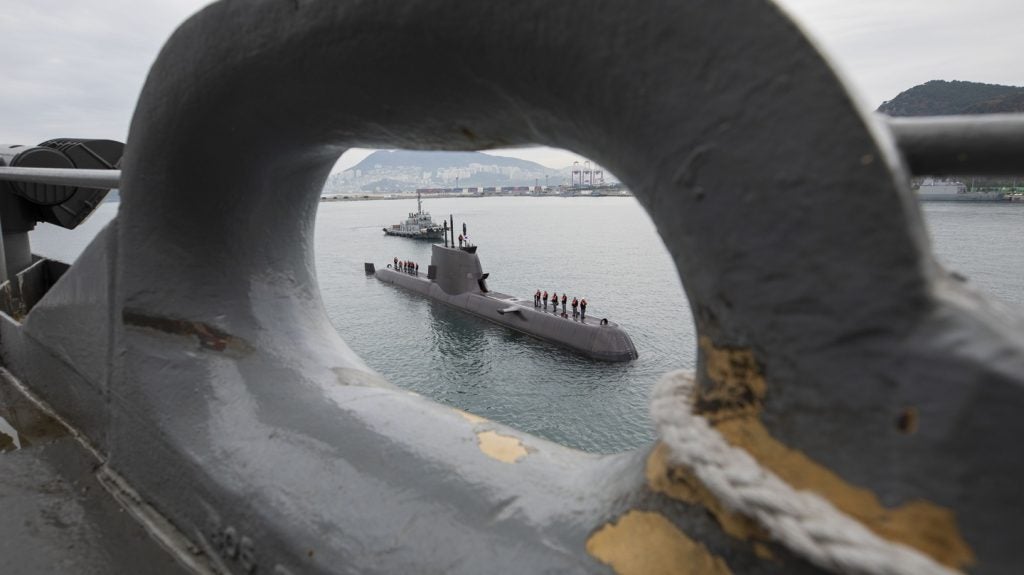
GlobalData’s analysis shows that South Korea operates a sizeable fleet of 21 conventionally powered submarines (SSK) across three classes: the Type 209-1200 (nine boats introduced from 1993-2001), the Type 214 (nine boats introduced from 2007-2020), and three of the latest KSS-III hulls delivered from 2021-present day.
A further six in the Batch 2 KSS-III class are planned, offering the Republic of Korea Navy a modern, capable, SSK fleet.
Crucially, Philly Shipyards was acquired in 2024 by Hanwha Group, at the time thought to be a way to leverage South Korean shipyard expertise to regenerate the US’ own industry, which is in considerable malaise.
The announcement can be viewed in contrast to the carefully developed AUKUS programme between the US, the UK, and Australia, which is seeking to develop Canberra’s nuclear submarine aspirations.
A nuclear-powered KSS-III Batch 3?
With an offer by President Trump to share nuclear propulsion technology with South Korea, Seoul could soon have all the technological elements required to design and manufacture an SSN.
Potentially, this could be through an adaption of the KSS-III design, which although displacing 4,000t submerged would almost certainly be able to be redesigned for nuclear propulsion. France’s Rubis-class SSNs displaced just 2,600t submerged, and were far shorter at 74m in length compared to the Batch 2 KSS’ 89m form.
A nuclear-powered KSS variant would be similar in scale and displacement to the UK’s former Trafalgar class, which although far from the size of the US’ own Virginia-class SSNs would still offer a platform able to operate at strategic levels.
The KSS-III Batch 2 design also features a 10-cell VLS system to launch cruise and (non-nuclear) ballistic missiles, a capability the UK’s latest Astute SSNs are incapable of performing in the same manner.
What about a South Korean Virginia class?
This would be a long shot, but with the US in desperate need to increase the rate of its own Virginia-class SSN Block V/VI builds, creating an industrial capability at Philly Shipyards to add manufacturing capacity could offer a solution.
At present, the US builds its Virginia-class SSNs at the General Dynamics Electric Boat site in Groton, and the HII Newport News Shipbuilding facility in Virginia.
Australia has its own claim on later model Virginia-class SSNs, either new build or already in US Navy service, via the AUKUS programme lease method, which could become permanent if the UK design chosen (SSN AUKUS) hits any delays.
Clearly, adopting the US Virginia design into ROKN service would be difficult, bringing an entire series of unique supply chain, training, and maintenance challenges. However, this would be somewhat offset by the potential to hook into Australia’s sustainment hub being developed at HMAS Stirling, or else utilise the US’ own sustainment sites.
More likely would be a nuclear-powered KSS-III variant, bringing design commonality across its submarine fleets. South Korea has a considerable civil nuclear energy programme and has many of the required skills to operate and sustain naval nuclear propulsion.
It is possible that the nuclear propulsion provision could be centred around the S9G pressurised water reactor used by the Virginia SSNs, which can operate for over 30 years without refuelling.


