


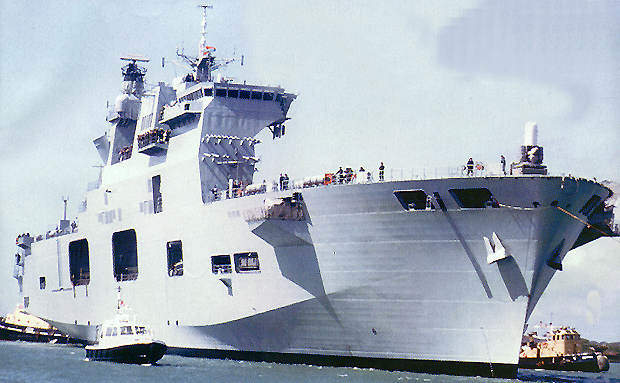


The UK Ministry of Defence issued an invitation to tender in July 1987 for an amphibious helicopter carrier for the Royal Navy. The order was placed in May 1993 with Vickers Shipbuilding and Engineering Ltd (now BAE Systems Marine) in Barrow-in-Furness, Cumbria.
Recommended White Papers

Recommended Buyers Guides

Kvaerner Govan Ltd is the principal subcontractor. The keel for HMS Ocean (LPH01) was laid in May 1994 and the ship was launched in October 1995. HMS Ocean was commissioned in September 1998 at Devonport, Plymouth, and is in operational service.
The primary role of HMS Ocean is to achieve the rapid landing of an assault force by helicopter and landing craft.
HMS Ocean helciopter carrier refits and deployments
HMS Ocean, carrying 300 Royal Marines and 400 air crew, was deployed as part of the UK task force supporting Operation Iraqi Freedom. Between March and May 2004, trials of the British Army’s new Apache AH Mk1 helicopter took place aboard HMS Ocean.
The UK is the first nation to test the Apache at sea. Trials included more than 750 take-off and landings in various sea states. Eight Apache AH Mk1 helicopters replaced Lynx helicopters as part of the Commando Helicopter Force.
In August 2007, Babcock Marine was awarded a contract for a refit / upgrade of HMS Ocean. The refit began in 2007 and included maintenance and upgrades to troop accommodation and aviation support facilities for the Apache helicopter.
HMS Ocean began sea trials in September 2008 and returned to operations in February 2009. The upgraded ship was initially deployed under the Commander UK Amphibious Task Group.
The LPH01 participated in the Bersama Shield exercise with Somerset and RFA Wave Ruler in June 2009.
In December 2011, the UK Ministry of Defence announced that HMS Ocean will be berthed in the Thames at Greenwich during the 2012 Olympics and Paralympics. The vessel will provide accommodation, logistical support and landing facilities for Lynx and Puma helicopters.
Design of Royal Navy’s amphibious helicopter carrier based on Invincible Class
The hull design is based on the design of the Invincible Class aircraft carrier (also built by Vickers) with a modified superstructure.
The building schedule included hull construction by Kvaerner Govan on the River Clyde and sailing under its own power to the BAE Systems shipyards at Barrow-in-Furness for the military equipment fit.
The ship carries a crew of 255, an aircrew of 206 and 480 Royal Marine Commandos. An additional 320 marines could be accommodated in a short-term emergency. HMS Ocean is capable of transporting and sustaining an embarked military force of up to 800 people equipped with artillery, vehicles and stores.
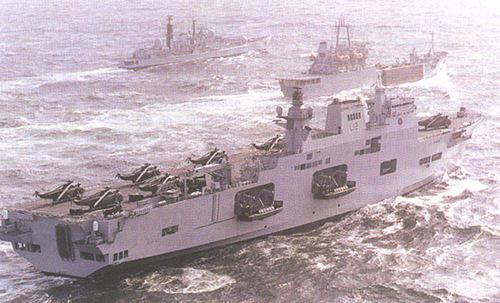
The ship has capacity for 40 vehicles but is not designed to land heavy tanks. There are four LCVP Mk5 vehicle / personnel landing craft on davits.
Aircraft support and carrying of Lynx / Chinook helicopters and Sea Harriers
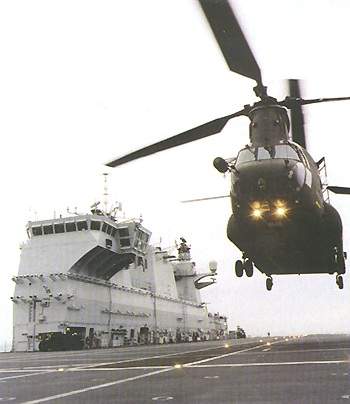
The ship has full facilities for 12 EH101 Merlin and six Lynx helicopters, plus landing and refuelling facilities for Chinook helicopters. 20 Sea Harriers could be carried but not supported. The flight deck is 170m long and 32.6m wide, with two aircraft lifts.
Command systems and weapons of HMS Ocean
HMS Ocean is equipped with the BAE Systems ADAWS 2000 combat data system, Link 11, 14 and 16 communications, an Astrium (formerly Matra Marconi) SATCOM 1D satellite communications system and a Merlin computer link.
The ADAWS 2000 combat data system, installed on both HMS Ocean and on the Royal Navy’s landing platform dock LPD assault ship, is compatible with the ships of the Royal Navy’s front-line fleet.
The weapon systems include four Oerlikon / BAE twin 30mm guns together with three Raytheon / General Dynamics Phalanx Mk15 close-in weapon systems.
Countermeasures on the HMS Ocean helicopter carrier
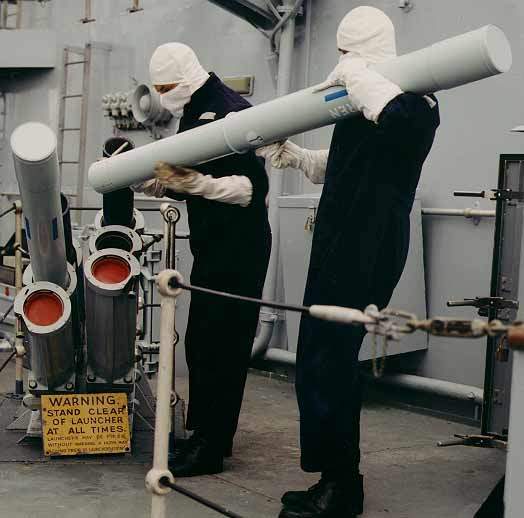
HMS Ocean is fitted with Outfit DLH, which includes the Royal Navy’s active offboard decoy (export name ‘Siren’) in addition to standard chaff and IR decoy payloads.
The Siren decoy, from Selex Sensors and Airborne Systems (formerly BAE Systems), is an expendable radiating decoy, which provides a soft-kill defence against radar-guided missiles and is effective against single or multiple threats in the I/J wavebands.
Siren is programmed with a complex set of jamming ploys and threat-specific data immediately before firing and, post launch, deploys under a parawing for controlled flight. Siren uses a variety of jamming techniques in order to seduce the anti-ship missile away from its intended target, using a high-gain, steerable antenna, to transmit the jamming signal into the main beam of the threat antenna(s).
HMS Ocean is equipped with eight Sea Gnat radar reflection / infra-red emitting decoys. Sea Gnat was developed under a Nato collaborative project involving USA, Germany, Norway, Denmark and the UK for protection against anti-ship guided missiles.
The electronic support measures system is the Royal Navy’s UAT from Thales Defence Ltd. UAT is a radar warning receiver and electronic surveillance system which provides targeting data and identification of hostile radar threats.
Also fitted is the Thales Type 675(2) ship-borne jammer, which has two antenna mounts to provide 360° azimuth coverage. Maximum elevation is 50° and the range is 500km.
Sensors and propulsion rates of the HMS Ocean helicopter carrier
HMS Ocean is equipped with the Selex Sensors and Airborne Systems Type 996 air and surface search radar. This is being replaced by the Royal Navy’s new-generation maritime medium range radar (MRR).
In August 2008, BAE Systems Insyte (with Qinetiq) ARTISAN 3D E/F-band radar was selected for the MRR. The radar will be retrofitted to HMS Ocean by 2015. Surface search and aircraft control radar is provided by two Kelvin Hughes type 1007 systems.
Propulsion is provided by two Crossley Pielstick 16 PC2.6 V 200 medium-speed diesel engines, rated at 23,904hp, with two independent shafts and a five-bladed fixed-pitch propeller. A 450kW KaMeWa bow thruster is fitted. The maximum speed is 18kt and the range is 8,000 miles.
Global Naval Surface Combatants & Warfare Systems Market 2011-2021
This project forms part of our recent analysis and forecasts of the global Naval Surface Combatants & Warfare Systems market available from our business information platform Strategic Defence Intelligence. For more information click here or contact us: EMEA: +44 20 7936 6783; Americas: +1 415 439 4914; Asia Pacific: +61 2 9947 9709 or via email.
