

The No Manning Required Ship (NOMARS) programme is intended to validate the reliability of fully unmanned vessels by eliminating human-related constraints, with the wider aim of supporting the US defence industrial base.
The programme is led by the Defense Advanced Research Projects Agency (DARPA), the US Government’s defence research agency.
Recommended White Papers

Recommended Buyers Guides

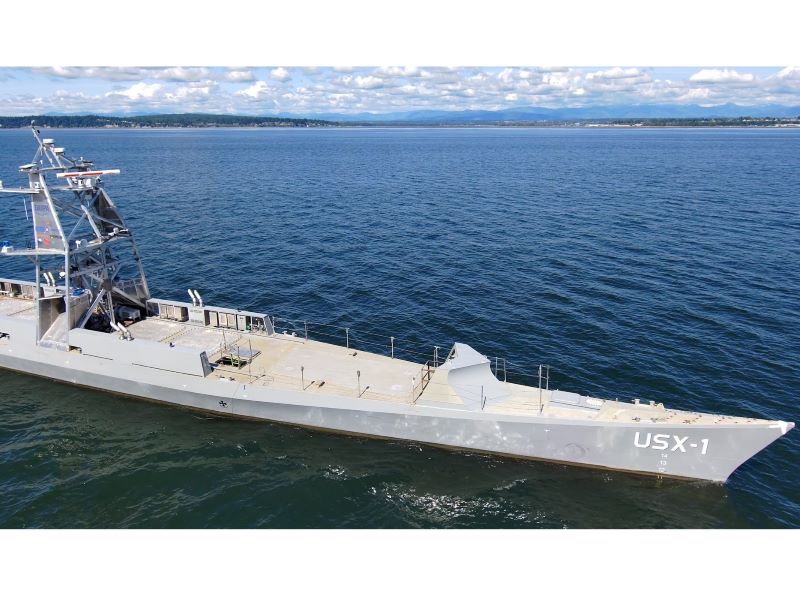
A prototype demonstrator vessel, classed as a medium unmanned surface vessel (MUSV), was completed in March 2025 and launched at Puget Sound for in-water testing focused on system performance and integration.
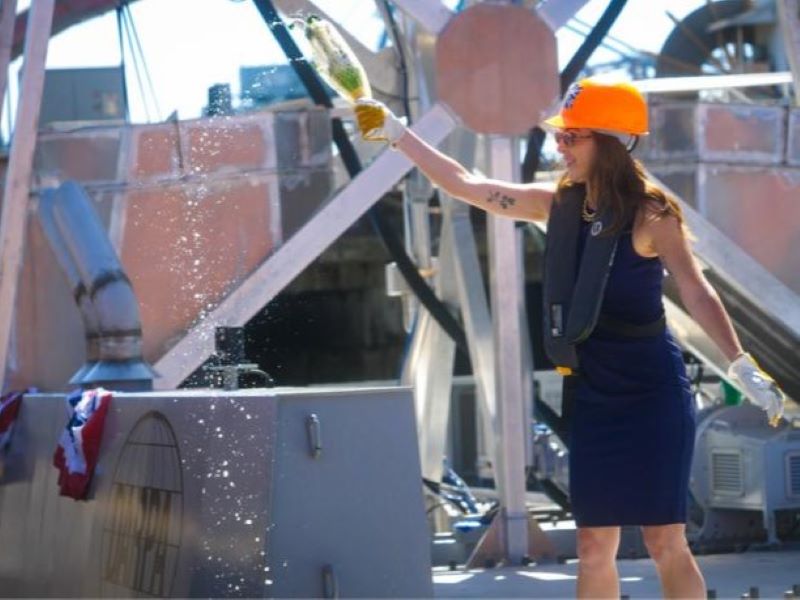
The demonstrator vessel was christened the USX-1 Defiant, in August 2025, at Everett Ship Repair in Washington, before beginning sea demonstrations of endurance and reliability the following month.
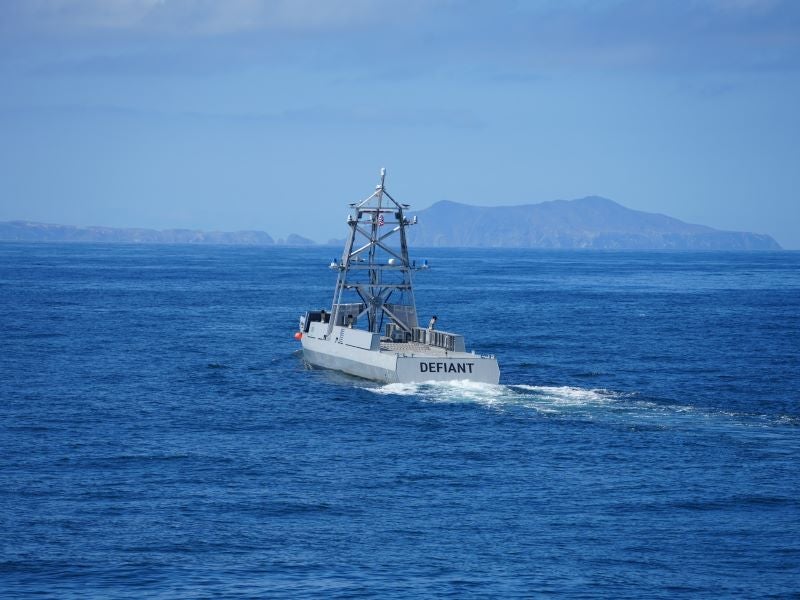
After completing a further 1,000 nautical miles (nm) of autonomous open-ocean transit, the vessel returned to Long Beach, California, in late September. Engineering updates were then implemented over the winter of 2025–26 to improve robustness.
The vessel returned to the water in February 2026 and is now undertaking final acceptance trials covering executive autonomy functions such as perception and navigation, alongside machinery control software updates.
NOMARS programme details
NOMARS is built around a clean-sheet naval architecture approach in which the hull is designed with no provision or expectation for anyone to be on board at any point while at sea, including during replenishment. By removing human-related constraints, DARPA is seeking gains in areas such as hull efficiency, survivability and overall reliability, while also focusing on resistance to interference and low observability features.
The absence of a crew also drives the requirement for new engineering approaches, particularly for power, propulsion and control strategies that can sustain operations through extended missions across a wide range of environmental conditions.
NOMARS is intended to challenge traditional naval design approaches by using innovative trade-off studies to maximise usable internal volume while working within a wide set of constraints. The objective is to enable smaller combatants that offer greater capability at lower cost, and that can be bought and sustained at scale.
According to GlobalData’s report, unmanned surface vessel adoption is accelerating as navies seek not only to increase capability but also to address manpower shortages. Platforms such as the Defiant ease the operational burden on crewed vessels, enabling human sailors to focus on more complex mission profiles and dynamic threats.
Development phases
Phase one of the NOMARS programme concentrated on broad design studies to generate tools and insights for future unmanned vessel development. Phases two and three of the programme are intended to translate these ideas into hardware, culminating in an experimental “X-ship” sea frame for trials and further design work.
In October 2020, DARPA issued seven phase one contracts covering both ship concepts that exploit the removal of crew requirements and technologies to support long-endurance operations without onboard maintenance. These awards included conceptual design activity, as well as work on health monitoring and adaptive management systems intended to support sustained availability at sea.
Autonomous Surface Vehicles, Gibbs and Cox, and Serco were granted phase one Track A awards to progress conceptual designs for new NOMARS demonstrators. Their work focused on improving vessel performance against emerging design requirements, potentially involving unconventional hull shapes, reduced freeboard, smaller air-filled spaces, the use of novel materials, and the removal or repurposing of areas traditionally intended for crews. The scope also included exploring distributed system concepts and developing vessel architectures designed around depot-based maintenance.
Barnstorm Research Corporation and TDI Technologies received phase one Track B awards to develop stronger methods for ship health monitoring through new self-adaptive health management architectures. This work was intended to support NOMARS objectives for endurance and reliability at sea.
InMar Technologies and Siemens also secured phase one Track B awards. InMar was involved in the development of methods for hull morphing to improve performance, while Siemens’ scope involved applying toolsets created under DARPA’s TRADES programme to help design optimised material structures for NOMARS ship concepts.
By August 2022, DARPA had selected a Serco-led design to progress into phase two, supported by a design space exploration tool that generated and assessed many vessel designs before refinement into the USX-1 Defiant prototype concept.
USX-1 Defiant design and features
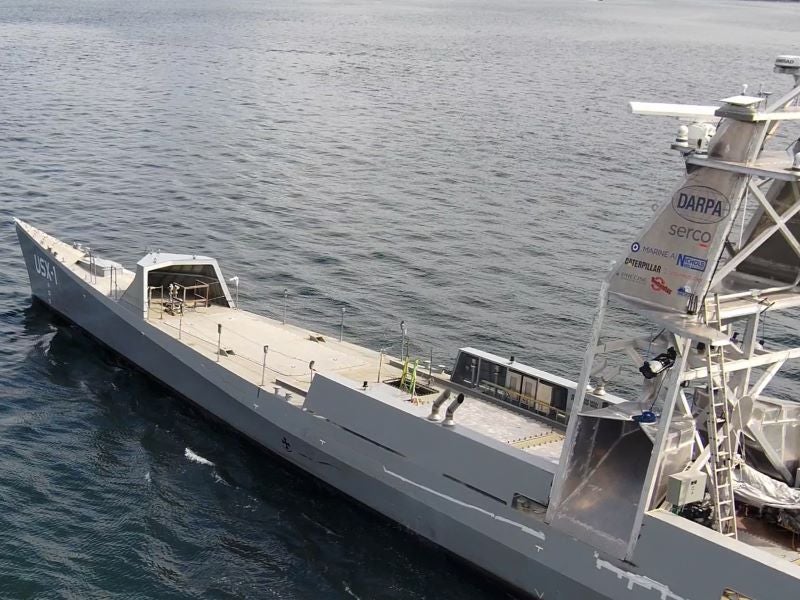
The USX-1 Defiant is 55m (180ft) long, stands 12.8m high, has a displacement of 240t (529,000lb) and is designed to carry up to 60t of payload. It has a top speed of 20 knots, a range of 7,000nm and is intended to operate in Sea State 5 and survive conditions up to Sea State 7.
The vessel is designed for extended autonomous deployment of up to a year without human intervention, operating independently or alongside other naval assets, offering lower operating cost for each mission hour compared with older platform types.
The USX-1 Defiant brings robotic and autonomous systems and AI into operational service, supporting a wide range of maritime tasks in both military and civilian settings.
It is designed to undertake long-endurance intelligence, surveillance and reconnaissance with a high degree of accuracy and efficiency, helping to reduce risks to naval personnel and assets while allowing crewed ships to be reassigned to higher-priority duties.
By integrating advanced sensors, AI-driven data analysis and proven autonomous capability at sea, the Defiant is intended to support distributed maritime operations by delivering timely situational awareness and an on-station response to emerging threats.
The platform can be configured for missions such as search and rescue, environmental monitoring, anti-submarine warfare, and humanitarian assistance and disaster relief. It can operate independently or alongside crewed vessels, providing adaptable support across maritime operations.
Sea trials
The Defiant’s sea trials involve testing an 800kW power system configuration based on four 200kW KARNO Core units in a keel-cooled arrangement. The modular layout is intended to support redundancy and reduce maintenance demands in the absence of onboard servicing.
The KARNO Core is a heat-powered linear generator designed to provide direct current output at 800V-direct current for integration with modern ship electrical systems and is planned to operate on F-76 marine diesel for US Navy use, with an emphasis on low thermal and acoustic signatures.
The technology has also been undergoing land-based development using simulated naval load profiles.
In December 2024, DARPA completed an initial at-sea refuelling demonstration aligned with the Defiant’s concept of operations. The test involved the US Navy’s PMS-406 Unmanned Maritime Systems Program Office and USV Squadron 1, using the experimental vessels Ranger and Mariner.
The Ranger carried a receiving station representative of the Defiant’s intended configuration, while the Mariner carried a compact refuelling station developed for the programme. The trial demonstrated the operational sequence while under way, including line handling, probe connection and pumping water.
Contractors involved
Power Engineering & Mfg was selected in April 2023 to design and build prototype gearboxes for the propulsion and propeller arrangement of the USX-1 Defiant.
In May 2026, Hyliion received a contract through the US Office of Naval Research, in partnership with DARPA, to deploy and test KARNO technology on the Defiant.
MarineAI was contracted to supply its GuardianAI autonomy stack for the vessel to support situational awareness, routing and obstacle avoidance, while Beier Integrated Systems provided the automation and machinery control package.
Other suppliers involved with the project include Caterpillar, DRS Naval Power Systems, ICE FLOE (trading as Nichols Brothers Boat Builders), Metron, Submergence Group and Thrustmaster of Texas.
