

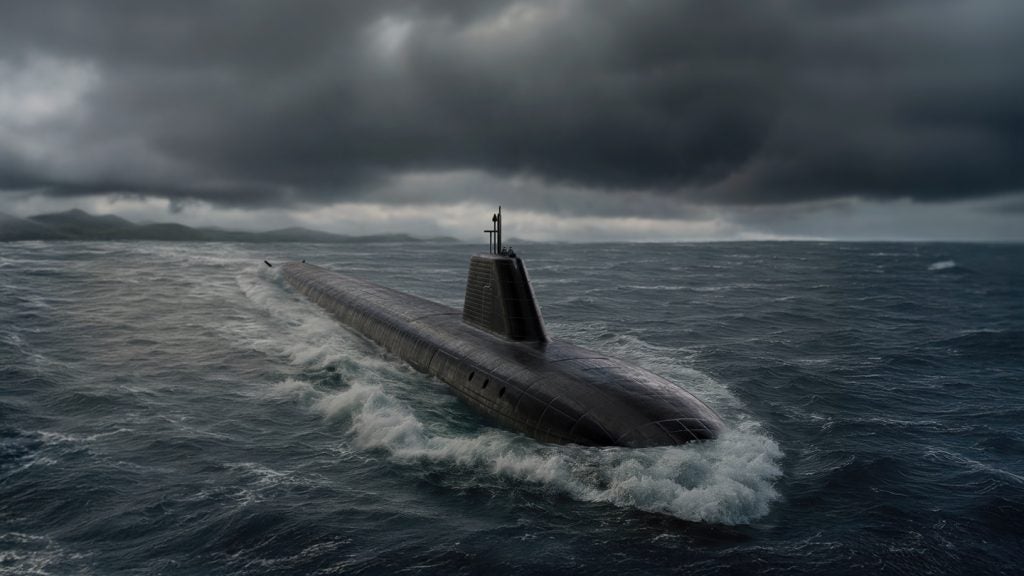
- UK adds £5.9bn to the Dreadnought SSBN programme as construction continues at Barrow
- Dreadnought is meant to replace Vanguard and sustain CASD, amid growing strain on the current fleet
- Analysis indicates costs are already being incurred into the contingency fund, amid a squeeze on conventional forces
Whisper it quietly, but the Royal Navy’s future Dreadnought nuclear-powered ballistic missile submarines (SSBNs) appear increasingly unaffordable for a country whose lack of investment into its conventional military has resulted in deep cuts to defence capability.
Announced on 29 July, a further £5.9bn ($7.8bn) in funding for “critical work to progress the nation’s Dreadnought-class nuclear deterrent submarines towards entry into service”, with work “continuing apace” at the BAE Systems yard in Barrow-in-Furness.
The contract also covers continued progress on the build of boat two, Valiant, and fabrication and outfitting of the remaining two boats, Warspite and King George VI, which are in the early stages of construction, stated a BAE Systems release.
The four-boat Dreadnought-class programme will replace the existing Vanguard SSBN fleet, in a bid to ensure the continuation of the country’s so-called Continuous at Sea Deterrent (CASD) capability.
Equipped with Trident II D5 ballistic missiles, the Vanguard and future Dreadnought classes provide the nuclear deterrent capability for the sitting UK Government, effectively ensuring its seat at the top table of the UN Security Council.
However, the Vanguard class is running on fumes, with patrols increasingly prolonged while boats sit waiting to be maintained in the country’s creaking nuclear repair yards. Indeed, it is possible that the principle of CASD has lapsed in recent years.
The UK Government maintains that its CASD capability has not been gapped.
In addition, the past two publicly acknowledged test firings by the Royal Navy of its Trident II D5 missile have resulted in failures in 2016 and 2024, leading to questions about the actual efficacy of the country’s nuclear deterrent.
The UK nuclear enterprise is unaffordable
The UK’s conventional military is in a dire state, with too few personnel, tanks and armoured vehicles, artillery, munitions, fighters, transport aircraft, frigates, and destroyers. In its current form, the UK’s conventional military capabilities cannot be considered viable for anything other than peacekeeping, notwithstanding special forces.
Conventional UK defence spending, removing the nuclear deterrent, single intelligence account, and the armed forces pensions, is around 1.7% of GDP.
The UK has tumbled down Nato's spending tables in recent years, with inflation wiping out any claimed increases in defence spending.
Meanwhile, the country’s military nuclear endeavours are in rude health, with nine Defence Nuclear Enterprise programmes currently occupying whole-life costs exceeding £10bn; Astute SSNs, Astraea nuclear warhead modernisation, the Clyde Transformation Programme, the Dreadnought SSBNs, Future Materials Campus, Nuclear Fuels Programme, SSN-AUKUS, and Submarine Build Modernisation.
The Dreadnought nuclear deterrent programme is budgeted to cost £31bn over its lifetime – plus a £10bn contingency – a figure that will certainly be broken, given the UK’s near flawless inability to run complex procurement and operational readiness to budget.
As of March 2024, £17.4bn had been spent on the Dreadnought programme, with updated figures expected to be provided once Parliament returns from its summer recess.
Detailed in a UK parliamentary research paper published in August 2025, in May 2022 the MoD awarded contracts for the initial stages of Delivery Phase 3. This phase is expected to last several years and will eventually see the first boat of class, HMS Dreadnought, enter sea trials.
Construction of the third boat, HMS Warspite, began in February 2023. The first Dreadnought SSBN is expected to enter service in the early-to-mid 2030s.
However, the paper also revealed that £3.37bn of the separate contingency fund had already “been accessed so far”, with the MoD stating the remaining funding had been allocated to “future years”.
This, the parliamentary research paper suggested, indicates that the full £10bn contingency fund will be spent.