During a panel discussion on the UK Royal Navy’s cultivation of an autonomous force at the Undersea Defence Technology conference in London, industry players observed that the nation’s naval projects have reached various levels in their transition.
With plans to build a ‘hybrid’ force structure that employs uncrewed underwater and surface vehicles alike, a leading intelligence consultancy, GlobalData, notes the persistent challenges when it comes to harnessing autonomy. The development of AI or autonomous systems presents its own unique set of financial, technological, legal, and ethical challenges as is evidenced by the slow and troubled pace of the development of autonomy solutions across all domains.
The Royal Navy is pursuing underwater autonomy at what it calls ‘degree four’ in which its undersea assets run fully autonomously, with no human in the loop, but still on the loop.
One of the panellists, the head of Underwater Battlespace Capability in the Royal Navy, Michael Wood, spoke to Naval Technology to explain the differences among the Navy’s projects and the challenges the service now faces in achieving autonomy.
A lot comes down to financing, Wood suggests: “The next spending review will be important in deciding how much investment is made in autonomous platforms.” In the Navy’s two-year-old Maritime Operating Concept, the service indicated that autonomous vehicles will play a valued part in the new force structure.
“The introduction of autonomous and uncrewed systems offers an opportunity to focus on the uniquely human ability to resolve complexity and ambiguity, make decisions, and understand audiences. This approach allows us to increase lethality and mass; transfer the dirty, dull and dangerous; and maximise the performance of our people.”
Project CETUS
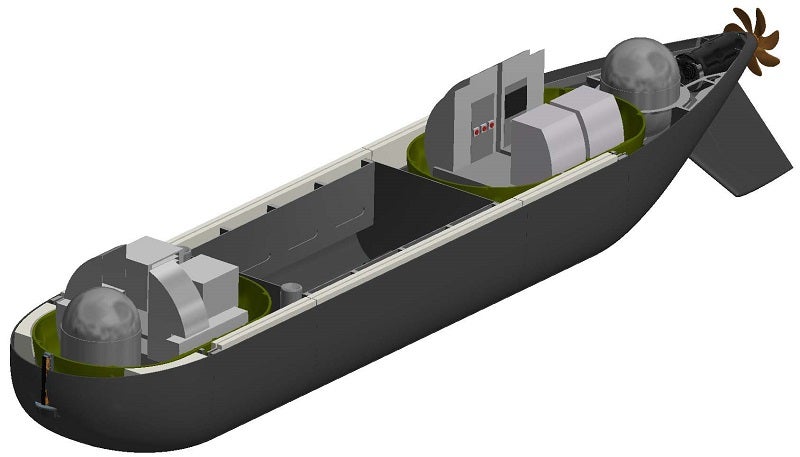
One project that is at a relatively lower level on the path to autonomy is Project CETUS, an extra-large autonomous underwater vehicle (XLAUV) the size of a bus, running on five days of endurance, which is currently in its early stages as a testbed for operations.
CETUS is not currently a core programme, but rather a demonstrator the Navy is effectively playing with as a loyal wingman at this stage.
It is designed to move stealthily through the oceans, monitoring hostile activity, and listening out for ships or submarines that may pose a threat to the fleet, or key national infrastructure such as deep-sea cables and pipelines.
“S201 [a submersible designation] is proving some mission autonomy, which we will push further with the Project CETUS XLAUV,” Wood noted. “We’re also looking to partner with DARPA [a US defence research agency] on lessons they are generating through the NOMARS demonstrator.”
Mine Hunter Capability Block II
The Mine Hunter Capability (MCH) Block II is a mine countermeasure (MCM) system. Currently, the majority of the Royal Navy’s MCM capability is provided by the Hunt– and Sandown-class MCM vessels, although these are slowly being withdrawn from service, with some being donated to Ukraine.
Its Block 2 phase will continue the work seen under Block 1, which saw the development of concepts and plans to create an uncrewed MCM capability.
Block 2 will further this through the maturation of technology, using machine learning and AI, improved command and control, as well as the development of new autonomous technologies.
Achieving autonomy
Autonomy “is gaining traction,” but “it takes time”, Wood stipulated. The Navy hopes to build “a much wider enterprise” in which it will “move away from proprietary architecture and software.”
This demands a cultural change, not just for the force but also for Government delivery agencies. “[We must] configure the Navy but also delivery, DE&S – they will need additional engineering, technical and commercial [resources] for wide-scale adoption of maritime autonomous systems.”
In the end, the force will start “coalescing around more common systems as we know the direction we’re heading”.
Additional reporting from Richard Thomas.