
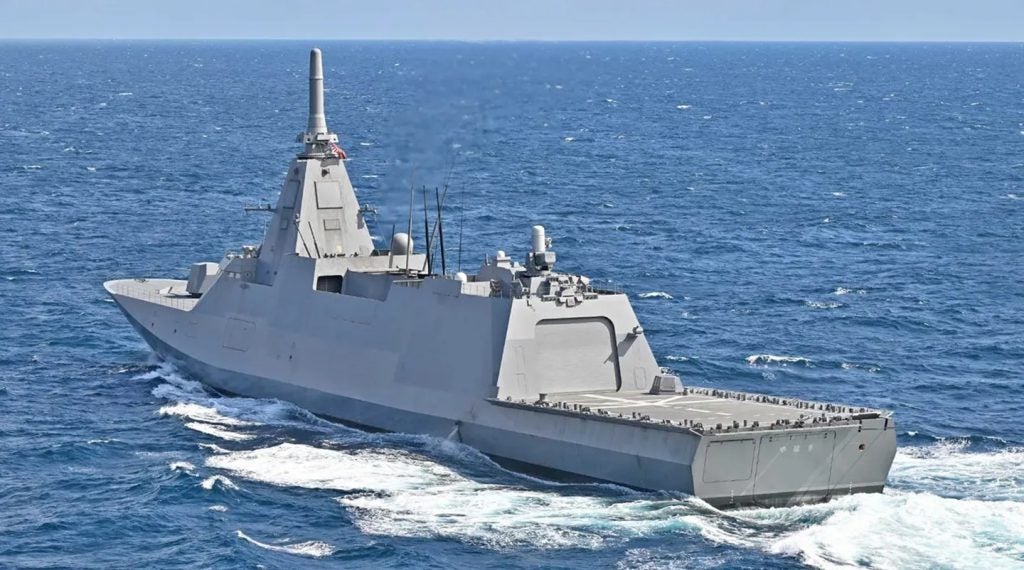
Palfinger Marine has been selected again to equip Japan's next-generation FFM-class multirole frigates with its advanced Slipway Systems.
This follows the company's prior successful integration of the technology into the Mogami-class frigates.
The contract encompasses an enhanced version of Palfinger's slipway system (PSS) technology, tailored to accommodate the specifications of the new FFM-class frigate design.
The stern launch and recovery systems (Stern-LARS) developed by Palfinger are engineered to streamline the deployment and retrieval of uncrewed surface vehicles (USVs) and boats for naval, governmental, and coast guard operations.
Japan's FFM-class frigates, although visually resembling the existing Mogami-class, represents an advancement in naval design, said Palfinger.
The new FFM-class frigates will have a hull that is 10 metres (m) longer and 1m wider than the Mogami-class. The initial five ships are scheduled for construction from 2027 to 2036.
Mitsubishi Heavy Industries has been appointed as the primary contractor for the frigate project.
Palfinger Marine Governmental, Navy & Coast Guard global key account & segment manager Torstein Svane said: "We at Palfinger are proud to have been selected once again as the supplier of our Slipway Systems for the Japan Maritime Self Defence Force’s future multirole frigates.
"Being chosen for the Stern-LARS solution for these vessels demonstrates that Palfinger has the high-quality products, engineering capabilities, and project execution power necessary to take on the most demanding projects."
Palfinger said its Slipway Systems are designed to mitigate common challenges and hazards associated with launching and retrieving USVs and boats in maritime environments.
The technology is claimed to enhance safety by removing the need for conventional lifting methods or mechanical connections during such operations.
Additionally, it boosts operational efficiency by enabling single operator use and reducing manual intervention.
The implementation of this system also improves operational speed and crew comfort, according to Palfinger.