
Newport News Shipbuilding (NNS), a division of HII, has begun topside testing of the new Electromagnetic Aircraft Launch System (EMALS) on the US Navy’s second Ford class aircraft carrier, USS John. F. Kennedy (CVN 79).
EMALS is the Navy’s latest complete carrier-based aircraft launch system. It is designed to launch all current and future carrier air wing platforms – lightweight unmanned to heavy strike fighters.
First integrated into USS Gerald R. Ford (CVN 78), EMALS replaces the existing steam catapults currently in use on the US Navy’s Nimitz class aircraft carriers.
The mission and function of EMALS remains the same as the traditional steam catapult; however, it employs entirely different technologies.
EMALS uses stored kinetic energy and solid-state electrical power conversion. This technology permits a high degree of computer control, monitoring and automation.
NNS topside testing
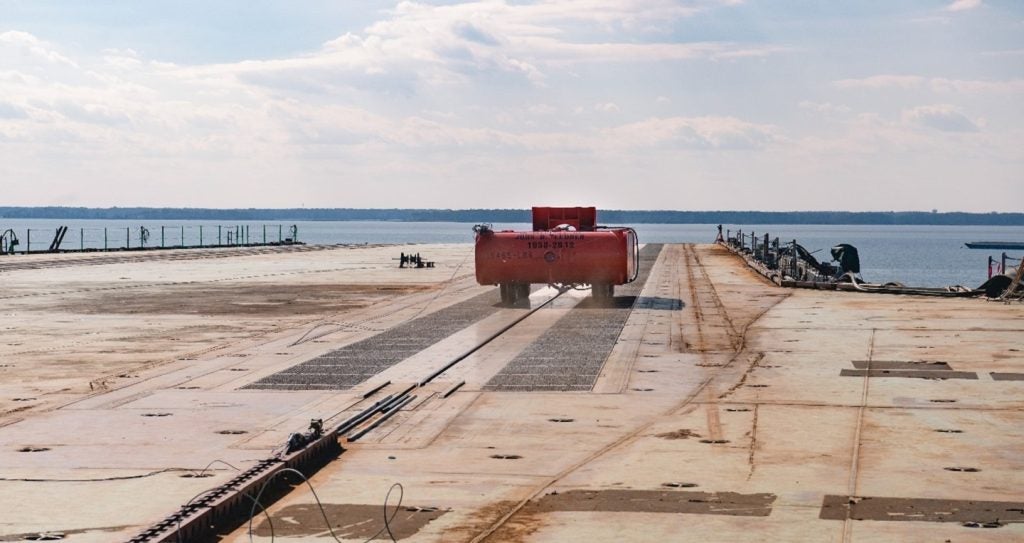
Following successful “no-load” testing on catapults one and two – known as the ‘bow cats’ – the NNS team, alongside the crew on CVN 79, have now started “dead-load” testing.
In this phase, large, wheeled, car-like structures of graduated weights up to 80,000 pounds, to simulate the weight of actual aircraft, are launched off the carrier’s bow into the James River, in Virginia, where the test is taking place.
They are then retrieved and relaunched until the conclusion of the test programme to ensure the catapults are ready for their primary intended purpose: to launch all carrier-based fixed-wing aircraft flown by the US Navy.
Traveling more than 300 feet down the catapult track at more than 150 miles per hour, EMALS provides expanded operational capability at reduced costs, higher launch-energy capacity, and more accurate end-speed control, with a smooth acceleration at both high and low speeds.
The launch profiles have been optimised to reduce stress on the aircraft, in contrast to the sudden acceleration of steam catapults.
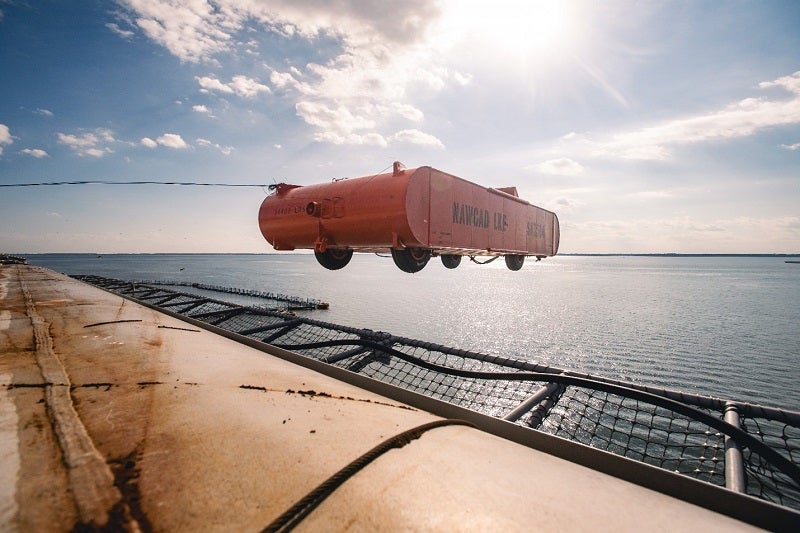
“As we make sustained progress in the construction, testing and turnover of John F. Kennedy, reaching the dead load testing phase is a visual demonstration of how far we’ve come,” said Lucas Hicks, vice president, John F. Kennedy (CVN 79) new construction aircraft carrier program.
“We are proud of the incredible teamwork that has brought us to this point, and remain committed to delivering this mighty aircraft carrier to the fleet so the crew can carry out the important mission ahead.”