
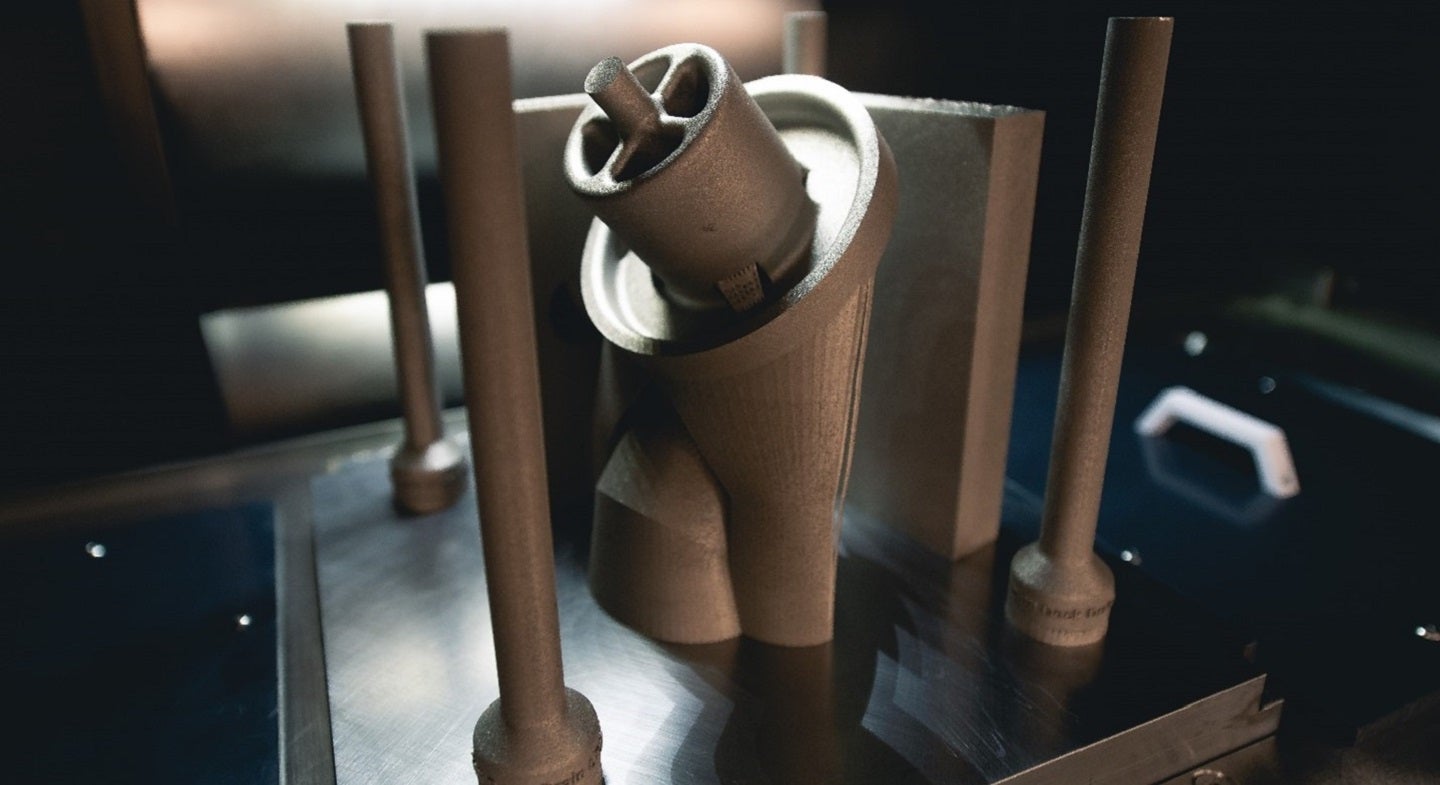
HII’s Newport News Shipbuilding division and General Dynamics Electric Boat (GDEB) have sourced a component from a 3D printing company called AMMCON, which they will integrate onto the Virginia-class general attack submarine (SSN), USS Oklahoma (SSN 802).
The two original equipment manufacturers (OEM) of the Virginia-class fleet have focused on the availability and deployment of marine-based alloys, such as copper-nickel, to provide an alternative to traditional copper-nickel castings.

Discover B2B Marketing That Performs
Combine business intelligence and editorial excellence to reach engaged professionals across 36 leading media platforms.
Recently, the OEMs decided it would use a 3D printed part for its copper-nickel deck drain assembly. Working with their supplier AMMCON on the model and proof of concept, HII and GDEB successfully created a copper-nickel deck drain part using additive manufacturing.
AMMCON is providing final machining and assembly of the part, before it is installed on the Oklahoma.
US Navy submarine programmes “lack essential schedule insight”
In total, 37% the US Navy’s (USN) SSN fleet – 31 of 49 SSN units – were unavailable for operations in FY2023, with 14 boats listed as undergoing maintenance and four vessels described as “idle” and still to undergo depot maintenance. The ratio of active/inactive has worsened slightly from FY2022, which had 33% of the SSN force idle or undergoing maintenance.
Delays also extend to the construction of the USN’s 12 forthcoming ballistic missile (SSBN) Columbia-class submarines. Already costing $132bn, the USN anticipates this amount to accumulate more as delays persist.
According to the US Government Accountability Office, “the Navy lacks insight into the programme’s schedule because the shipbuilder (HII Newport) has not conducted a schedule risk analysis, which can help identify and manage risks to achieving planned delivery dates.”
HII and GDEB’s transition to 3D printing may serve as a solution to delays due to the on-demand and customised delivery of parts as well as specialised tools, which HII has leveraged in the past with the use of a spot face cutter onboard the John F. Kennedy (CVN 79) Gerald R. Ford class aircraft carrier.
Thanks to developments in advanced manufacturing methods such as 3D printing, the American naval manufacturer HII had previously claimed that these tech developments will “save thousands of man-hours over time.”
Additional reporting by Richard Thomas.


