

- UK Minister suggests work at Rosyth shipyard could be sustained with orders for uncrewed and autonomous platforms
- Babcock is expected to complete the construction of the conventionally crewed Type 31 frigate programme in the early 2030s
- The British shipbuilder is already positioning itself with marine autonomy suppliers in the South West of England
UK orders for uncrewed maritime vehicles (UMVs) could keep Babcock busy at its shipyard in Rosyth, Scotland, as the shipbuilder approaches the completion of five Type 31 frigates in the early 2030s.
Earlier this week, the naval prime marked a rare double milestone in the construction of two of these conventionally crewed vessels for the Royal Navy. Manufacturing began on the fourth ship, HMS Bulldog, while the second in class HMS Active rolled out of the assembly hall.
Go deeper with GlobalData


Discover B2B Marketing That Performs
Combine business intelligence and editorial excellence to reach engaged professionals across 36 leading media platforms.
Although Babcock still may build the Type 31 for allies – just as BAE Systems will build Type 26 ships for Norway – the Minister for Defence Readiness and Industry Luke Pollard spoke to Naval Technology, expounding on the government’s plans to sustain work at Rosyth in any event:
“So when Bulldog goes to sea… it’s likely that she’ll have autonomous platforms alongside her. Now there are additional opportunities for shipbuilding. So they might not be the 6,000 tonne versions, but they’re about increasing lethality, increasing survivability, [and] increasing deterrence.”
A hybrid navy
The UK Ministry of Defence agreed to recommendations in the Strategic Defence Review (SDR) in June last year, in which the authors called for “a more powerful but cheaper and simpler fleet” bolstered by UMVs.
To this end, the document states the Royal Navy should engage with industry to rapidly deliver an integrated frigate force for anti-submarine warfare, comprising crewed, uncrewed, and autonomous platforms.
However, the UK does not have a concrete design for such a requirement at present.
But intelligence from the analytics firm GlobalData indicates that there is growing attraction to the global military UMV market: valued at $1.8bn last year, the consultancy projects the compound annual growth rate will increase by 8.9% over the next ten years.
It could be said that this expansion is driven by Ukraine’s use of uncrewed and remotely operated maritime attack drones in devastating up to one third of Russia’s Black Sea Fleet in March 2024. One can see the value of the asymmetric solution to a cash-strapped government being forced to rethink its priorities.
In the last several months, the UK Government has routinely delayed its Defence Investment Plan (DIP), which will provide a cost breakdown of priority defence programmes for the next decade. Staggeringly, having already pushed the deadline twice, there is a concern this will happen again since the department’s notable rephrasing of the release date to an unspecified time this year.
“When we’re looking at the shipbuilding pipeline,” Pollard continued, “I think it’s tempting to look at the opportunities of where are the big crewed platforms in the future?
“What the SDR set out and what the DIP will… be able to illustrate more clearly is… we want a hybrid navy of crewed, uncrewed, autonomous systems – this is the direction of travel we’re [taking].”
What’s in the works?
Babcock is preparing for UMV orders, having already put forward its own concept known as the Autonomous and Remote Maritime Operational Response (ARMOR) Force.
The notion will place a Type 31 as a command ship that coordinates with multiple smaller but sizable uncrewed platforms which can be configured for different missions, whether that be combat or surveillance.
“We’ve already got that concept, both in hardware and software,” acknowledged David Lockwood, Babcock’s CEO, speaking to Naval Technology at Rosyth. “The great thing about [Type] 31 is… it’s got the volume and the power… and space to create all that capability.”
Displacing 5,700 tonnes, the Type 31 general purpose frigate is intended to perform the role of a mothership to UMVs given its 119-square metre mission bay. For context, this space can accommodate up to six 20-foot ISO containers.
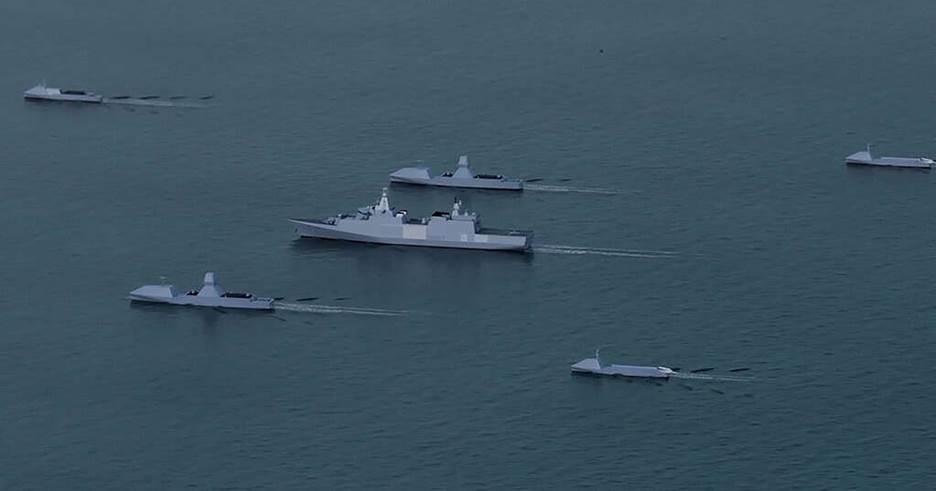
Only days after Pollard spoke to this reporter on 24 February, Babcock announced it will partner with the UK regional cluster, Tech South West, and the University of Plymouth to launch a new National Marine Autonomy Accelerator.
This initiative will support companies working in autonomous marine systems and technologies. In forming a closer partership among defence, research and industry, “we’ll be providing an array of targeted opportunities” assured Dan Pritchard, co-founder of the cluster.
The move could be interpreted as a way for Babcock to position itself among key suppliers, incubating the necessary skills within the marine autonomy sector, as the UK prepares to place future orders in the long-awaited DIP.
Equally, advancements in marine autonomy can also be found in the Fleet Experimentation Squadron, a specialised unit of the Royal Navy, dedicated to testing and deploying maritime technologies. The unit operates two autonomous testbed vehicles: the 42-metre long XV Patrick Blackett uncrewed surface vessel and the 12-metre XV Excalibur uncrewed underwater vehicle.
It is this commitment to the development cycle that prompted Pollard to argue “there’s [only] one navy on the entire planet that’s leading the way on this, and it’s the Royal Navy.”
But this is not strictly true, of course, as GlobalData points out that while Europe does dominate the global military UMV market with close to a 40% share, the continent is followed by Asia-Pacific and North America with shares of around 32% and 20%, respectively.



