

On the morning of 1 February 2024, Ukraine’s Ministry of Defence (MoD) posted a video on the social media website X, formerly Twitter, depicting what appears to be an uncrewed surface vessel (USV) impacting with a warship.
“As a result of a number of direct hits to the hull, the corvette was damaged, rolled to the stern, and sank,” the MoD summarised in its post.
Go deeper with GlobalData


Discover B2B Marketing That Performs
Combine business intelligence and editorial excellence to reach engaged professionals across 36 leading media platforms.
Ukraine’s Main Intelligence Directorate claims that soldiers in a special unit within its ranks, known as ‘Group 13’, “destroyed the missile ship ‘Ivanovets’ of the Black Sea Fleet of the Russian Federation.”
The Russian ship was said to be patrolling the Black Sea near Lake Donuzlav near occupied Crimea.
“According to preliminary information, the search and rescue operation of the Russian occupiers on the Donuzlav was not successful,” Ukrainian defence intelligence stated.
While there has been a flurry of discussion and speculation online in response to the incident, Western officials say it was highly likely that Ukrainian USVs had struck the Russian corvette.
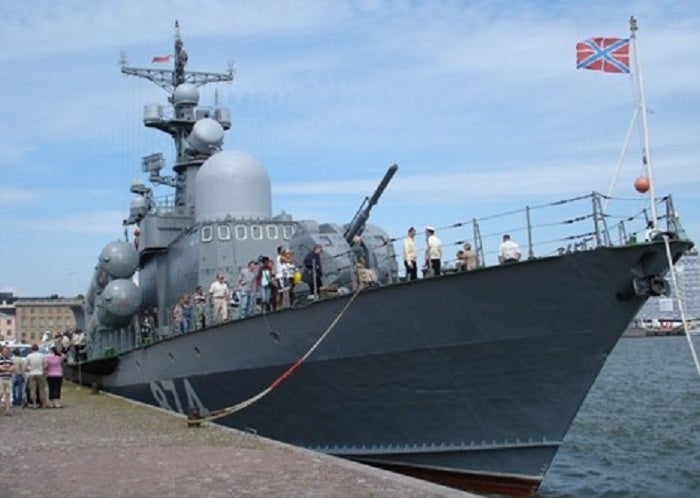
The Ukraine MoD tweet says that the warship was a Russian Tarantul missile corvette – a class of ship that was designed by JSC Almaz Central Marine Design Bureau, based in St Petersburg, Russia, and manufactured by the Russian shipbuilding company Vympel Shipyard JSC.
Designated Project 12418, the Tarantul-class corvette destroys enemy combat vessels, landing craft and enemy naval forces in both littoral waters and open seas. Other missions include patrolling, rescue, anti-piracy, border protection and reconnaissance.
It is armed with one 76 milimetre (mm) AK-176M gun mount at the front and two 30mm AK-630M gun mounts at the rear for protection against sea-based and aerial threats. The vessels also feature 16 Uran-E (Kh-35) shipborne missile systems in launch containers on both sides to engage a variety of sea-based targets.
Ukraine’s use of USVs demonstrates their “glaring power differential”
This is not the first time that the Ukrainian Armed Forces have bested Russia’s naval force.
In 2022, Ukraine’s anti-ship missiles sank Russia’s Black Sea flagship, the Moskva. At the end of last year, Ukraine’s land-attack missiles damaged Russia’s fleet headquarters in Sevastopol and an advanced S-400 air defence system.
Since then, Russian warships have been fleeing occupied Crimea for ports further east, though even those may remain within range of USV attacks, says the RAND Corporation, a US-based global policy think tank.
“The Ukrainian Armed Forces have been forced to adapt their tactics, techniques and procedures.”
Tristan Sauer, GlobalData Defence Analyst.
Although the Ukrainians are bereft of warships, the force has displayed an impressive asymmetric offensive against the Black Sea Fleet.
“Due to the glaring power differential between Ukraine and Russia, the Ukrainian Armed Forces have been forced to adapt their tactics, techniques and procedures in order to maximize the tactical and strategic value of capabilities,” GlobalData Defence Analyst Tristan Sauer observed.
One key factor that continues to impact the growth of the military USV market is the development of vehicular autonomy solutions that utilise advanced technologies such as artificial intelligence (AI), GlobalData intelligence notes.
USV platforms can either be designed as remotely operated vehicles (ROV) or autonomous surface vehicles (ASV) however, there are no tethered remotely operated USV designs as such systems would provide limited practical benefits.
Though communications with remotely operated USVs are not subject to the same technical limitations as submersible platforms, the inherent difficulty in maintaining reliable command and control (C2) capabilities over vessels operating at extended ranges or in the electromagnetic contested and/or congested environments continues to hamper wider adoption.
Consequently, the majority of current USV development programmes focus primarily on ASV development, with investment in related high technology fields such as AI, machine learning, computer vision, and autonomous networking capabilities underpinning global efforts to field these systems.
Due to C2 issues with autonomous USVs, their marked imprecision will provide a cost benefit to their deployment compared to a Russian corvette, which the Ukrainian Government says costs “approximately $60–70m.”



