
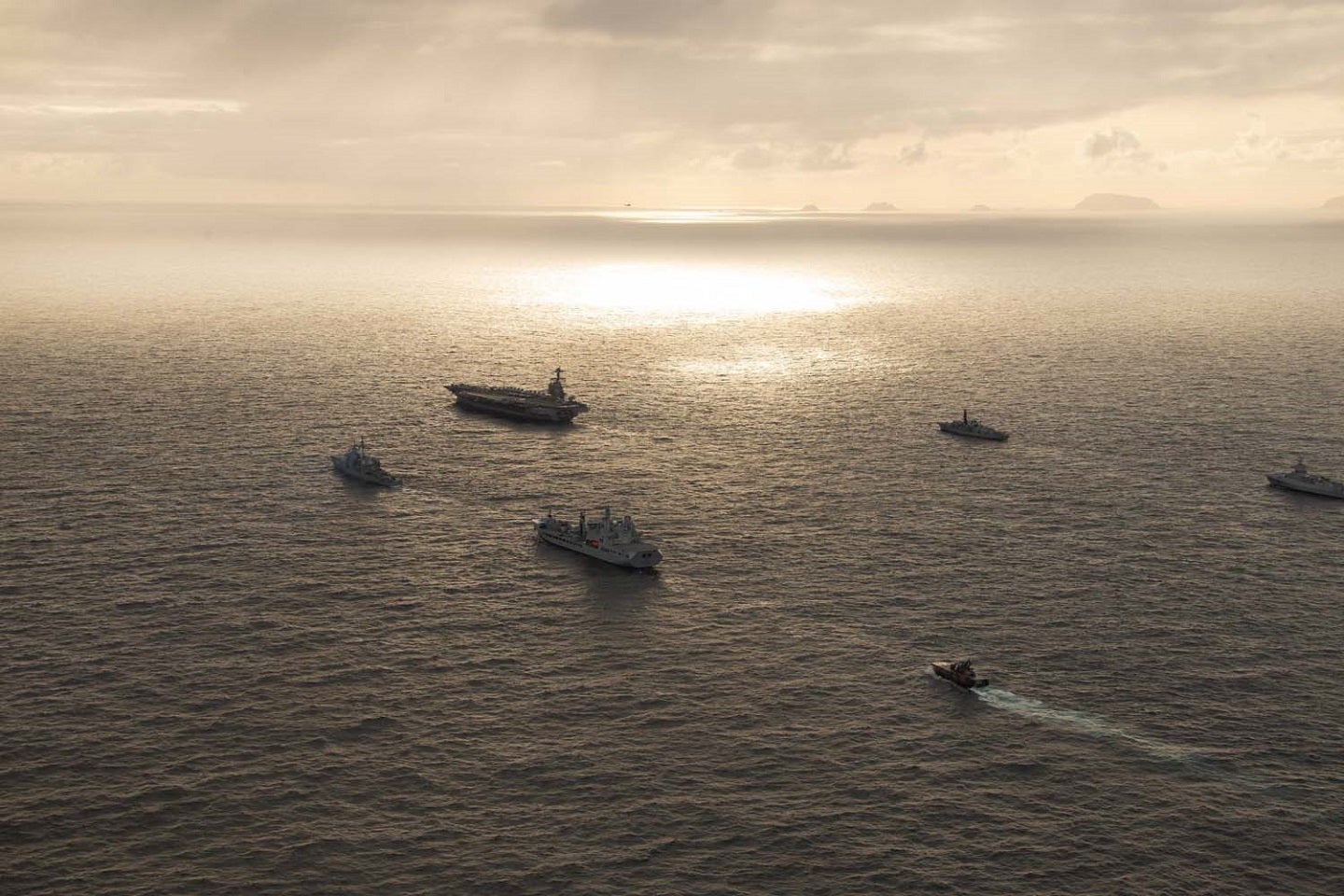
The UK Royal Navy has formed the core elements of a task force charged with protecting the world’s largest warship, the USS Gerald R Ford, in recent exercises north of the Arctic circle.
The Royal Navy’s submarine hunter, HMS Northumberland; Type 45 destroyer, HMS Defender and the tanker, RFA Tideforce, are tested vessels at escorting Britain’s aircraft carriers.
Go deeper with GlobalData


Discover B2B Marketing That Performs
Combine business intelligence and editorial excellence to reach engaged professionals across 36 leading media platforms.
However, they have now teamed up with the US Navy’s Carrier Strike Group 12, whose flagship is the Gerald R Ford. The fleet trained with its Nato partners along a 96-mile long fjord off the north-west coast of Norway, in the High North region.
Together with the Norwegian stealth corvette, HNoMS Steil, Northumberland and Defender posed as ‘enemy’ forces to test the allied task group before switching to protecting the aircraft carrier from anti-ship missile attacks and from air assaults from US Navy F/A-18s.
This followed Exercise Viking Trident, a large air defence exercise that saw the Carrier Strike Group defend against multiple waves of ‘hostile aircraft’: including Norwegian F-35s, US Navy F/A-18s and US Air Force B1-B supersonic bombers.
“This has been an outstanding opportunity to integrate with a US Carrier Strike Group alongside our Norwegian allies and I am incredibly proud of the professionalism and high standards set by the crews of Tideforce, Defender and Northumberland,” Commander Will Edwards-Bannon, Northumberland’s Commanding Officer, stated.
Undersea capabilities
Defender and Northumberland both have anti-submarine warfare capabilities, according to the Royal Navy.
As protective vessels in the Arctic training simulation, how would these capabilities serve to prevent attacks from beneath the surface?
According to GlobalData intelligence, the global underwater warfare systems market was valued at $4.9bn in 2022 and is projected to grow at a compound annual growth rate of 3.41% until 2032.
It is expected to reach $6.8bn by 2032 and cumulatively value $64.9bn over the forecast period. So we can expect there to be substantial innovation in the sector, and therefore a formidable task for the Royal Navy ships. The market consists of six categories: torpedos, naval mine, sonar, torpedo countermeasure systems and decoys, sonobuoys, and uncrewed underwater systems.



