
The UK Ministry of Defence (MoD) announced that it will allocate £5bn ($6.75bn) towards uncrewed autonomous systems and laser weapon systems – split £4bn and £1bn respectively – in this Parliament (the next five years).
This decision comes off the back of the Strategic Defence Review (SDR), published a day earlier on 2 June, which recommends that the department transform the UK Armed Forces with greater use of autonomy.
Go deeper with GlobalData


Discover B2B Marketing That Performs
Combine business intelligence and editorial excellence to reach engaged professionals across 36 leading media platforms.
All of this will be supported by new measures, including the development of a common digital foundation and a protected Defence AI Investment Fund.
Drone capabilities
The SDR recommended that an initial operating capability for a new Defence Uncrewed Systems Centre should be established by February 2026 to accelerate exploitation of small, uncrewed air systems (UAS) across all three military services, helping to deliver them to the front line faster.
The Army in particular will pursue a three-layered operational formation that risks uncrewed systems in disposable and attritable layers while preserving personnel and platforms as a more valuable third layer. The SDR offers a prescribed model:
“A ‘20-40-40’ mix is likely to be necessary: 20% crewed platforms to control 40% ‘reusable’ platforms (such as drones that survive repeated missions), and 40% ‘consumables’ such as rockets, shells, missiles, and ‘one-way effector’ drones.”

US Tariffs are shifting - will you react or anticipate?
Don’t let policy changes catch you off guard. Stay proactive with real-time data and expert analysis.
By GlobalDataLikewise, there is a new, and somehwat unclear, ambition to move the Royal Navy to “a hybrid carrier air wing.” This essentially includes combat aircraft, autonomous collaborative platforms in the air, single-use drones, and, eventually, long-range missiles capable of being fired from the carrier deck.
Laser capabilities
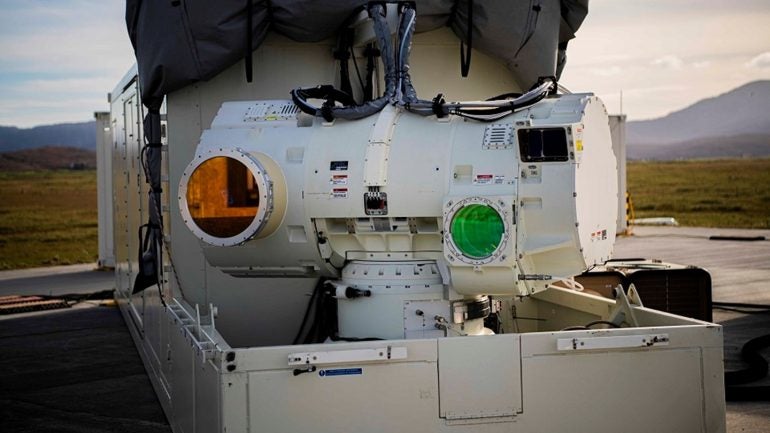
Laser weapon systems such as DragonFire – said to be the first high power laser capability entering service from a European nation – will be fitted onto Royal Navy Type 45 destroyers in 2027.
The new directed-energy weapon (DEW) capabilities will provide low cost and sustainable alternatives to conventional missiles to shoot down targets, such as drones, at the speed of light, reduce collateral damage and have a low-cost per shot, reducing reliance on expensive ammunition.
A new DEW will be created for the British Army in this decade, alongside the Royal Navy’s DragonFire. It will form part of a layered air defence and counter-drone system to better protect UK forces while reducing collateral damage and reducing reliance on expensive ammunition.
This includes different types of DEW systems, including the 15 kilowatt Land Laser DEW system due to be integrated onto Wolfhound armoured vehicles, as well as the radio frequency DEW system that UK technicians designed to counter drone swarms within a particular range.



