
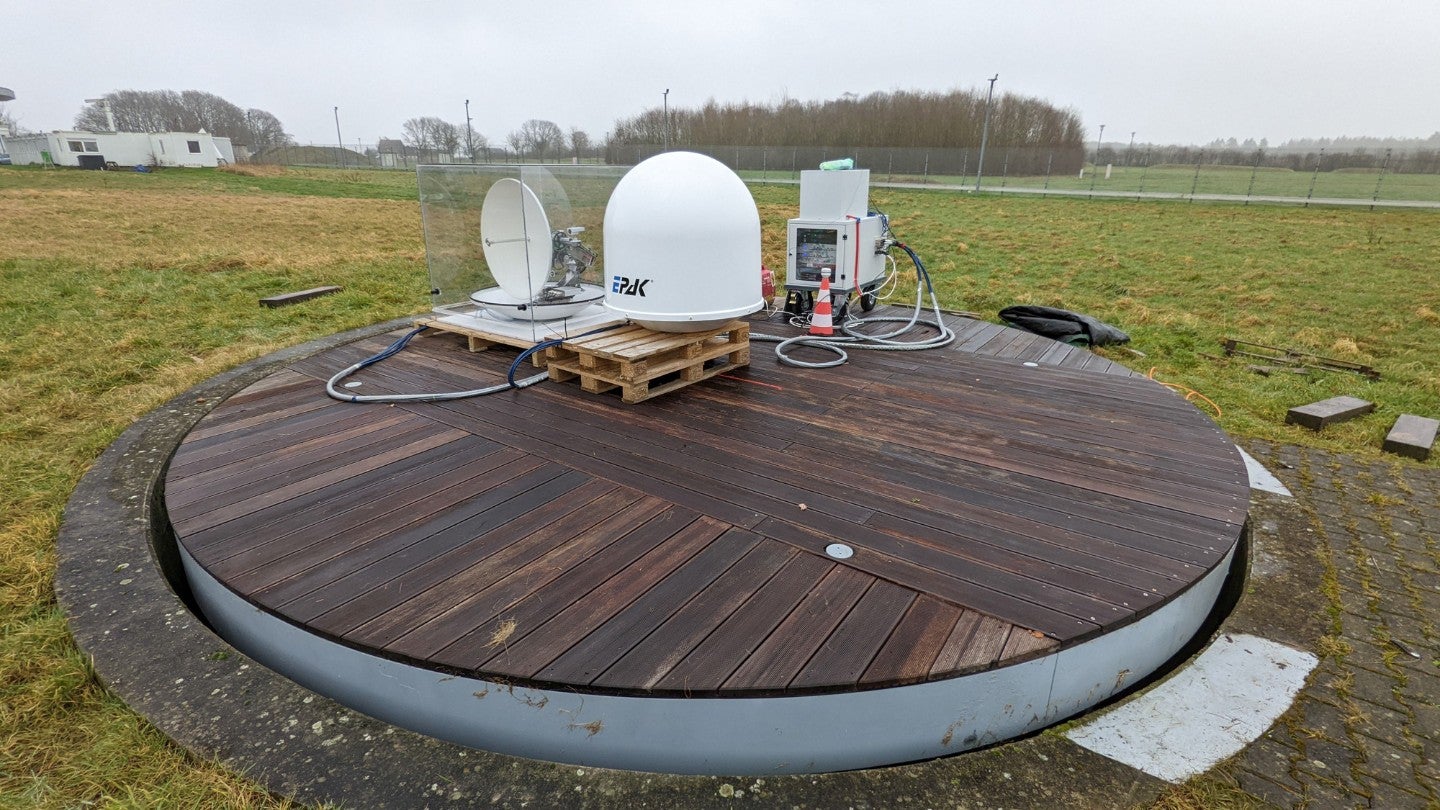
Germany has been investigating a new passive radar system for target detection and imaging using the signal from the Starlink satellite network, with details of a functioning demonstrator appearing in the latest annual report from Germany’s Ministry of Defence on defence technology, published on 15 January 2024.
The opportunistic use of existing transmitters from the Starlink network opens the door for covert operation that is robust against jamming and better at detecting stealth targets, according to the report.

Discover B2B Marketing That Performs
Combine business intelligence and editorial excellence to reach engaged professionals across 36 leading media platforms.
Even by modern standards, Starlink is a massive constellation, consisting of more than 3000 satellites. From an altitude of 550km, the low earth orbit satellites provide global, all weather coverage with a strong bandwidth signal to Starlink’s customers, and also users in Ukraine.
For the purposes of Fraunhofer Institute for High Frequency Physics and Radar Techniques (FHR), designers of the SABBIA 2.0 passive radar system demonstrator, this is an ideal set of circumstances. The large number of Starlink satellites means that objects can be illuminated from multiple directions, bringing to sight objects that might be obscured in practical situations where there is only one transmitter.
The system uses one high-gain reference antenna to track a selected Starlink satellite and copy its signal, and a second surveillance antenna pointed towards an observation area to receive echoes from its target.
By observing the behaviour of the Starlink satellite, the SABBIA 2.0 passive radar system can detect targets without emitting its own radar signal. It can also operate from a moving platform, such as a ship, as it does not emit a signal from its location, and its own movement can be compensated.
As well the energy-saving benefits that come from opportunistically using Starlink radiation to run a passive radar system, the system is difficult to detect by adversaries, and therefore cannot be easily disturbed by interference radiation.
A new prototype from FHR has begun combing the Starlink signal with radiation from geostationary television satellites to generate continuous radar imaging, allowing radar images that can be recorded for remote sensing.


