
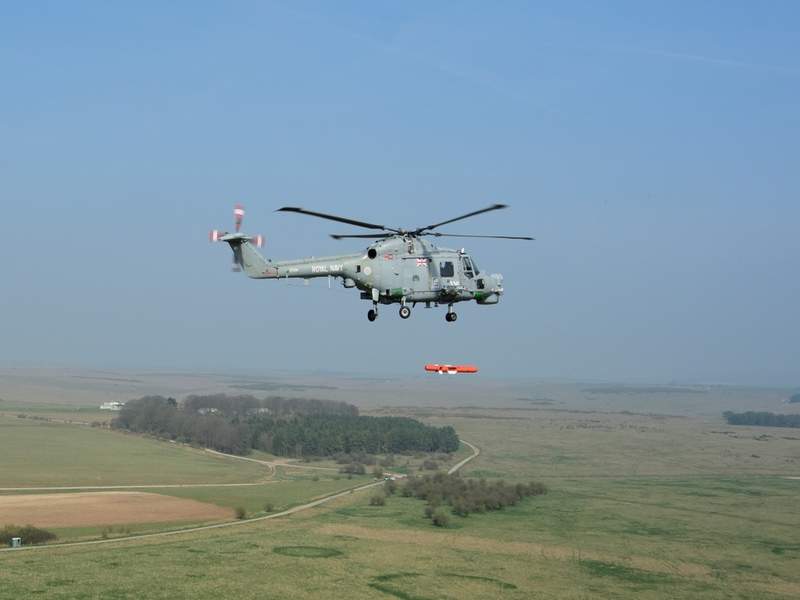

MBDA has successfully conducted air carriage and jettison trials of its advanced Sea Venom / Anti-Navire Léger (ANL) anti-ship missile at the Larkhill Range at Boscombe Down military airport in Amesbury, UK.
A series of air carriage trials were conducted on-board the UK Royal Navy’s Lynx Mk 8 helicopter, before the two Sea Venom / ANL missiles fitted with telemetry kits were successfully jettisoned.

Discover B2B Marketing That Performs
Combine business intelligence and editorial excellence to reach engaged professionals across 36 leading media platforms.
The trials confirmed that the Sea Venom / ANL missile can be integrated onto the Lynx and Super Lynx naval helicopters, which will continue to remain in frontline service and supplied to customers worldwide.
The tests have resulted in the de-risking of the 100kg-class anti-ship missile's integration process on both the Lynx and Super Lynx helicopters for the export market.
MBDA conducted the Sea Venom / ANL anti-ship missile trials in collaboration with the Royal Navy, the UK Defence Solutions Centre (DSC) and British defence technology company QinetiQ under the Defence Growth Partnership (DGP) initiative.
The Sea Venom missile was first designed as part of a collaboration between the UK and France to jointly develop missile technologies.
The Anglo-French lightweight anti-ship missile has been designed to provide an improved capability, and replace the existing and legacy systems such as the Sea Skua lightweight short-range air-to-surface missile (ASM) developed in the UK, as well as France's the AS15TT anti-ship missile.
Sea Venom is planned to be used from the AW159 Wildcat helicopter in the UK, while the French defence procurement agency (DGA) Direction générale de l’armement is currently carrying out a development flight campaign for the anti-ship missile on a Panther testbed helicopter.
The Sea Venom missile has been specifically designed to destroy a variety of vessels from safe stand-off ranges, from fast inshore attack craft (FIAC), through medium-sized fast attack craft (FAC) up to large vessels.
Image: Sea Venom / ANL anti-ship missile trials on UK Royal Navy’s Lynx Mk 8 helicopter. Photo: courtesy of MBDA.


