
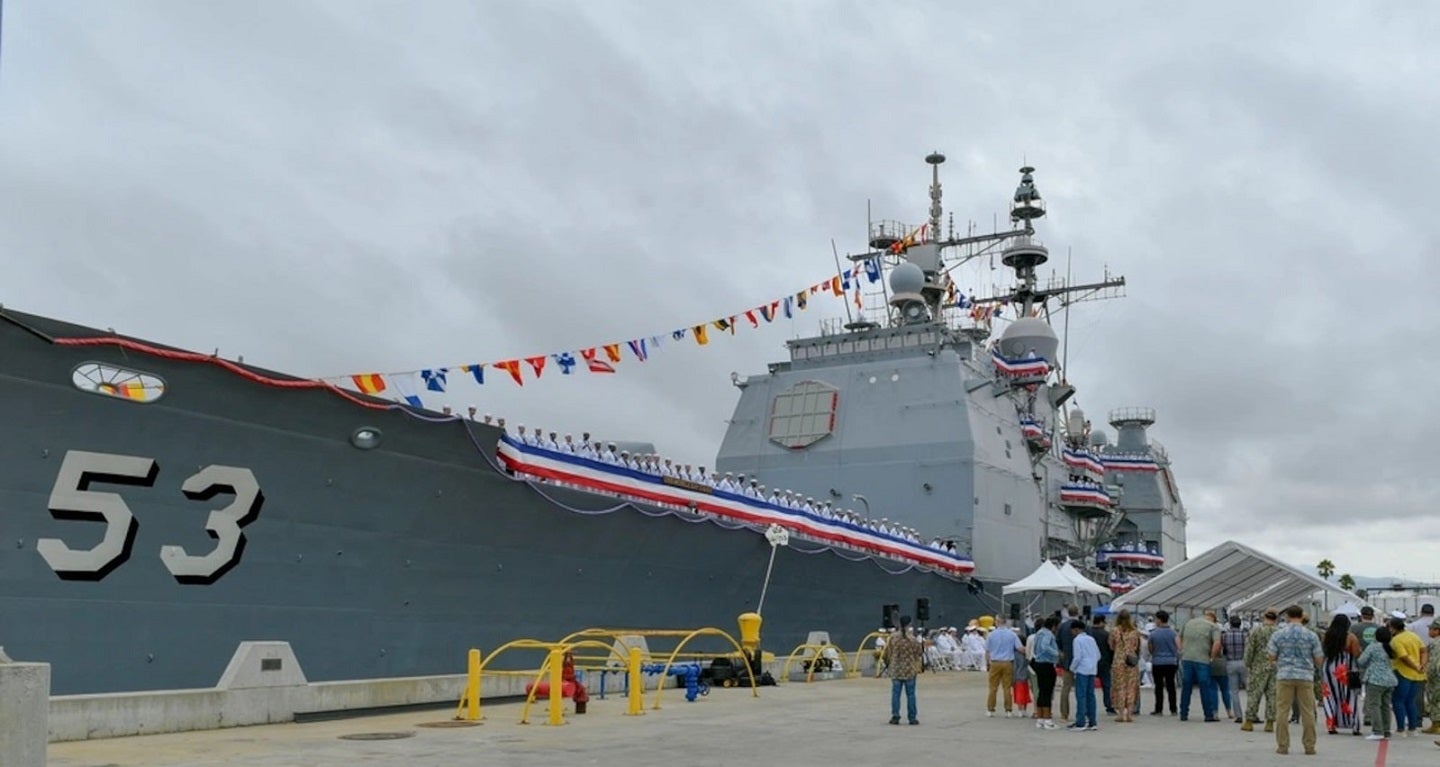
The US Navy cruiser, USS Mobile Bay (CG 53),has decommissioned at Naval Base San Diego on 10 August 2023 after more than three decades of naval service.
Ingalls Shipbuilding in Pascagoula, Mississippi built the Mobile Bay from 1982, and the US Navy commissioned the vessel on 21 February 1987, at Alabama State Docks in Mobile. The vessel was the first named after the American Civil War battle at Mobile Bay, honouring the Union naval victory in August 1864.
Go deeper with GlobalData


Discover B2B Marketing That Performs
Combine business intelligence and editorial excellence to reach engaged professionals across 36 leading media platforms.
The cruiser’s history includes the 1989 evacuation of the US Embassy in Beirut, Lebanon; launching 22 Tomahawk Land Attack Missiles (TLAMs) during Operation Desert Storm; US Coast Guard Law Enforcement Detachment seizure of 10.5 metric tons of cocaine approximately 800 miles southwest of Acapulco, Mexico; and launching TLAMs in support of Operation Iraqi Freedom in 2003.
Maintaining a superior force structure on the world stage
At the ceremony Vice Admiral Roy Kitchener, Commander of the Naval Surface Forces, acted as the ceremony guest speaker. “The Sailors of USS Mobile Bay demonstrated time and time again the resolve and readiness the Surface Force provides around the clock in support of our nation’s interests,” Kitchener stated.
However, the cruiser’s operational history comes to an end at a time when the US Navy is losing the advantage as the service struggles to outmatch the swelling force structure of China’s People’s Liberation Army Navy (PLAN).
The Surface Fleet Force’s recent decision, on 4 August, to extend the life of four existing Arleigh Burke-class destroyers (DDG 51) indicates the navy’s strained attempt to maintain its ‘around the clock readiness’; particularly in the Indo-Pacific where the PLAN infringes in sovereign territory.
While Rear Admiral Fred Pyle, Director of Surface Warfare, said that the move to extend the life of these ships strengthens America’s force size, it is rather a move to buy time before nine new DDG 51s, among other ships, are inducted into the navy during the first half of the next decade.
The navy will be inactivate the ship and tow it to the Inactive Ship’s facility in Bremerton, Washington where it will be in a Logistic Support Asset status.
This means that “inactive vessels designated as retention assets form a reserve of sea power available for future reactivation,” according to the navy’s general policy report on inactive ships.
“It is the navy’s objective to maintain retention assets in a fixed state of preservation consistent with available funds. It is further the navy’s objective to maintain all inactive vessels, whether for retention or pending disposal,” the report states.
While this policy may be a matter of general protocol for decommissioned ships, given the navy’s relative force structure it would be fair to say that the Mobile Bay has not exhausted its usefulness just yet.


