
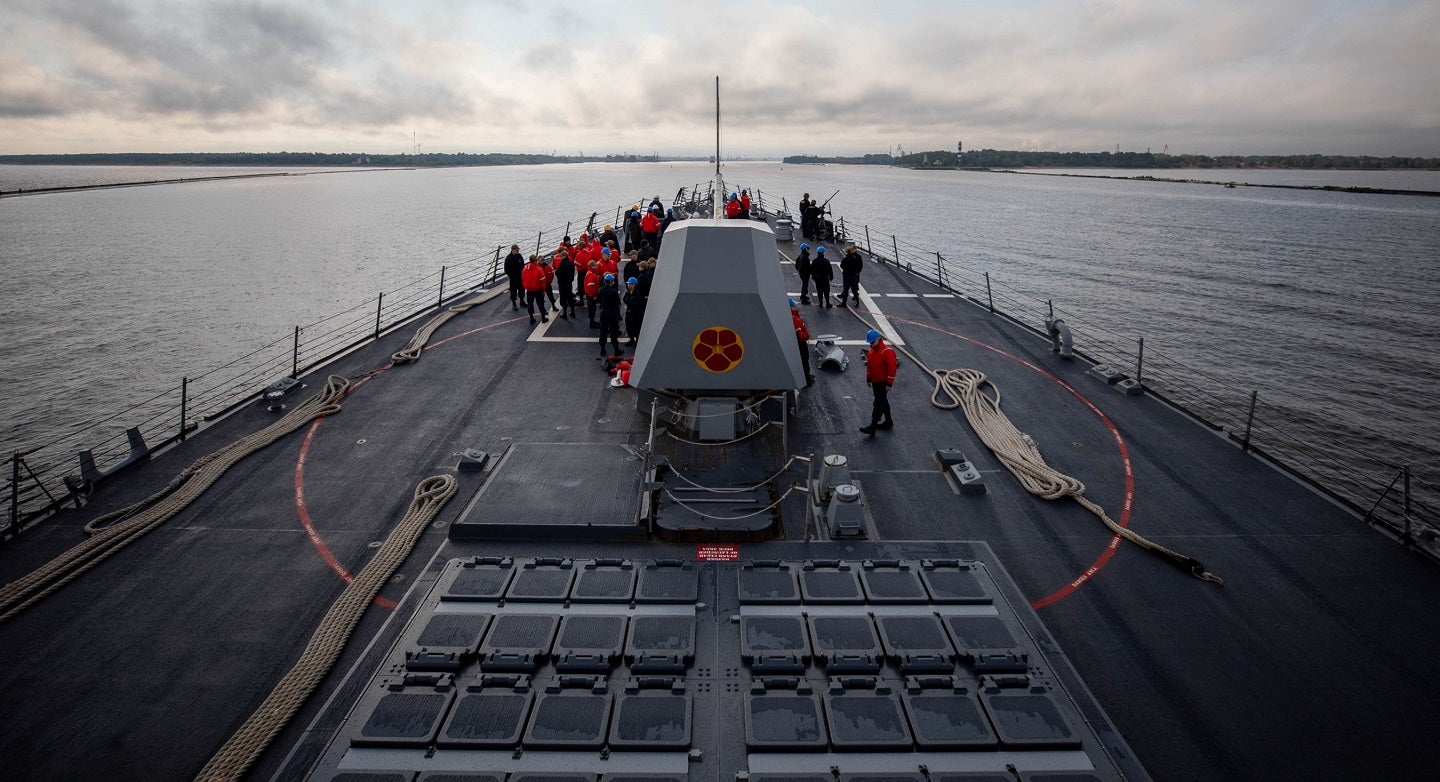
A US Navy flight IIA Arleigh Burke-class destroyer, the USS Roosevelt (DDG 80), arrived in Riga, Latvia on 6 August as part of its fifth Forward Deployment to Europe.
Roosevelt has been operating in the Baltic Sea since early July, participating in various allied exercises during that time, including Neptune Strike 23-2, Standing Nato Maritime Group One operations, and a Naval Surface Fire Support live fire exercise off the coast of Latvia.
Go deeper with GlobalData


Discover B2B Marketing That Performs
Combine business intelligence and editorial excellence to reach engaged professionals across 36 leading media platforms.
“Latvia hosted Roosevelt several weeks ago for a live fire gunnery exercise, where we shot our 5-inch gun onto the Latvian range while in [their] territorial waters. This proved yet another critical capability between two Nato partners, while strengthening our alliance,” Jeffrey Chewning, Roosevelt’s commanding officer, stated
While at port Riga, the crew will replenish their stores and fuels and host dignitaries from the Latvian government and US Ambassador, demonstrating the strength of the countries’ partnership.
“Over our last several patrols, Roosevelt has visited nearly every one of our Nato allies in the Baltic, but we have yet to see Latvia,” said Lieutenant Junior Grade Maryrose Stone.
The vessel forward-deployed to Rota, Spain, beginning its fifth Forward Deployed Naval Forces – Europe patrol on 27 June, employed by US Sixth Fleet to defend US, allied and partner interests.
Northern and eastern European force deployment
The US Navy continues to help secure Nato’s northern and eastern flanks, projecting the renewed strength of the military alliance against Russia in the wake of the war in Ukraine.
The Baltic falls under Nato’s eastern flank, directly bordering Russia. Baltic countries such as Latvia, Lithuania and Estonia have a limited military capacity and must operate as part of a joint Nato alliance. Their small economies do not have the capacity to meet the new demands of defence alone.
GlobalData forecast Latvia’s defence budget to grow to just shy of $1bn by 2027, up from $0.9bn in 2022. While the growth in the historic period amounted to a compound annual growth rate (CAGR) of 7.1%, and the projected spending in the forecast period will produce a CAGR of 2.4%, the amount is not enough to project an appropriate level of deterrence alone amid this intense geopolitical environment.
Only recently has Lithuania expressed intent to acquire main battle tanks for the first time. The Baltic nation selected the Leopard 2 largely because of its interoperability and support of the spares, equipment and maintenance of provided by many of its western European neighbours that operate the Leopard.
Similarly, Nato Air Forces have operated with an iterative deployment of F-35 sorties in Estonian airspace, and since May, this included its Baltic neighbours.
Likewise, since Finland and Sweden joined Nato, the US Navy announced it has deployed the USS Mesa Verde, a San Antonio-class amphibious transport dock, to Narvik in north-west Norway on the 5 August.


