

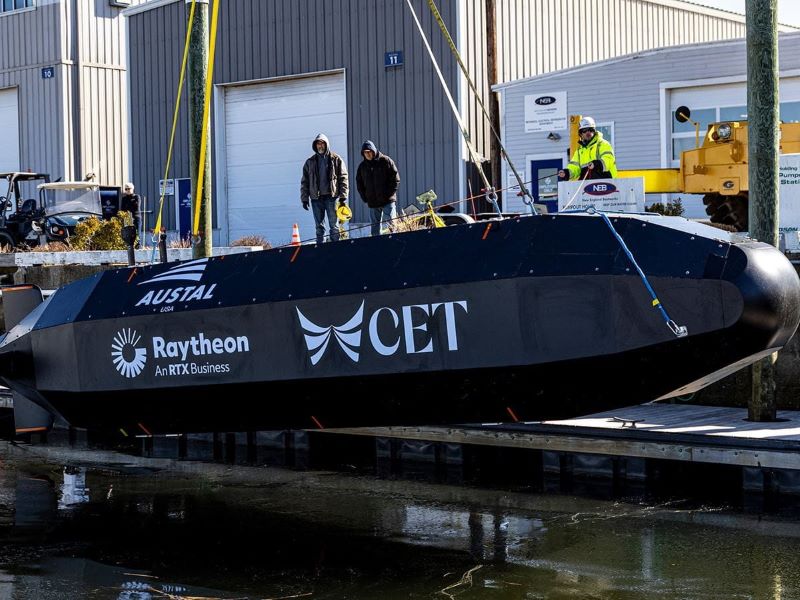
HADALUS is a low-cost, autonomous underwater vehicle (AUV) jointly developed by Composite Energy Technologies (CET) and Raytheon.
Designed for contested logistics, the platform draws on autonomy and software packages created by the US Navy and made available for industrial use.
Recommended White Papers
Recommended Buyers Guides
The HADALUS programme progressed from concept to a sea-demonstrated prototype in less than 18 months. Funding from both companies supported vehicle design and build, integration of the launcher, sonar and electronics, plus pre-exercise system testing.
In December 2025, CTE was chosen to take part in the Nato Defence Innovation Accelerator for the North Atlantic (DIANA) 2026 Challenge Programme cohort. Under the DIANA initiative, CET will provide a HADALUS AUV for assembly and testing in Europe.
The work will focus on proving rapid deployment and long-range performance, alongside an Anti-Submarine Warfare mission package that is already in service on crewed platforms. The programme is also expected to support the company’s plans to expand its European presence, including local assembly, as it pursues wider uptake among Nato and allied customers.
HADALUS platform design and features
HADALUS measures 34ft (10.3m) in length with a cross-section of 6ft. It offers up to 3,000 nautical miles (5,556km) of endurance and has an operational depth of more than 3,000m.
The AUV uses a free-flooded, all-carbon-fibre exoskeleton intended to provide high strength and payload capacity. It incorporates a patented composite design positioned as a lower-cost alternative to conventional metal-framed vehicles, with costs reduced to around one-fifth.
The composite structure reduces wet and dry weight to increase payload capacity and extend operating range, while also supporting shorter production lead times, improved corrosion resistance and enhanced stealth through greater acoustic transparency.
Payload configuration is designed to be adaptable through straight, interchangeable hull sections that can be swapped to change capacity, including adding payload volume or extra batteries.
HADALUS-XL AUV details
Unveiled in February 2025, HADALUS-XL is the largest platform in the HADALUS family of flat-pack AUVs.
HADALUS-XL was introduced at BlueTIDE 2025, a maritime innovation demonstration held in August 2025 in Rhode Island, US, by 401 Tech Bridge with the US Navy and other partners, which included a traditional christening ceremony.
The platform can carry up to 6,000lb (2,721kg) of mission payload over 2,000 nautical miles (nm). It can also swap mission payload for low-cost subsea batteries to extend range to 3,000nm with more than 60 days loiter.
The AUV is designed for contested logistics and can be transported in standard containers and assembled at the deployment location, supporting rapid deployment with extra-large endurance and increased payload capacity.
CET plans to manufacture the HADALUS range at its Rhode Island facility, which has the capacity to produce up to 360 extra-large AUVs per year.
HADALUS AUV demonstrations
In July 2025, CET and Raytheon completed a live in-water demonstration in Narragansett Bay, Rhode Island. The vehicle carried out autonomous mission profiles under operational conditions while a support vessel monitored performance.
In August 2026, the two companies ran a demonstration focused on HADALUS undersea launch performance during a US Navy exercise. The vehicle conducted multiple at-sea missions on a Navy undersea test range and demonstrated that it could be launched while remaining submerged.
The exercise marked the first time the US Navy had observed this integrated capability operating in the water, pointing to the potential for a single unmanned platform to undertake detection, reacquisition and engagement tasks within one mission.
Mission capabilities
HADALUS is intended for contested logistics, supporting supply lines where traditional options are assessed as too risky. It can be configured to transport fuel; ammunition; meal, ready-to-eat; and medical supplies, with an emphasis on low observability and delivery accuracy.
The system is designed to ship in standard containers and be assembled without specialist equipment, using low-skilled labour. It can carry tonnes of payload while remaining stealthy for up to 2,000nm. After deployment, it can push onto a beach to unload up to four pallets of cargo, then retrieve its anchor and submerge again.
Flat Pack design details
CET developed a modular AUV configuration called Flat Pack, which is patent pending and intended to allow multiple AUVs to be transported in a single 20ft container.
The concept aims to ease logistics by enabling several vehicles to be shipped together, assembled on-site using low-skilled labour and deployed in larger numbers from shore without support vessels. The approach allows up to three HADALUS-XL to be loaded into a 20ft cargo container or the same number to be carried in a C-17 aircraft.
