

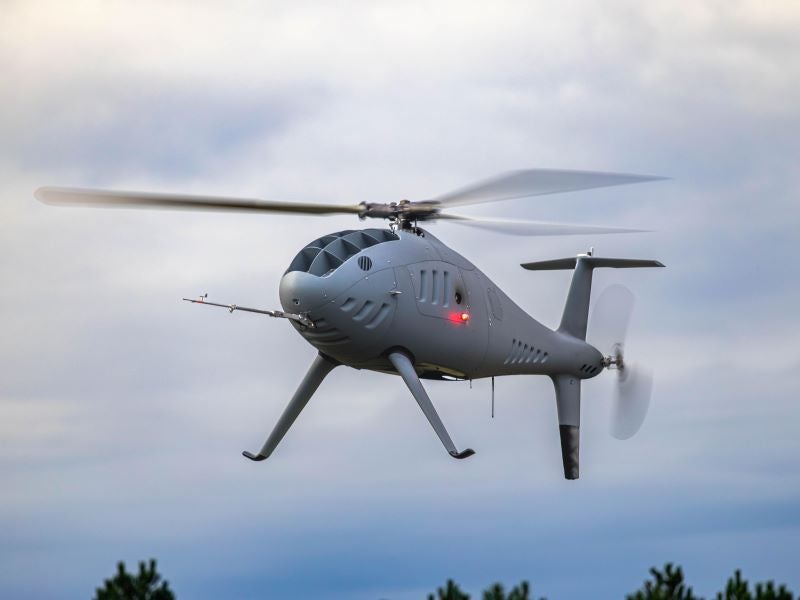
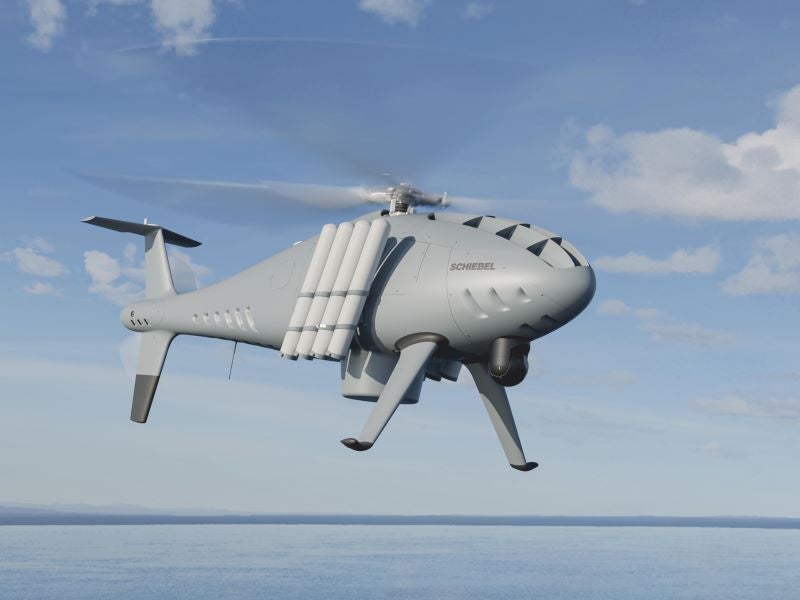
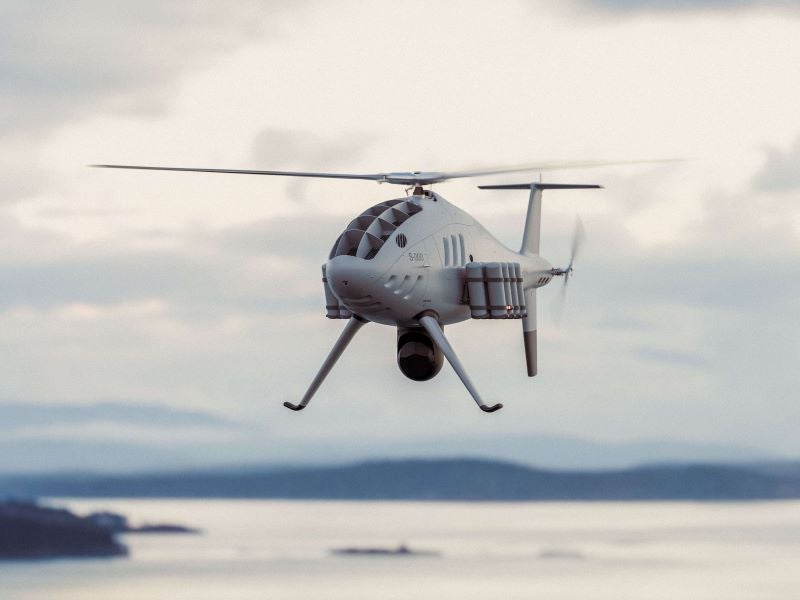
The CAMCOPTER® S-300 is a heavy-lift unmanned air system (UAS) being developed by Schiebel, an Austrian-based developer of mine detection equipment and unmanned helicopter platforms.
The vertical take-off and landing (VTOL) system is designed to provide live intelligence and enhanced situational awareness in demanding operational theatres. It brings together extended endurance, substantial payload capability and adaptable mission performance in one platform, making it well-suited to operate from ships as well as from remote, minimally supported land sites.
Recommended Buyers Guides
The platform is currently taking part in a wide-ranging flight test programme. Early findings have validated the aircraft’s capability, handling and operational flexibility, representing important steps towards achieving in-service readiness.
CAMCOPTER development details
Schiebel first detailed the development of the CAMCOPTER S-300 at the Euronaval 2022 exhibition held in October 2022 in France.
The company subsequently unveiled the initial design details of the platform at the Paris Air Show in June 2023. Schiebel partnered with Pietro Rosa TBM, a compressor airfoils and mission-critical components manufacturer, for the S-300’s rotor head forging blanks.
In January 2025, the CAMCOPTER S-300 was designated as the dedicated UAS for the Seabed and Anti-Submarine Warfare Capability through Unmanned Feature for Europe (SEACURE) consortium, following a grant agreement signed by Schiebel, under a European Defence Fund (EDF) call addressing unmanned systems for anti-submarine and seabed warfare.
The SEACURE consortium brings together 35 companies across 13 European nations.
Led by Thales, the programme’s objective is to strengthen collaborative anti-submarine and seabed warfare capabilities by employing unmanned aerial, surface and sub-surface platforms to safeguard vital maritime infrastructure. The SEACURE programme is expected to conclude with an extensive at-sea trial in 2028.
In December 2025, Schiebel concluded the first CAMCOPTER S-300 flight test campaign at the CESA Drones site in Sainte-Helene near Bordeaux, France.
Conducted in a military environment, the trials examined key flying qualities and overall system performance. During the sorties, the aircraft demonstrated stable handling while completing standard assessments covering handling qualities, flight control responsiveness and general air vehicle behaviour.
In June 2026, the CAMCOPTER S-300 was selected as the airborne element for the EDF’s Stand-off anti-submarine Warfare Operations by Remote Deployment (SWORD) project.
The SWORD project is exploring stand-off anti-submarine warfare operations using remote deployment. It is being delivered by a consortium comprising prominent European defence and technology companies and is led by TKMS ATLAS ELEKTRONIK.
CAMCOPTER S-300 design and features
The CAMCOPTER S-300 is derived from Schiebel’s experience with the CAMCOPTER® S-100, a maritime unmanned helicopter that has accumulated several hundred thousand flight hours globally.
The S-300 measures 4.85m (16ft) in length and 1.89m in height, with a fuselage width of 0.9m and a landing gear span of 1.72m. It has a main rotor with a diameter of 5.3m.
The platform has a maximum take-off weight of 700kg (1,545lb), an empty weight of around 320kg and a total payload capacity including fuel of 350kg.
The aircraft does not require launch or recovery equipment, supporting operations in confined areas and shipboard hangars.
A triple-blade folding rotor design enables two CAMCOPTERS-300 UAVs and one ground control station (GCS) to be transported in a standard 20ft container.
The CAMCOPTERS-300 is designed to be operated using the same GCS as the CAMCOPTER S-100, maintaining commonality for users transitioning between the two systems and limiting the need for additional operator training.
The platform’s data link supports a range of up to 200km, or around 108 nautical miles, subject to the available configuration.
Payload details
For maritime missions, the platform can be equipped with a multi-mode surveillance radar offering second-generation active electronically scanned array surveillance performance comparable to radars used on crewed rotary-wing aircraft. It can also carry sonar equipment and additional sensors.
Payload carriage is distributed across multiple bays, with the nose bay supporting up to 50kg, each side bay up to 80kg, the main bay up to 250kg and the auxiliary bay up to 50kg.
Electrical power provision is rated at 3,000W at 28V-direct current for payloads.
Propulsion and performance
The CAMCOPTER S-300 uses a heavy-fuel aviation engine compliant with the Nato single fuel policy and can operate on Jet A 1, JP 8 and JP 5. The internal fuel tank can hold up to 300 litres.
The UAS has a maximum airspeed of 120 knots (220km/h) indicated airspeed (IAS), a dash speed of 100 knots IAS and a cruise speed of 55 knots for maximum endurance. Under intelligence support activity conditions and at reduced gross weight, the service ceiling is 6,400m.
Endurance can be extended to up to 24 hours with a 50kg payload, while a 250kg payload typically reduces endurance to around six hours.
The airframe is rated to +3.5g and -1.0g and is designed to operate between -40°C and +55°C.
CAMCOPTER S-300 mission capabilities
The CAMCOPTER S-300 is positioned for anti-submarine warfare roles, while combining endurance with higher payload margins.
It can also support search and rescue missions through extended on-station time and real-time imagery, with the option to carry rescue stores internally or as an underslung load.
For cargo delivery, it is intended to move supplies to locations that are difficult or unsafe for crewed aircraft, using autonomous operation to support logistics.
Orders and deliveries
In February 2024, Schiebel and South Korea-based Hanwha Systems and UI Helicopter secured a Defence Acquisition Programme Administration contract to develop and supply the CAMCOPTER S-300 for the South Korean Ministry of Defence.ce.
