

- Protecting critical national infrastructure appears to be the predominant issue occupying concern at UDT 2026 in London
- The show floor is dominated by autonomy and ISR systems gearered toward enabling multi-mission UUVs
- Explore Greyshark, Herne, an sensory subsea cable and a cohesive DEEP underwater concept
It comes as no surprise that the Undersea Defence Technology (UDT) exhibition this year is dominated by autonomy and intelligence, surveillance and reconnaissance (ISR) systems, all of which are geared toward equipping uncrewed underwatrer vehicles (UUVs) of all kinds.
This correlates with market intelligence from GlobalData, which suggests the UUV segment is projected to make up more than 40% of the global uncrewed maritime vehicles market.
Go deeper with GlobalData


Discover B2B Marketing That Performs
Combine business intelligence and editorial excellence to reach engaged professionals across 36 leading media platforms.
Likewise, the UK and Northern Europe are struggling to maintain control of their waters in the North Atlantic and Baltic areas with minimal deterrence in the face of encroaching Russian naval assets. The British Government lately intimated that the Royal Navy could only shadow adversary submarines operating over subsea cables over the course of a month.
It remains uncertain whether the UK and Norway were able to prevent Russia’s accumulation of subsea data.
While protecting critical national infrastructure (CNI) may be the predominant issue occupying concern at UDT, there are other underwater systems which attracted attention too which are similarly worth exploring.
Greyshark AUV
One prominent system on display is the Greyshark autonomous underwater vehicle (AUV) developed in close collaboration among German suppliers: EUROATLAS, EvoLogics and Fassmer.
The Foxtrot variant of the platform is a long endurance vehicle, powered by hydrogen fuel cells – in contrast to the Bravo version, which is a battery-powered short-range system – can reach 8,000 nautical miles at four knots over a period of 16 weeks.
The AUV can currently reach a depth of 650 metres with plans ongoing to extend this further to 4,000.
Using a segmented ring rotor propeller, Greyshark allows for extreme vertical dive angles and a short turning radius. This electric propulsion unit ensures the platform has a reduced signature with minimal water disturbance, making it difficult to detect.
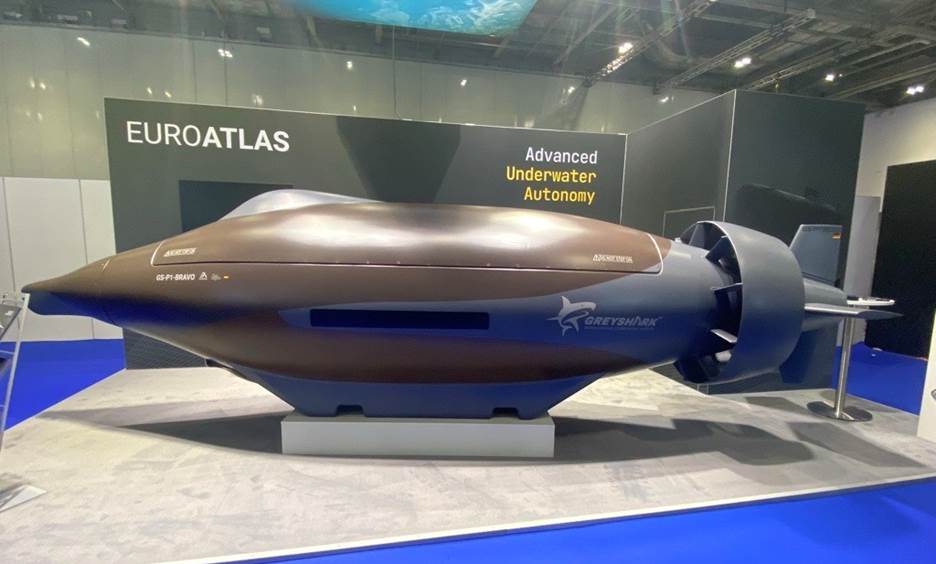
Although Greyshark is multi-purpose, the AUV is currently marketed for pipeline protection, port security or covert reconnaissance.
The platform utilises an integrated artificial intelligence (AI) module that provides real-time onboard automatic target recognition and collision avoidance information. It also enables interaction within a swarm to share situational awareness.
Having scanned an area, the swarm can split tasks among units and perform different roles.
Herne XLAUV
At the BAE Systems stand, the global defence prime displayed its Herne extra large autonomous underwater vehicle (XLAUV).
While the platform is designed by the prime another partner company, Cellula Robotics, is currently building the system in Canada. The duo signed a signed a ten-year strategic partnership agreement in September 2025 to develop and deliver Herne sometime this year.
The vehicle combines BAE Systems’ Nautomate autonomous control system with Cellula’s expertise in subsea engineering and the 12-metre Solus-XR modular hull.
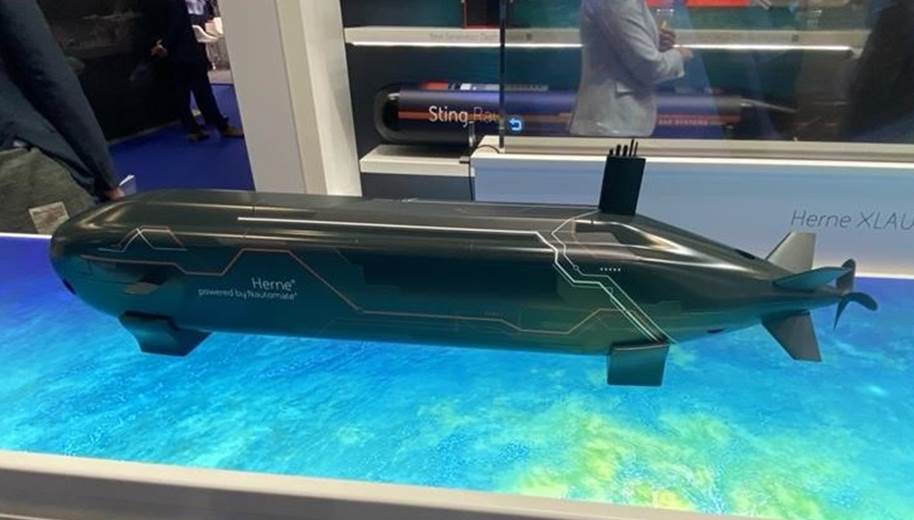
It is understood that the platform is also on track to become the first platform of its kind to be certified by the Lloyd’s Register in line with its Unmanned Marine Systems Code.
The Herne is powered by electrical propulsion and the platform can fit into a 40 foot ISO standard container. It can reach up to 5,000 kilometres (or more than 4,300 miles) for 45 days at a time with the ability to reach 5,000 metre depth.
Subsea inline cable
SubConnect, a subsidiary of the Global Marine Group, displayed its inline deployed cable networked interface gateway at the event.
This particular subsea cable, tasked with transferring telecommunications using fibre optic cables, also functions as a shore to shore sensory node.
Instead of fixing sensors to CNI after manufacturing the pipeline, SubConnect has made the sensor monitoring part of its design from the outset.
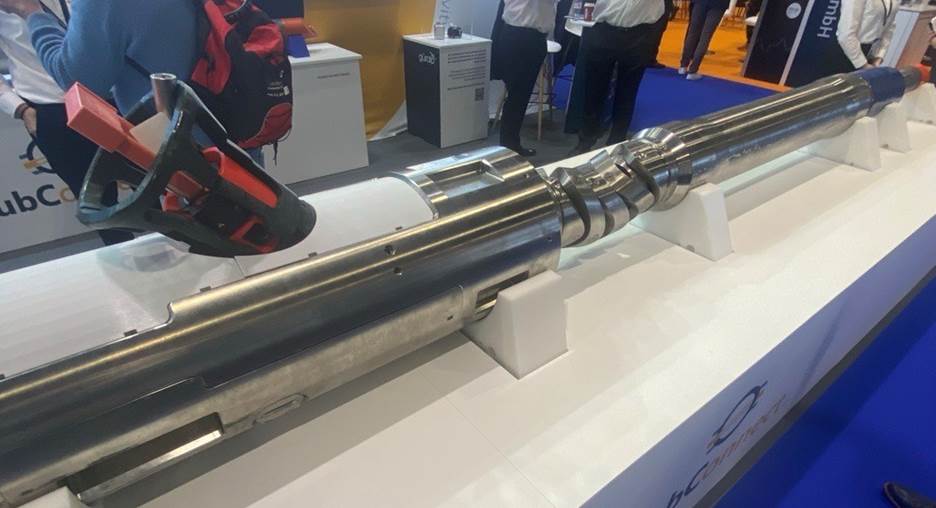
This dual-use capability, besides monitoring environmental and seismic data on the sea floor, can also be applied to the global defence industry insofar as it detects adversarial naval platforms or tampering with the infrastructure.
The system also uses a wet mate connector (the red unit protruding from the pipeline above). This feature allows remotely operated vehicles (ROV) to plug into the port to enable the ROV to swap out sensor pods or add new defence ISR tools to the network.
X500 AUV
Meanwhile, Italy’s leading naval systems supplier Fincantieri displayed the X500 AUV system.
The vehicle is the centrepiece of the company’s Dynamic Ecosystem for Enhanced Performance (DEEP) concept, conceived toward the end of 2025, and constitutes a modular, scalable, and cyber-secure “system of systems” designed for the protection and in-service maintenance of critical underwater infrastructures.
X500, developed in collaboration with another italian compant, Graal Tech, serves as the centrepiece of this undersea C4ISR network, which also includes an acoustic early warning system, the command and control software and AI-based analysis and recognition systems.
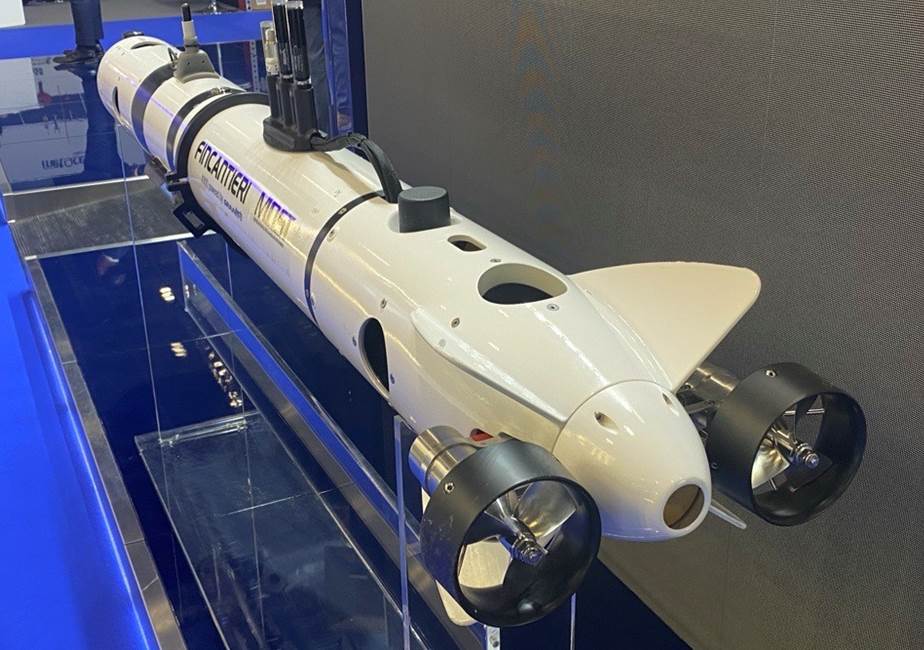
The X500 follows the success of the its smaller sister, the X300 model, with the main difference being the depth the two systems can reach in metres, as their names suggest.
It is understood that Qatar intends to purchase the AUVs alongside Fincantieri’s Surface Advanced Naval Drone, an uncrewed surface vessel developed by the subsidiary IDS.
SAND is designed to act as a mothership or communications relay for the X500 AUV, carrying launch a recovery systems for the underwater drones.


