

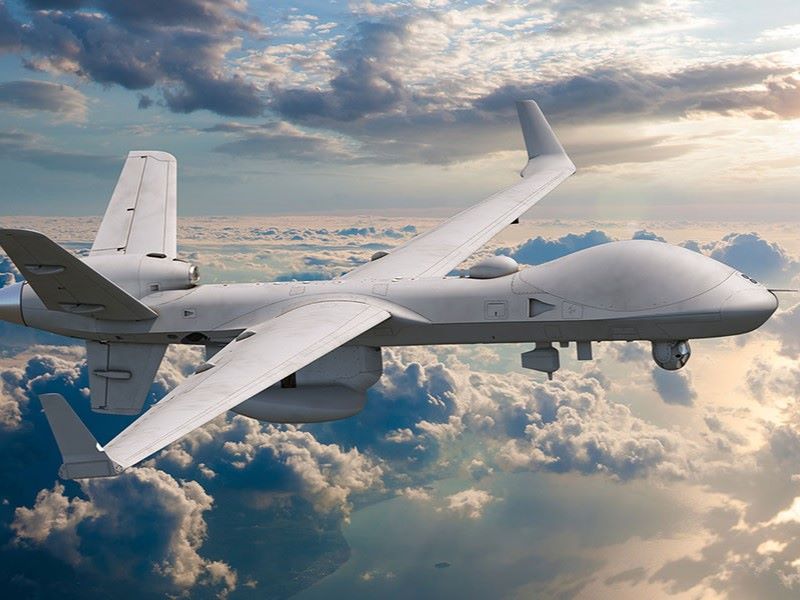
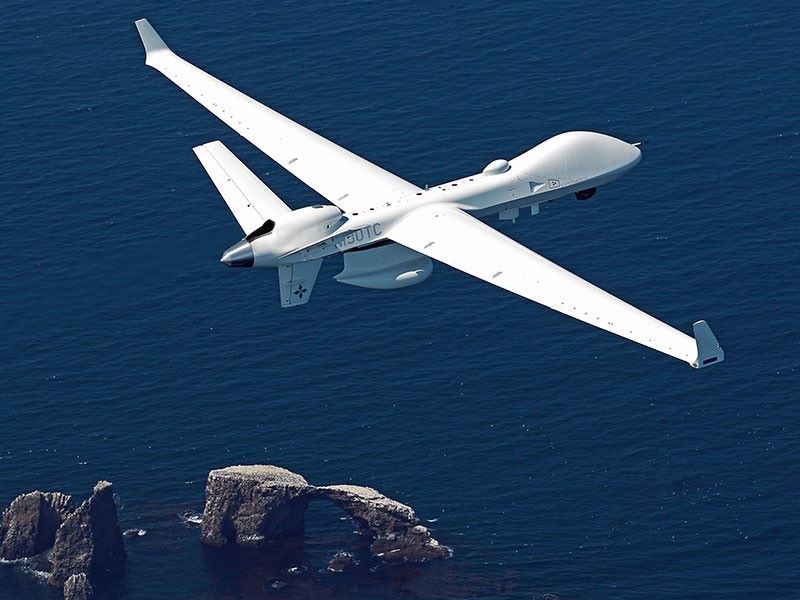
The MQ-9B SeaGuardian is a maritime-specific, remotely piloted aircraft system developed by General Atomics Aeronautical Systems (GA-ASI).
It is intended to operate in a wide range of weather conditions and to integrate safely into civil airspace, supporting military users and civilian agencies with continuous maritime situational awareness.
Recommended White Papers

Recommended Buyers Guides

The unmanned aircraft can perform search and rescue, law enforcement, anti-surface and anti-submarine warfare (ASW), airborne mine countermeasures, and detect and deter operations.
The MQ-9B SeaGuardian is designed specifically to meet the needs of the US Navy and Marine Corps, as well as allied and partner forces worldwide, in countering peer and near-peer adversaries.
The wider MQ-9B family includes the SkyGuardian and SeaGuardian, as well as the Protector RG Mk1.
MQ-9B SeaGuardian development background
In September 2020, General Atomics completed the first maritime test flights over shipping routes off southern California, using a SeaGuardian configured for open-water surveillance to assess performance in a maritime operating environment.
In January 2021, General Atomics and Leonardo integrated the Seaspray 7500E V2 radar into the centreline radar pod of the aircraft, using an active electronically scanned array to detect, track and classify maritime contacts, and incorporated an Open Mission Systems approach to support interoperability and future upgrades.
The UK Civil Aviation Authority approved a point-to-point domestic flight of the SeaGuardian uncrewed aircraft using the UK airways structure for the first time in September 2021.
General Atomics flew an MQ-9B SeaGuardian from Royal Air Force (RAF) Waddington to RAF Lossiemouth with air traffic services provided by NATS, the UK’s civil air navigation service provider.
In May 2022, the company launched work on a short take-off and landing variant for the MQ-9B line, covering the SkyGuardian and SeaGuardian versions. The addition was based on an optional wing and tail kit intended to be installed quickly without altering the main airframe or its subsystems.
In June 2024, the company and Lockheed Martin began work to add Net-Enabled Weapons capability to the aircraft, aimed at enhancing intelligence, surveillance, reconnaissance and targeting.
General Atomics demonstrated an anti-submarine warfare configuration for SeaGuardian in February 2025, using multiple pre-production Sonobuoy Dispensing System (SDS) pods to deploy and assess ASW sensors.
In April 2025, General Atomics, during a ground test, presented new software intended to provide in-flight target updates that enable the aircraft to improve maritime tracking and demonstrated the ability to pass sensor data to a missile using Link 16 messages.
In January 2026, General Atomics and the US Navy conducted a flight test of the SDS using more dispensing pods than in previous trials, increasing the number of sonobuoys carried. The test was aimed at enhancing the ASW capability of the SeaGuardian.
The aircraft released AN/SSQ-36 Bathythermal, AN/SSQ-53G DIFAR passive and AN/SSQ-62F DICASS active sonobuoys, the first release of multi-static active coherent buoys from an uncrewed platform.
In February 2026, General Atomics announced plans to integrate long-range standoff munitions on the MQ-9B SkyGuardian and SeaGuardian, citing work to adapt payload capacity, stability and range for extended-range precision weapons.
Weapons referenced included Lockheed Martin’s Joint Air-to-Surface Standoff Missile and Long-Range Anti-Ship Missile, and the Kongsberg and Raytheon Joint Strike Missile, with a flight demonstration of at least one weapon expected during 2026.
Design and features
The MQ-9B SeaGuardian measures 11.7m (38.38ft) long with a 24m wingspan and a maximum take-off weight of 5,670kg.
The remotely piloted aircraft can carry 363kg of payload internally and up to 2,155kg externally on nine hardpoints, including a centreline station.
The SeaGuardian is designed for demanding environments and uses a fatigue and damage-tolerant airframe with a stated 40,000-hour service life, supported by lightning protection and de-icing and anti-icing systems.
It supports automatic take-off and landing and uses an open, modular payload and mission management architecture.
Optional mission kits for the platform include ASW, tactical and strategic signals intelligence, integration with the Link 16 tactical data network, airborne early warning, and communications relay or gateway functions.
Engine and performance
The MQ-9B SeaGuardian is powered by a Honeywell TPE331-10 turboprop engine and can operate at altitudes above 40,000ft or 12,200m. It has an endurance of more than 30 hours.
The aircraft can cruise at approximately 210 knots true airspeed (KTAS) and achieve a range in excess of 5,000 nautical miles (nm), subject to configuration.
MQ-9B SeaGuardian payload
SeaGuardian has been developed to support naval missions through an integrated set of sensors and intelligence systems.
The aircraft’s sensor suite includes multi-mode maritime surface-search radar with inverse synthetic aperture radar imaging, an automatic identification system receiver, high-definition full-motion video sensors with electro-optical and infrared cameras, and electronic intelligence receivers.
Its surveillance capability includes electro-optical and infrared coverage, supported by a multi-mode radar designed to sustain performance in adverse weather and reduced-visibility environments such as cloud, fog, mist or smoke. The platform can be fitted with mission-specific payloads to match operational needs.
A surface-search radar provides wide-area maritime situational awareness, while communications payloads enable the aircraft to function as a relay within a broader network.
The aircraft is fitted with certified very high frequency and ultra-high frequency radios and uses dual satellite communication datalinks for beyond-line-of-sight command and control.
Avionics and software are developed to DO-178 and DO-254 design assurance standards. The platform includes detect-and-avoid functions incorporating Traffic Collision Avoidance System , Automatic Dependent Surveillance–Broadcast and due regard radar, and it is designed to support type certification using a STANAG 4671-aligned approach.
The MQ-9B SeaGuardian can also carry, deploy and track sonobuoys, contributing to unmanned ASW activity.
Orders and deliveries
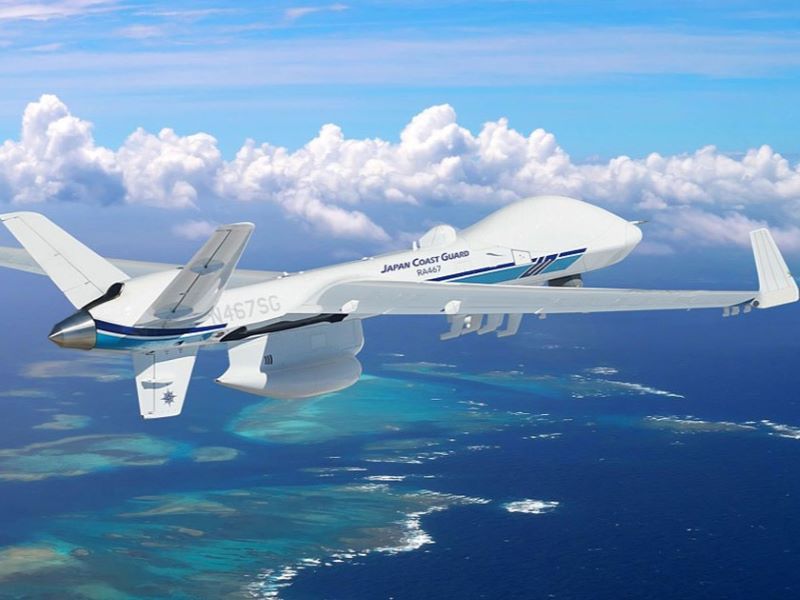
The Japan Coast Guard (JCG) signed an agreement in August 2024 to acquire two SeaGuardians, following an earlier contractor-operated arrangement in place since April 2022.
In December 2024, the Japan Maritime Self-Defence Force selected the SeaGuardian for its long-endurance uncrewed aerial vehicle requirement, following trial operations that began in May 2023.
In January 2026, Germany’s Federal Office of Bundeswehr Equipment, Information Technology and In-Service Support and the Nato Support and Procurement Agency announced plans to acquire eight MQ-9B SeaGuardian aircraft alongside four certifiable ground control stations, with initial deliveries scheduled for 2028.
