

- Thales confirmed that their sonar systems were “worked harder” than they have been previously
- Using building blocks from heritage systems – Sonar 2076 and 2087 – Thales developed Nano76 to be integrated onto the hull of uncrewed underwater vehicles (UUVs)
- The UK Royal Navy will test the efficacy of the 75x75cm tiles against a “calibrated sound source” on 17 December
Thales UK have developed a prototype for a small acoustic detection suite to be integrated onto the hull of UUVs.
Sonar Nano76, as it is known, comprises a new suite of sonar technologies including a collection of 75x75cm tiles, up to 48 of them to form a single array. The project, developed in just ten months, cost the company more than £2m ($2.67m) of its own funds.
Go deeper with GlobalData


Discover B2B Marketing That Performs
Combine business intelligence and editorial excellence to reach engaged professionals across 36 leading media platforms.
The prototype fits into the Royal Navy’s Atlantic Bastion strategy to cultivate a network of disaggregated sensors across the opaque underwater domain, within which Russian submarines have had an advantage. According to the First Sea Lord, General Gwyn Jenkins, Russian incursion into UK waters has increased by 30% in the last two years with the aim of disrupting British and allied seabed pipelines and cables.
UUVs have become a capital platform in their own right as the service begins to bring in uncrewed systems to preserve personnel, increase its declining force structure, and to monitor the country’s seabed infrastructure.
Uncrewed horizon
The vehicle acts like a truck, carrying capabilities around the ocean, or sitting on the seabed in a static situation, listening for weeks or longer and transmitting data to command and control.
According to GlobalData, a leading intelligence consultancy, over 41% of the Uncrewed Maritime Vehicle Market is invested in UUVs. In tandem, the uncrewed surface vehicle segment leads with a market share of more than 58%.

To this end, Thales will help increase the subsurface picture by integrating its miniaturised sonar capability onto the hull of UUVs.
But first, the Royal Navy will conduct a real time wet test on 17 December using a calibrated sound source to determine the efficacy of the system themselves.
Last week, Naval Technology learned more about the operational use case of Nano76 within the Atlantic Net phase in discussion with Thales’ sales director for underwater systems, Ian McFarlane.
State of the Navy
Thales have supplied the Royal Navy with towed array sonar systems – S2076 and S2087 – hundreds of metres long, tethered to the aft of Type 23 frigates and Astute-class submarines. Yet the concept for Nano76 emerged from the discovery that the company’s existing systems were falling into disrepair faster than they ever had before.
“We could see that we were getting more systems back in a worse state of repair, which showed that they were being worked harder and worked more than previous which led us to think things are obviously starting to heat up,” McFarlane said.
It does not help that the Royal Navy have seen a persistent reduction of ships and assets in recent years. Recently, the service announced the decommissioning of HMS Lancaster, a forward deployed Type 23 frigate, which will not be replaced.
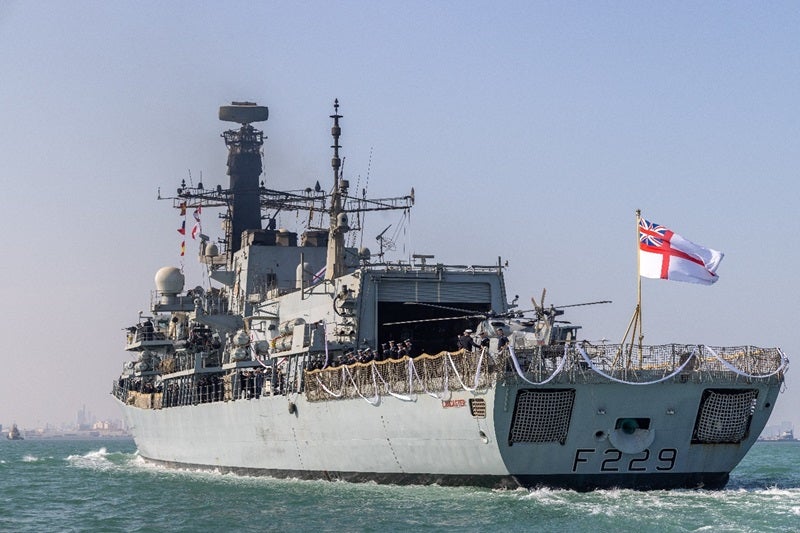
In this backdrop, uncrewed platforms will play a pivotal role in bolstering Royal Navy presence across the Atlantic in tandem with allied forces, particularly Norway. “We could see that there was going to be… a capability gap,” McFarlane continued.
“We thought one way of doing this is for us to develop a new sonar product to fit to [UUVs] particularly, and also to seabed nodes, so that sonar products can either listen in a passive mode or be operated in an active mode.”
Nano76
The new Nano76 sonar suite builds off heritage systems, particularly the inboard processing, to generate a new suite suitable for a smaller vehicle.
“Because it’s a lot smaller in terms of its size compared to a ship or an SSN and it’s going at a fairly slow speed, then the probability of detection itself is much lower so [the UUV] is less likely to get interfered with because it’s more stealthy.”
While the suite can detect sounds from adversarial movements passively through the tiles, the system can also operate in the active mode.
One critical feature is that this active/passive capability allows the vehicle to act as a communications node beneath the surface, “either receiving [data] using your passive tiles or transmitting using your active ping,” McFarlane detailed.
“And since the active ping has a very narrow beam, and it’s steerable, you have a very low probability of intercept, so you can [project] a data burst, which [lasts a] short time, but also directed and that means that you still remain covert.”
Painting a picture
What is important from an operator perspective is forming a recognisable underwater battle space picture, and they want that from as many data feeds as possible.
“So they’ll take that from their towed array on their own ship; they’ll take it from dipping sonar from a helicopter; and they’ll take it from 76Nano on a UUV, and all of those data feeds have to come together in one system to provide a seamless, recognised, tactical underwater battle space picture,” McFarlane described.
One new feature includes the use of synthetic aperture sonar (SAS) for seabed imaging, which helps create a visual construction of the underwater environment and the ability to review subsurface infrastructure.
The SAS capability will cover six kilometre range, allowing the operator to sweep over a pipeline or in a wide area to determine if there is anything of interest.
“The key thing here for us is speed of response, and the imaging that we’re getting is good enough for what we want to have a look at.”
Royal Navy test
On 17 December, the Royal Navy will undertake a real time wet testing of the system.
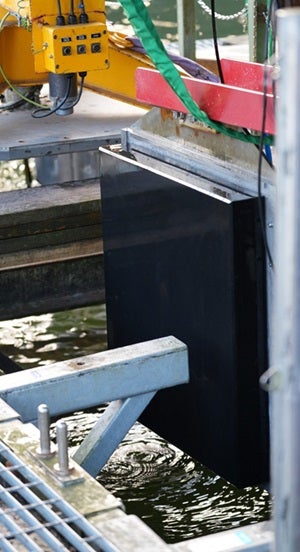
“What we’re intending to do… is to have a calibrated sound source… that gives out certain frequencies, certain strengths, certain direction, and you put your sonar in the testing facility, and then make sure that the sonar is seeing what the sound source is pumping out.
“And equally, for a transmit capability, you put your transmitter in there and have a receive capability, and make sure that the receive capability is seeing what you’re transmitting to make sure you know you’re right.”
The service will then insert the live feed into a control centre, amalgamating the data with other information, again, “to form that recognised tactical under undersea battlespace picture from various different data sources.”
UK production
The passive sonar tiles are relatively compact, McFarlane mentioned, “it’s an order of magnitude smaller” than the flank array that Thales is producing for the Dreadnought-class nuclear powered ballistic missile submarines yet “you use those tiles to make up a big array.”
The size of these tiles also means Thales does not need large scale production facilities. In a conflict scenario, the supplier would not be producing the product in one place.
“We wanted to distribute production around the UK” to avoid the type of hybrid strike campaign Russia is waging in Ukraine.


