
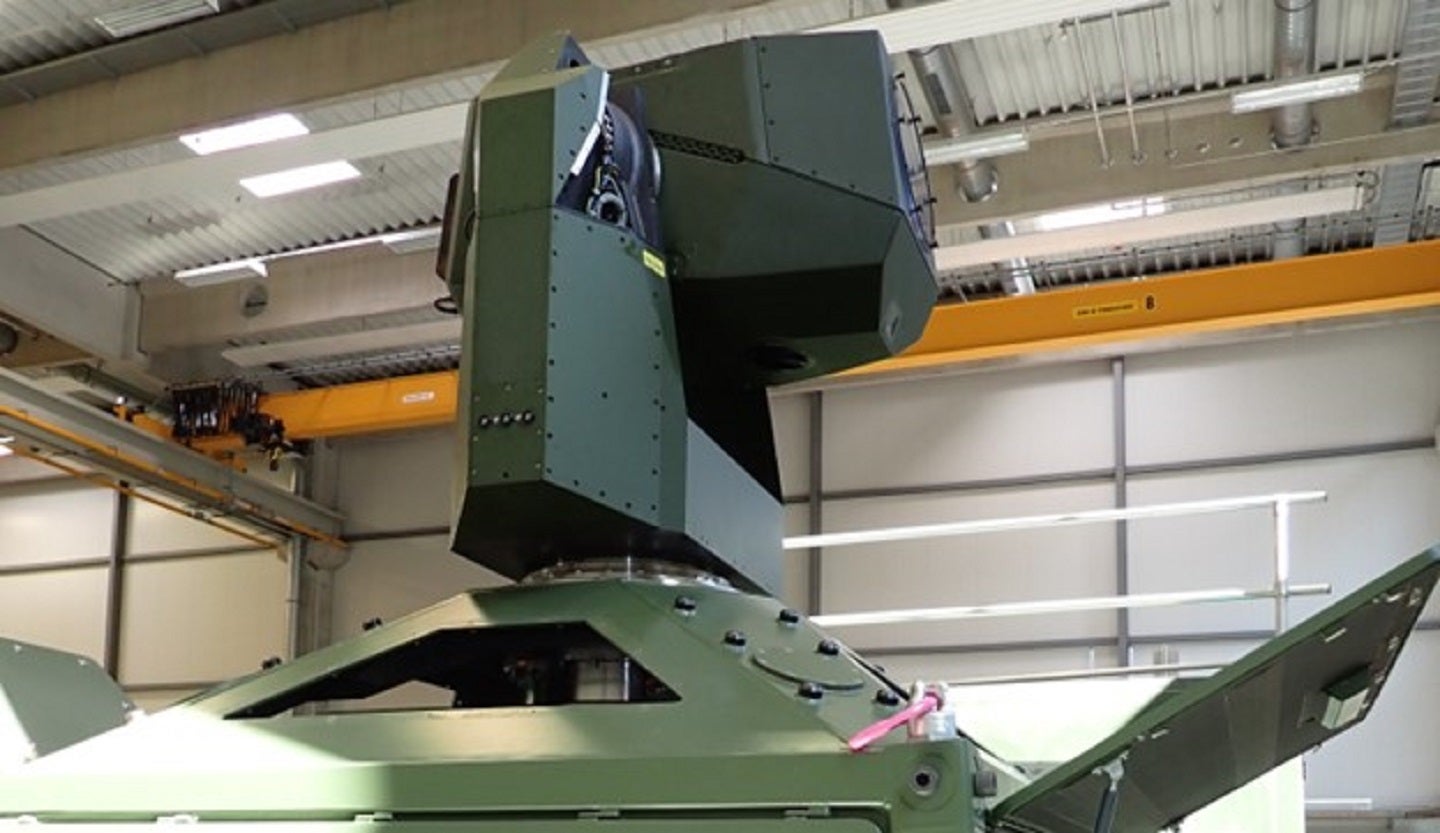
Two German armament manufacturers, MBDA Deutschland and Rheinmetall, through a collaborative working group called ARGE, will bring their joint naval product, a High-Energy Laser (HEL) weapon system, to market in the next five to ten years.
Confident in their respective skills in the field of laser technology, both companies have concluded a corresponding cooperation agreement to develop a military HEL weapon.
Go deeper with GlobalData


Discover B2B Marketing That Performs
Combine business intelligence and editorial excellence to reach engaged professionals across 36 leading media platforms.
This announcement comes after the system’s 15-month trial onboard the German Navy frigate, FGS Sachsen (F219), between June 2022 and September 2023.
A month after the successful test, in which the demonstrator was fired more than 100 times, Naval Technology was invited to MBDA Deutschland, where the company discussed its plans to deploy the weapon in the coming years.
What does the HEL weapon do?
HEL systems engage targets at the speed of light, with very low optical detectability, while operating with the highest possible precision and minimal collateral damage.
Crucially, the low cost per engagement will certainly balance the net cost of conventional missile systems throughout their lifecycle – accounting for supplementary equipment and projectiles.
This is significant given the rate at which missiles and projectiles are being spent by the two sides amid the two-and-a-half-year Russian invasion of Ukraine. The rate is high enough for Russian forces to resort to using more sophisticated weaponry, such as the Kh-101 missile – a supposedly ‘hypersonic’ missile that is, in actuality, an air-launched ballistic missile.
Deploying the HEL weapon
Although the technology is ready, the German Armed Forces require a smaller, integrated and modular system as opposed to the 20-foot, six-and-a-half tonne container unit that the German Navy deployed on the Sachsen frigate last year.
Likewise, Germany wants a HEL system that is more powerful than the current demonstrator, along with the ability to engage more difficult targets such as drone swarms.
Currently, the demonstrator’s beam operates at 50-100kw, which requires a three-to-five-second engagement time to destroy a target.
During the October 2023 update, Doris Laarmann, head of laser business development, MBDA Deutschland, suggested the company expects to fulfill these additional developments by 2027+. Though, now, after Rheinmetall’s announcement on 20 September 2024, this will be sometime between 2029-30.


