

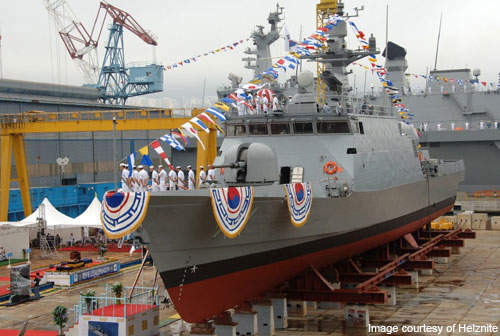
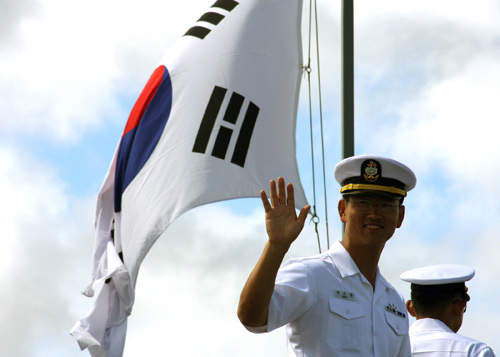
The Gumdoksuri Class is a next-generation patrol boat designed for the Republic of Korea Navy (ROKN), a branch of the Republic of Korea Armed Forces. Gumdoksuri Class vessels are high-speed boats armed with missiles, and will be the successor to the old Chamsuri Class patrol boats. The lead ship of the Gumdoksuri Class, the Yoon Young-ha (PKG 711), was launched on 28 June 2007 by Hanjin Heavy Industries (HHI).
The vessels will be deployed near the inter-Korean maritime border to help protect and defend ROKN’s interests in the ocean. The vessels are also known as the fast patrol boat (PKX) and guided-missile patrol killer (PKG).
Recommended Buyers Guides

The Gumdoksuri Class is built by two companies – Hanjin Heavy Industries and STX. The first boat of the Gumdoksuri Class was commissioned on 17 December 2008 and will serve as a testing bed for revised design to be developed in future.
Gumdoksuri A, a variant of the class, has faced certain problems while sailing. The current speed of the variant is 20kt, half the required speed of 40kt. The problems arose due to the technical infeasibility between the water jet propulsion system and the hull’s design.
Gumdoksuri Class deliveries
The lead ship in her class, the Yoon Young-ha (PKG 711), was delivered in 2007 to the South Korean Navy. The ship was commissioned at Jinhae naval base, south of Seoul, on 17 December 2008.
South Korea’s Defence Acquisition Programme Administration (DAPA) awarded STX Shipbuilding (STX), a contract in 2007 to build four Gumdoksuri Class ships. Han Sanggook (PKG 712) and Jo Cheon Hyeong (PKG 713) were launched in September 2009. Hwang Dohyun (PKG 715) and Suh Hoowon (PKG 716) were launched in December 2009. Two more boats were launched by Hanjin Heavy Industries in July 2010.
Programme
Development plans for the Gumdoksuri Class first began in 2003, after one ship of the Chamsuri Class was sunk in the Yellow Sea in 2002. The first ship of the Gumdoksuri Class was named after Yoon Young-ha, the late Navy lieutenant commander. Yoon was among the soldiers who were killed in 2002, following a skirmish with North Korea.
The ROK Navy’s Gumdoksuri Class development programme intends to build state-of-the-art patrol craft with cooperative engagement capability.
Variants
There are two variants of the Gumdoksuri Class vessel. One is the Gumdoksuri A, which is a 500t patrol craft with anti-ship missiles and the second is the Gumdoksuri B, a 200t patrol craft. About 24 Gumdoksuri As and 18 Gumdoksuri Bs are currently in production, and nine are expected to enter service by 2015.
Propulsion
In a combined diesel and gas (CODAG) arrangement, the ships have been powered by two diesel engines and General Electric LM500 marine gas turbines. The engines were provided by German Motoren und Turbinen-Union (MTU) and rated at approximately 5,600shp.
The LM500 is a version of TF34 engine with the fan removed. It contains a simple-cycle, two-shaft gas turbine and an aerodynamically coupled power turbine. The engine is designed with corrosion-resistant materials and has built-in borescope ports and a water wash manifold for compressor cleaning. The engine incorporates a variable stator compressor driven by an aircooled, two-stage turbine possesses maximum reliability and component life. The LM500 has the highest fuel efficiency and is lightweight and compact.
The engine’s single-shaft generator consists of a 14-stage, 14.5:1 high-pressure compressor with variable inlet guide vanes and variable stator vanes in the first five stages. It also has a machined ring annular combustor equipped with 18 externally mounted fuel injectors and an aircooled two-stage-high pressure turbine. The turbine is located on a second shaft which has four stages connected to the load on the air inlet end of the engine.
The low-speed shaft has no differential bearings and provides for front end drive. The engine has a good stall margin and is flexible with a wide speed and power range. It has been designed with a split casing for ease of maintenance. The turbine permits high turbine inlet temperatures for high efficiency with long hot section parts life.
Davis, a maker of IR signature suppressors (IRSS), designed and manufactured the exhaust systems for the LM500 gas turbine propulsion engines outfitted on the Gumdoksuri Class ships.
A seawater injection (SWI) system is equipped in every exhaust system. It cools both the exhaust duct metal and plume and reduces the IR signature. Exhaust systems ensure that the backward flow of seawater does not affect the engine’s performance. The exhaust system exits the ship via the hull.
On 30 June 2005, GE Transportation provided GE LM500 aero-derivative marine gas turbine kits to Samsung Techwin. Initial assembly and trial tests by Samsung Techwin were completed at their factory in Changwon, Korea. Manufacture and design of the total exhaust systems for the LM500 gas turbine propulsion engines on the Gumdoksuri was completed in 2007.
Radar systems
MteQ, a Korean maker of radars, manufactured the radar director. The small ship surface search radar was approved by the Korean Navy in 2002 and deployed in the same year in the Gumdoksuri Class vessel.
Protection
The Gumdoksuri Class patrol boats are outfitted with Dyneema HB25 for protection against a spectrum of ballistic threats. The ships are protected by an aluminium and glass-epoxy resin layer to reduce the overall weight while remaining its flame retardant properties. Dyneema HB25 is manufactured by DSM Dyneema. Samyang Comtech, maker of ballistic equipment has developed the boat’s armour panels.
Combat management and weapons
The Gumdoksuri Class is outfitted with an independent technology combat system, which consists of an EOTS and tracking radar. The search radar can identify more than 100 targets simultaneously. Another important feature is the electronic optical tracing system with target tracking functions.
The command and arming control system has an open-type structure and applies the commercial communication middleware. The ships are equipped with KSSM anti-ship missiles, 76mm guns and advanced radar systems. The ships are outfitted with surface to surface fire / air control systems.
The Global Naval Surface Combatants and Warfare Systems Market 2011-2021
This project forms part of our recent analysis and forecasts of the global naval surface combatants and warfare systems market available from our business information platform Strategic Defence Intelligence. For more information click here or contact us: EMEA: +44 20 7936 6783; Americas: +1 415 439 4914; Asia Pacific: +61 2 9947 9709 or via email.
