
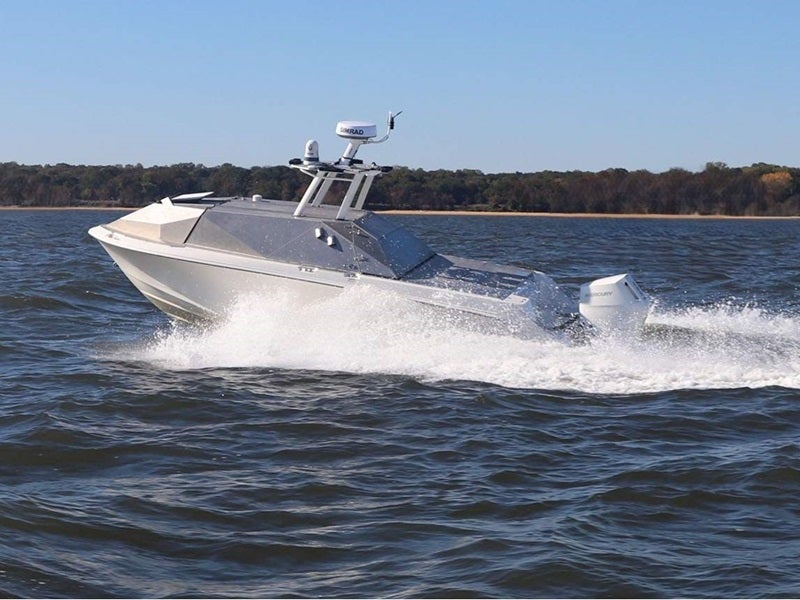
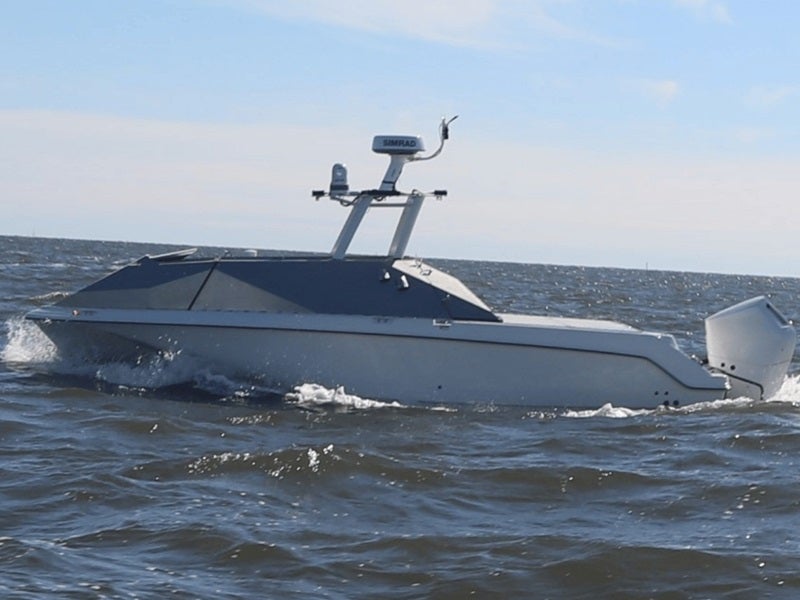
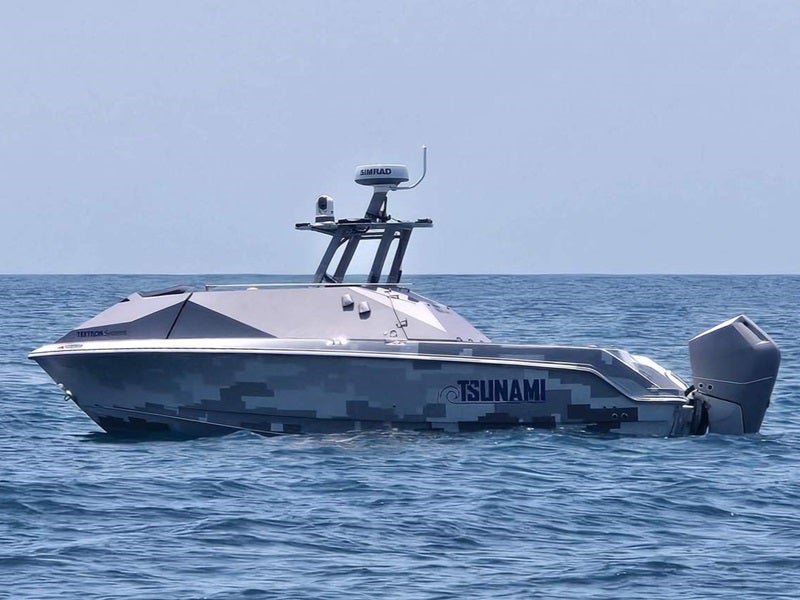
The TSUNAMI™ range of autonomous maritime surface vessels provides an affordable, rapidly deployable capability tailored to the requirements of the US Department of Defense (DoD) and allied navies.
Introduced in January 2025, the platform was developed by Textron Systems in collaboration with Brunswick Corporation to deliver a multi-role surface platform capable of cooperative operations across the naval force.
Recommended Buyers Guides
Designed for versatility, the vessels can undertake a wide variety of tasks, including surveillance, logistics and force protection, enabling fleets to respond to shifting threats and operational requirements.
TSUNAMI specifications
The TSUNAMI series is built around Brunswick Corporation’s proven, high‑performance hulls and has integrated Textron’s established Common Unmanned Surface Vehicle autonomy control system.
The platform is offered in several variants, spanning lengths of roughly 20ft to 42ft.
The 21ft variant has a beam of 8.6ft, a power output of 300hp, and can reach speeds of more than 40 knots.
The 24ft variant with a beam of about 8.5ft has a power output of 300hp and can reach speeds of up to 43 knots. It has mission payload capacities of approximately 900kg.
With a beam of about 9ft, the 25ft variant delivers 400hp and a top speed of up to 41 knots. It has mission payload capacities of approximately 1,652kg.
The 24ft, 25ft and 28ft models are in high‑volume production and are rated for operations up to Sea State 4, with operational ranges of approximately 600 to more than 1,000 nautical miles.
Textron has also demonstrated a feasible pathway to scale the concept to additional hull sizes, configurations and production volumes.
Design and features
TSUNAMI is based on a modular open systems architecture to maximise interoperability and modularity, allowing easy integration with diverse platforms and flexible mission fits, including multidomain payloads.
The family represents a step forward in modular autonomy, enhancing the capability of both new and retrofitted maritime assets.
The series is gasoline (petrol) powered to simplify logistics, reduce maintenance complexity and lower operating costs, with a typical payload capacity listed at roughly 453.6kg.
Furthermore, the platform is Unmanned Maritime Autonomy Architecture compatible, a US Navy framework that defines standards for modular, interoperable autonomy systems used in uncrewed surface and underwater vessels.
Payload
Typical standard equipment includes an electro‑optical/infrared camera, maritime radar and both line‑of‑sight and beyond‑line‑of‑sight communications links.
The vessels are also fitted with advanced sensors and onboard data‑processing systems to support real‑time situational awareness.
Propulsion
The TSUNAMI platforms can be fitted with the Verado, Mercruiser and Mercury diesel engines.
The Verado engine delivers a power of 250hp-600hp in single mode and up to 2,400hp in quad mode while the Mercruiser engine delivers a power of 200hp-430hp in single mode and up to 860hp in dual mode.
The Mercury Diesel engine can provide a power of 115hp-550hp in single mode and up to 1,100hp in dual mode.
TSUNAMI mission capabilities
TSUNAMI platforms are designed to execute complex missions autonomously, freeing personnel to concentrate on higher‑level tasks. Their integrated surveillance suites support reconnaissance and intelligence collection, delivering timely information critical to operations.
The programme benefits from an established, high‑volume production line and can scale rapidly to meet evolving maritime requirements. A global logistics and maintenance network underpins worldwide sustainment and support.
Orders and deliveries
In May 2025, Textron Systems delivered the first 24ft TSUNAMI craft to the Naval Surface Warfare Center Dahlgren Division of the US Navy.
The sale marks a significant step in the partnership between Textron Systems and the DoD and also includes engineering support alongside an advanced surveillance technology package.
