

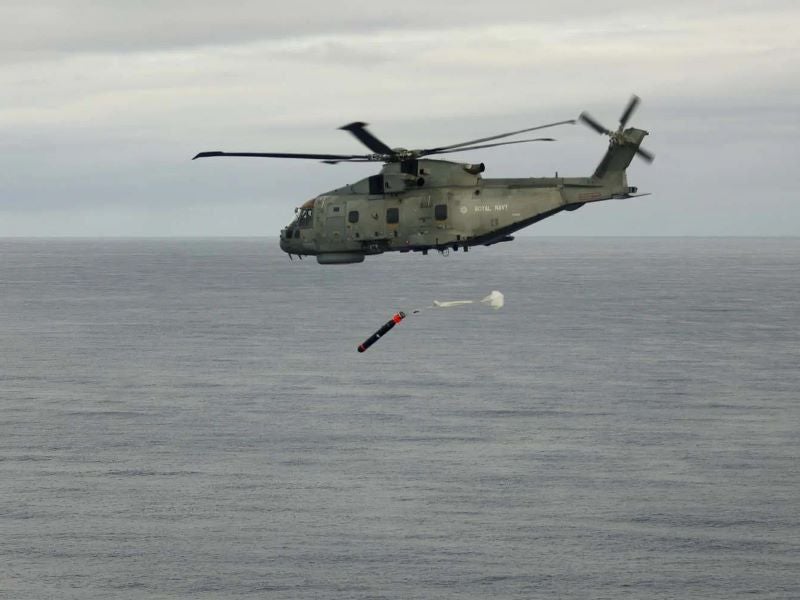
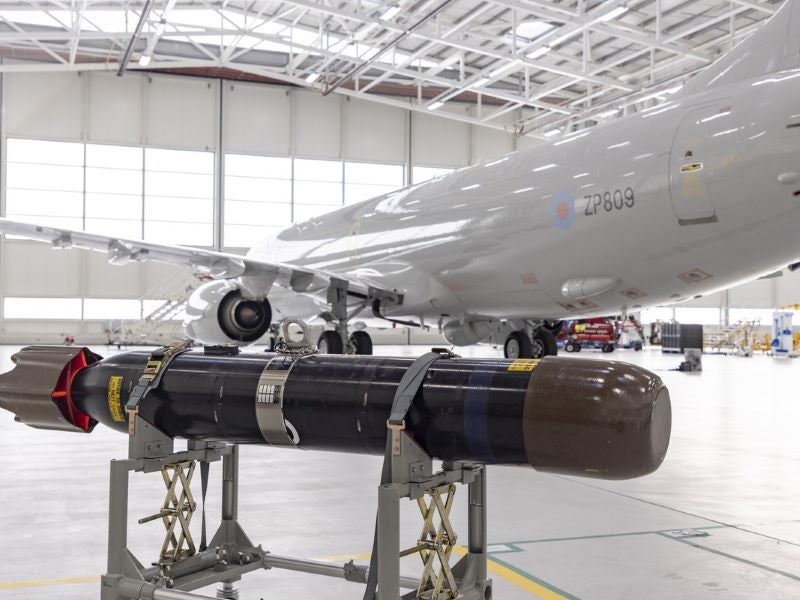
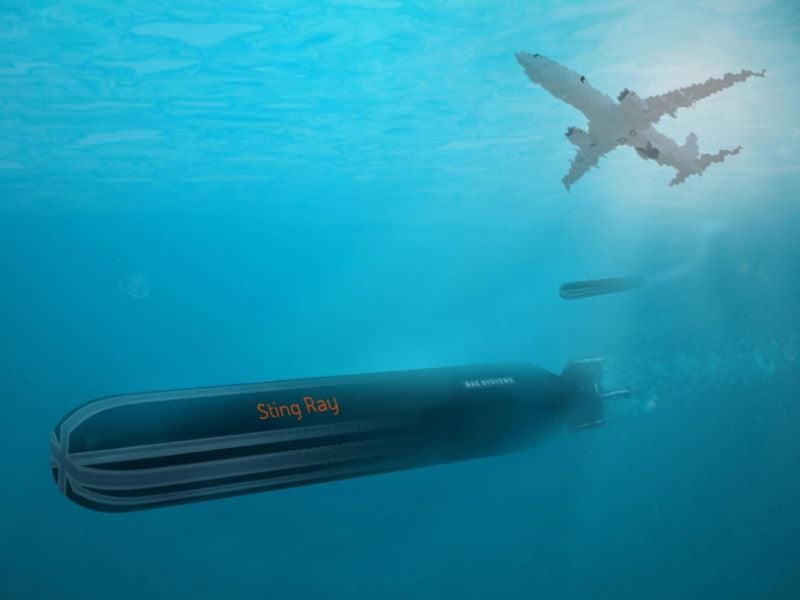
BAE Systems’ Sting Ray Mod 1 is a lightweight anti-submarine warfare torpedo operated by the Royal Navy and the Royal Air Force.
Built for use in both deep-water and coastal environments, it can be launched from helicopters, maritime patrol aircraft and surface warships, including frigates, to engage a broad spectrum of submarine threats.

Recommended Buyers Guides

The Mod 1 version entered service in 2001 as a replacement for its predecessor, the Mod 0, which was introduced in 1983.
In November 2023, the UK Ministry of Defence (MoD) confirmed the Sting Ray as the UK’s future lightweight torpedo capability, while the RAF’s Poseidon maritime patrol aircraft is set to continue using the US Navy’s Mk 54.
In September 2024, the UK MoD awarded BAE Systems a £60m ($82m) contract to carry out the assessment phase of the Sting Ray Mid-life Upgrade programme that would upgrade Sting Ray from the Mod 1 to Mod 2.
The four-year phase covers design and development activities, prototype manufacture and in-water testing to improve performance against emerging threats.
Sting Ray Mod 1 design and features
Designed to satisfy the UK MoD’s operational needs for a next-generation lightweight torpedo, the Sting Ray Mod 1 tackles two principal user priorities at the same time.
First, it responds to tougher operational demands and evolving threats through software-led upgrades. Second, its maintenance-free architecture helps lower whole-life costs and reduce the overall cost of ownership.
The design is intended to reduce through-life support by minimising the need for intrusive maintenance.
Performance is supported by updated acoustic and tactical software derived from extensive in-water trial data from the earlier variant, and by a more modular software structure to simplify future updates.
Hardware changes include a reworked front-end array, improved digital signal processing, and updated navigation and guidance computers, alongside a new motor controller and electromechanical actuation for the control surfaces.
The Mod 1 uses active and passive sonar to track a submerged target and can travel at speeds of up to 45 knots.
The Mod 1 also features a redesigned nose section intended to improve lethality, with trials indicating greater penetration than earlier performance.
Navigation and guidance
The Sting Ray Mod 1’s signal processing, navigation and guidance subsystems are built on the latest commercial off-the-shelf hardware.
The torpedo’s digital signal processing capability is designed to run more advanced classification techniques, improving target discrimination and helping to reduce false returns, while retaining capacity for later software growth.
The Mod 1 uses an upgraded autopilot intended to support complex tactical routines, particularly in shallow-water operations, and to process a larger volume of data from the launch platform.
A solid-state inertial measurement unit supports navigation and tactical modes, which are intended to counter modern acoustic countermeasures. The processing architecture is designed with spare capacity in memory, processing throughput and bus traffic to accommodate future enhancement.
The guidance and homing system is designed to improve aim point selection so the warhead can be brought onto a normal incidence against a submarine pressure hull.
Propulsion details
Power for the torpedo is provided by a magnesium and silver chloride battery that uses seawater as the electrolyte, with refinements to the battery stack and installation.
The Mod 1 replaces the earlier electro-hydraulic servo system with electromechanical actuation, removing hydraulic fluids, pumps and associated seals to reduce maintenance and support burden.
Propulsion system maintenance demands are further reduced through improved bearing lubrication and extended-life hull seals.
Sting Ray Mod 1 warhead
The Sting Ray Mod 1 was developed to address both high-speed, deep-diving, double-hulled submarines in open-ocean conditions and quieter conventional submarines operating in littoral waters.
It carries an insensitive-munition shaped-charge warhead intended to defeat hardened submarine targets. The 45kg Torpex warhead represents roughly one sixth of the weapon’s total weight.
In addition to blast effects, the shaped charge forms a focused jet designed to breach the pressure hull. The warhead was designed to meet current Nato requirements and remain aligned with likely future standards.
