

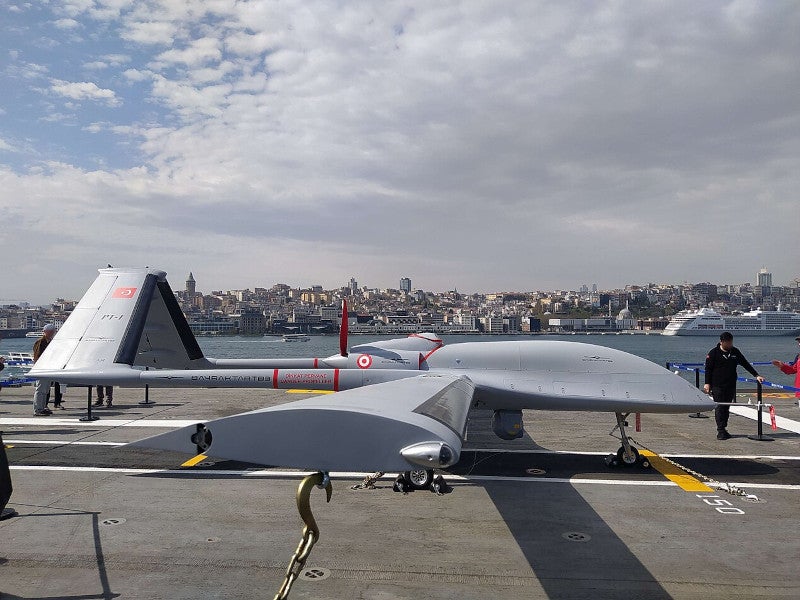
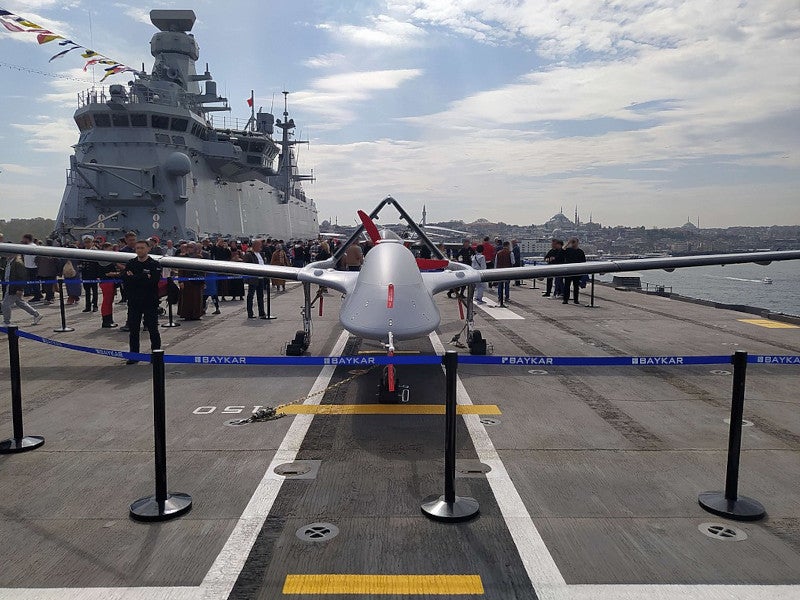
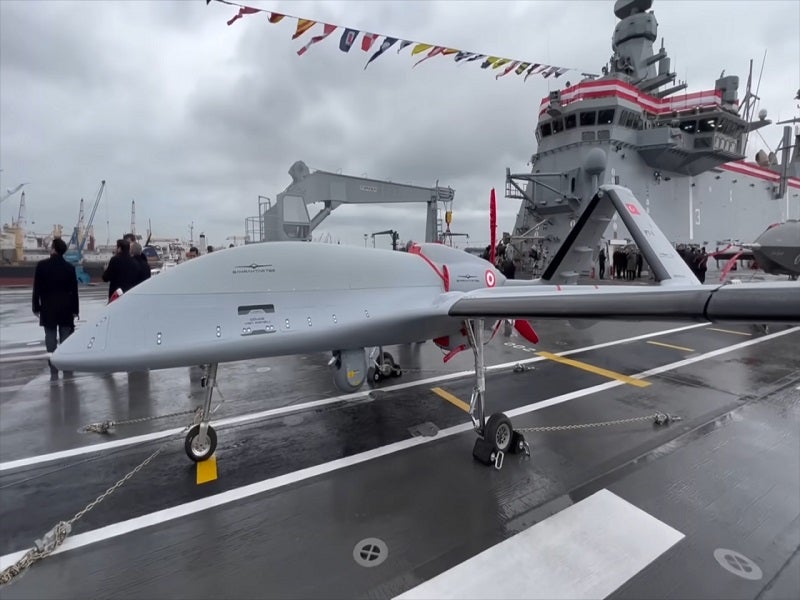
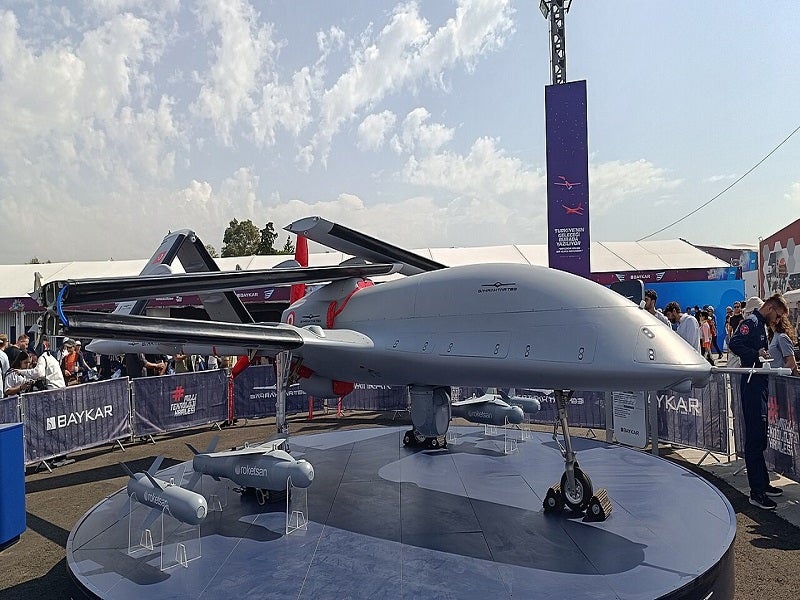
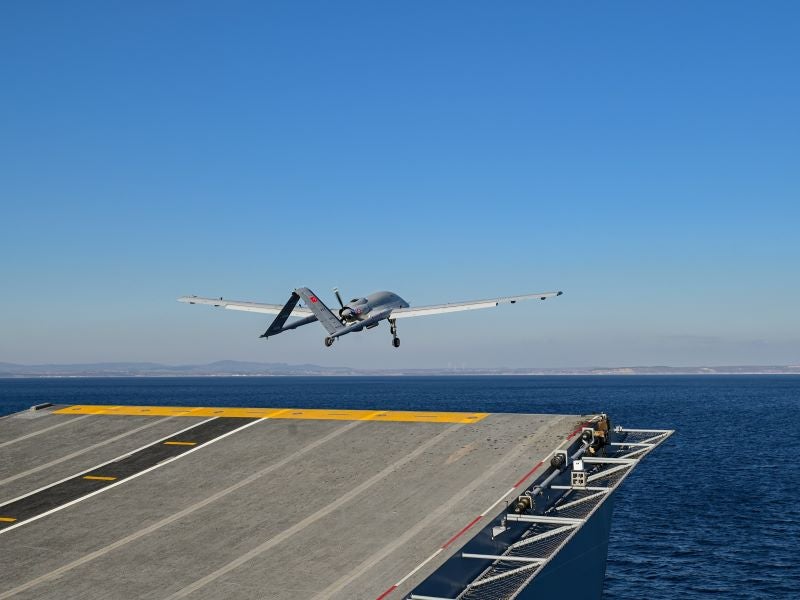
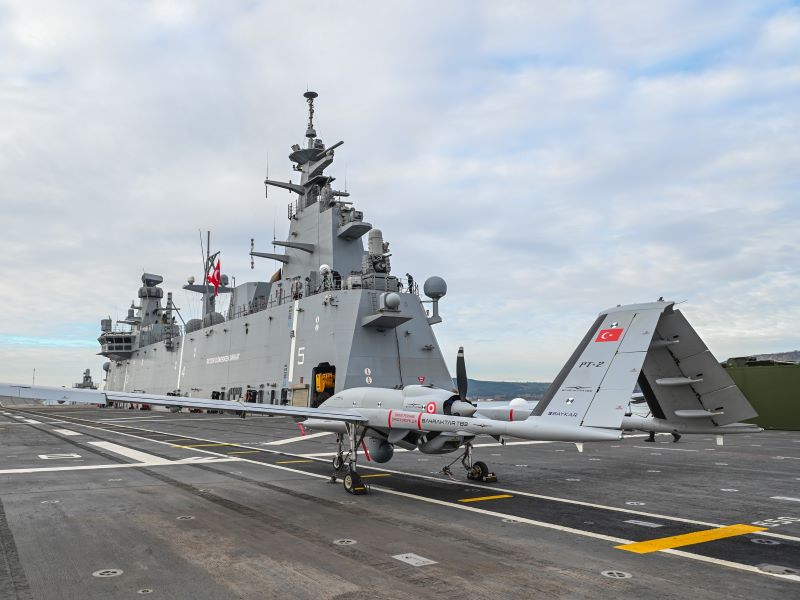
The Bayraktar TB3 is an armed unmanned aerial vehicle (UAV) currently under development by Turkish defence company Baykar Technologies.
It can perform reconnaissance, surveillance and intelligence missions, and is also equipped with intelligent munitions mounted under its wings, enabling it to perform assault operations effectively.
Recommended Buyers Guides

The UAV is designed to operate on short-runway aircraft carriers such as the TCG Anadolu multipurpose amphibious assault ship. Its customised capabilities, such as foldable wings, also allow for the execution of military operations overseas.
The Bayraktar TB3 UAV completed its first flight in October 2023, and its 25th flight test by March 2024.
In June 2025, the UAV completed 100 successful sorties as part of ongoing trials aboard the TCG Anadolu amphibious assault ship. The latest trials assessed the UAV’s vision-based, AI-assisted capability for fully automatic take-off and landing.
Bayraktar TB3 development details
The development of the Bayraktar TB3 UAV was first announced by Baykar in October 2020.
The UAV was unveiled in March 2023 at TEKNOFEST, an aerospace and technology festival held in Turkey.
The UAV concluded its fifth successful flight test in November 2023, demonstrating its capabilities in medium-altitude flight with the landing gear retracted. It also demonstrated its ability to reach a velocity of 130 kilometres per hour in further trial flights.
In December 2023, the UAV completed a long-duration flight test, covering a total distance of 5,700km during a 32-hour flight.
It remained airborne for 12 hours during its 12th flight test, evaluating its mid-altitude system performance.
The Bayraktar TB3, equipped with the ASELFLIR-500 electro-optical reconnaissance, surveillance and targeting system, completed a system identification and performance test during a medium-altitude flight in March 2024. The ASELFLIR-500 system was developed by Aselsan, a defence company based in Turkey.
In June 2024, the UAV completed a high-altitude systems performance test, where it reached an altitude of 36,310ft.
Bayraktar TB3 armed UAV design and features
The Bayraktar TB3 UAV has a wingspan of 14m, a length of 8.35m and a height of 2.6m. It has a maximum take-off weight of 1,600kg and a payload capacity of 280kg.
The UAV’s cruise speed is 125 knots, maximum speed is 160 knots and endurance is more than 24 hours with a service ceiling of 25,000ft.
The Bayraktar TB3 is twice as heavy as its predecessor, the Bayraktar TB2, and also has fully autonomous take-off and landing capabilities along with reinforced landing gear and folding wings.
In addition, the UAV can be operated from extremely remote distances due to its capabilities for both line-of-sight and beyond-line-of-sight communication.
Bayraktar TB3 payload
The Bayraktar TB3 UAV can be equipped with up to six munitions, including laser-guided and INS GPS-guided weapons, infrared-guided options and air-to-air munitions.
For intelligence, surveillance and reconnaissance missions, it supports modular payloads such as interchangeable electro-optical infrared sensors with a laser designator, a multi-mode active electronically scanned array radar, electronic intelligence equipment and sonobuoys.
Propulsion
The Bayraktar TB3 UAV is powered by a PD-170 engine manufactured by Tusas Engine Industries (TEI), a Turkish aerospace engine maker.
The TEI-PD170 turbo-diesel aviation engine is specifically designed to fulfil the power requirements of medium altitude, long endurance-class UAVs. It boasts a capacity to generate 172 horsepower.
The TEI-PD170, weighing 162kg, is equipped with a two-stage serial turbocharging system and can run on JP-8 or Jet-A1 fuel.
The engine has a straight four-cylinder configuration with a displacement of 2.1 litres, supplied by common rail fuel and controlled by full authority digital engine control (FADEC). The propeller is regulated by a FADEC-controlled hydromechanical governor.
The TEI-PD170 engine entered mass production after 10,000 hours of calibration and testing. It made its first flight with the Anka platform in December 2018 and has subsequently been utilised in flights with the Aksungur drone, and now with the Bayraktar TB3.
