
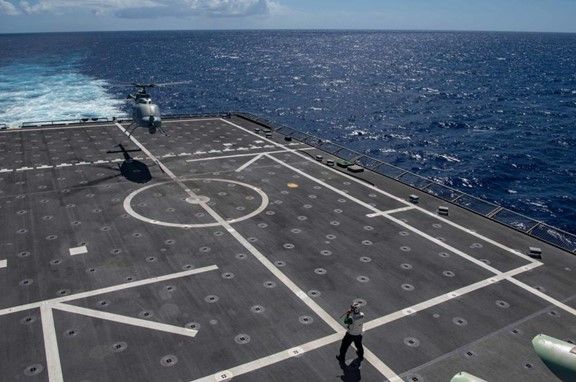
The US Navy has deployed its MQ-8C Fire Scout uncrewed aerial system (UAS) to the Indo-Pacific Area of Responsibility (AOR), aboard USS Jackson (LCS-6).
It is the second deployment of the MQ-8C UAS developed by Northrop Grumman and first to the AOR.
Go deeper with GlobalData

Discover B2B Marketing That Performs
Combine business intelligence and editorial excellence to reach engaged professionals across 36 leading media platforms.
During its operational deployment, the UAS will provide improved maritime intelligence, surveillance, reconnaissance and targeting (ISR&T) capabilities to the forces.
Earlier in April, MQ-8C completed its return to flight operations, aboard Independence-class littoral combat ship (LCS), USS Jackson, in the Philippine Sea.
US Navy captain Dennis Monagle said: “The MQ-8C Fire Scout is an extremely flexible unmanned aerial system and a pillar in the Navy and Marine Corps unmanned campaign plan.
“While Fire Scout will still be active on remaining littoral combat ships, the system is being built into the Constellation-class frigate design, most notably the USS Constellation (FFG-62), as well as other ship classes.”
The US Navy is further planning to deploy the UAS on the Constellation-class guided-missile frigates and for conducting operations under Expeditionary Advanced Base Operations concept from shore sites.
Other potential deployments of the MQ-8C include mine countermeasures, logistics cargo role and anti-submarine warfare.
Northrop Grumman Fire Scout programme director Lance Eischeid said: “The MQ-8C Fire Scout’s initial deployment was aboard USS Milwaukee (LCS-5) in the Caribbean Sea.
“MQ-8C Fire Scout provided increased ISR&T capability that contributed greatly to the success of the US Navy’s counter-narcotics operations.”
The uncrewed system MQ-8C Fire Scout provides critical decision-making capabilities to the naval forces.
It also supports other advanced capabilities, such as sensor information sharing across multi-domain forces, improving weapon capacity, demonstrating manned-unmanned teaming (MUMT), reducing risk and increasing survivability.



