
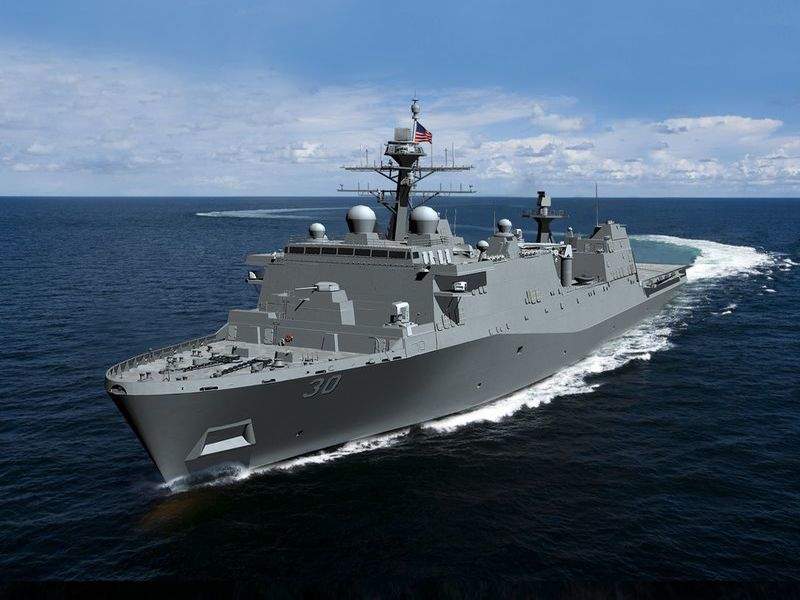
The US Navy has awarded a $165.5m advance procurement contract to Huntington Ingalls Industries’ (HII) Ingalls Shipbuilding division for the supply of a next-generation amphibious transport dock known as LPD 30.
LPD 30 is slated to be the first Flight II landing platform / dock (LPD).
Go deeper with GlobalData


Discover B2B Marketing That Performs
Combine business intelligence and editorial excellence to reach engaged professionals across 36 leading media platforms.
It is expected to replace the retiring Whidbey Island (LSD 41) and Harpers Ferry (LSD 49) dock landing ships.
Huntington will provide long-lead-time material and advance construction services in support of LPD 30 under the arrangement.
The company will use the contract funds to purchase long-lead-time materials and major pieces of equipment such as main engines, diesel generators, deck equipment, shafting, propellers, valves and other related systems.
Ingalls Shipbuilding president Brian Cuccias said: “This is a significant milestone as we embark toward a new flight of LPDs.
“The Flight II LPDs will be highly capable ships, meeting the requirements and needs of our navy / Marine Corps team.
“We look forward to delivering this series of affordable LPDs to our nation’s fleet of amphibious ships.”
Ingalls possesses a vendor base of 400 companies across 30 states and has delivered a total of 11 San Antonio-class (LPD 17) ships to the navy to date.
The company is currently building two more ships known as Fort Lauderdale (LPD 28) and Richard M. McCool Jr. (LPD 29).
It expects to commence fabrication works for LPD 30 in 2020.
The LPD Flight II variant will feature additional capabilities that will allow it to support new and emerging US Marine Corps and US Navy requirements, including the ship-to-shore connector, CH-53K helicopter and improved troop armoury / weapons stowage.
The 684ft-long, 105ft-wide San Antonio-class ships are primarily used to embark and land marines, their equipment and supplies ashore via air cushion or conventional landing craft and amphibious assault vehicles.
They are supported by helicopters or vertical take-off and landing aircraft such as the MV-22 Osprey during deployment.
The Marine Air Ground Task Force is expected to deploy the ships to conduct amphibious and expeditionary sea control and power projection missions.
Furthermore, the vessels will also be used for humanitarian assistance and disaster relief missions.



