
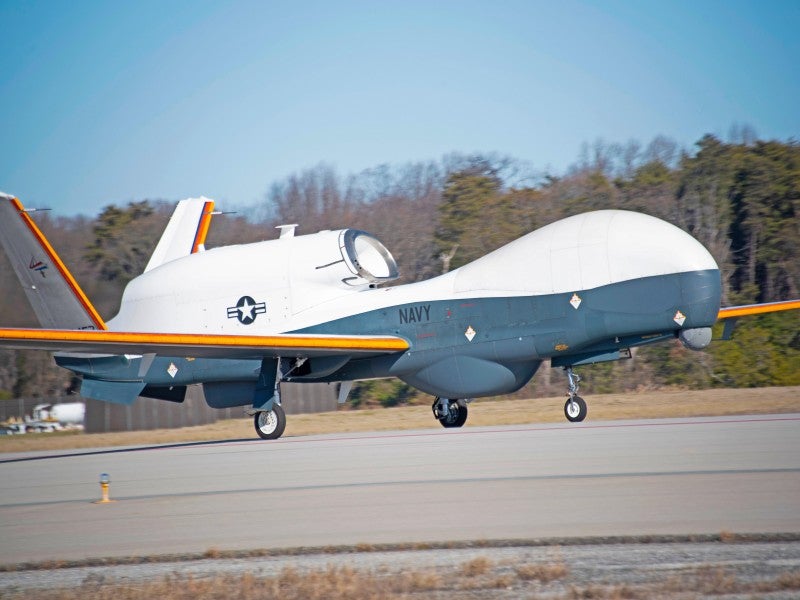
The US Navy has conducted the first flight-test of MQ-4C Triton uncrewed aerial system (UAS) to evaluate its ability to fly with ice wing accumulation.
Announced by the Naval Air Systems Command, the test was conducted at Patuxent River in Maryland, US on 25 January.
Go deeper with GlobalData


Discover B2B Marketing That Performs
Combine business intelligence and editorial excellence to reach engaged professionals across 36 leading media platforms.
It was the first test performed under the series of 15 planned flight demonstrations to validate the UAS’ capabilities to fly in icing conditions. The tests are slated to continue throughout this summer.
Under the latest effort, a test team performed basic flying drills with the UAS, including sideslips, control surface pulses and sustained turns at 20,000ft.
The data from this test will be used by the team to analyse if the UAS can respond to the inputs as predicted. It also confirms whether the team can safely proceed to the next test or not.
With gradual progress, the team has planned to increase average duration for ice-shape testing to nearly five hours.

US Tariffs are shifting - will you react or anticipate?
Don’t let policy changes catch you off guard. Stay proactive with real-time data and expert analysis.
By GlobalDataMQ-4C Triton programme manager captain Josh Guerre said: “This timeline will support deployment of latest MQ-4C multi-intelligence variant.”
Since late 2022, an integrated test team has been preparing MQ-4C Triton to undertake this anti-ice testing.
The UAS was equipped with 3D-printed nylon ice-shaped, orange-coloured blocks that are designed to simulate ice accumulation on aircraft’s wings and V-tail.
According to MQ-4C Triton lead test engineer Amanda Marge, the ice-shaped blocks are coated with a ‘coarse grit’, making these blocks more textured and rough, to replicate the scenario of ice accumulation inside a freeze.
Marge added: “The objective is to verify that there’s sufficient stability and control in order to remove restrictions in flight clearance for flying in icing conditions – which could significantly increase fleet’s sortie rate.”



