
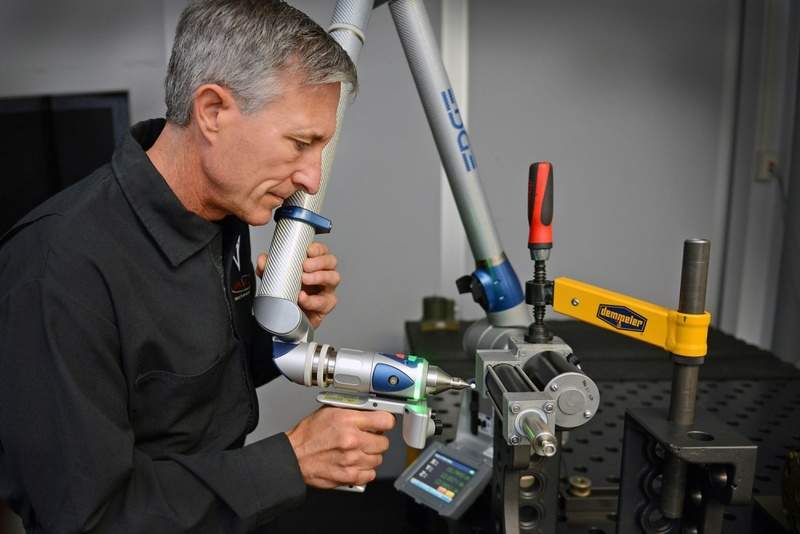
The US Space and Naval Warfare Systems Command (SPAWAR) Enterprise experts have used 3D scanning and printing technology to repair a critical piece of AN/TRC-194 antenna.
Between 2015 and last year, rainwater intrusion had caused the azimuth antenna drive to fail.
Go deeper with GlobalData


Discover B2B Marketing That Performs
Combine business intelligence and editorial excellence to reach engaged professionals across 36 leading media platforms.
To repair the AN/TRC-194 antenna with existing parts was a challenging task as the original antenna pedestal was manufactured in 1988 and its parts were no longer available.
In order to protect the azimuth antenna drive from further rainwater intrusion, the SPAWAR System Center Pacific’s (SSC Pacific’s) Reverse Engineering – Science and Technology for Obsolescence, Restoration and Evaluation (RESTORE) lab collaborated with the Program Executive Office for Command, Control, Communications, Computers and Intelligence’s (PEO C4I’s) Undersea Communications and Integration Program Office (PMW 770).
In June last year, SSC Pacific’s RESTORE lab collaborated with PMW 770 with an aim to scan the entire antenna using a 3D laser scanner.
By October, the data was converted to develop a working computer-aided design (CAD) model that would be capable of precisely articulating through the full antenna range of motion.
RESTORE Lab chief engineer Stephen Cox said: “Scanning the entire system allows us to create a blueprint that our engineers can reference when fabricating a solution.”
Over a period of nearly six months, a number of azimuth antenna designs were created and tested within the CAD model, and the components of the selected design were scanned and additively manufactured on a 3D printer.
Cox added: “The scan-to-CAD-to-cab method lowers the cost and increases the speed at which a unique product can be made.
“It also facilitates rapid changes and the product becomes better, faster, with each engineering cycle.”



