
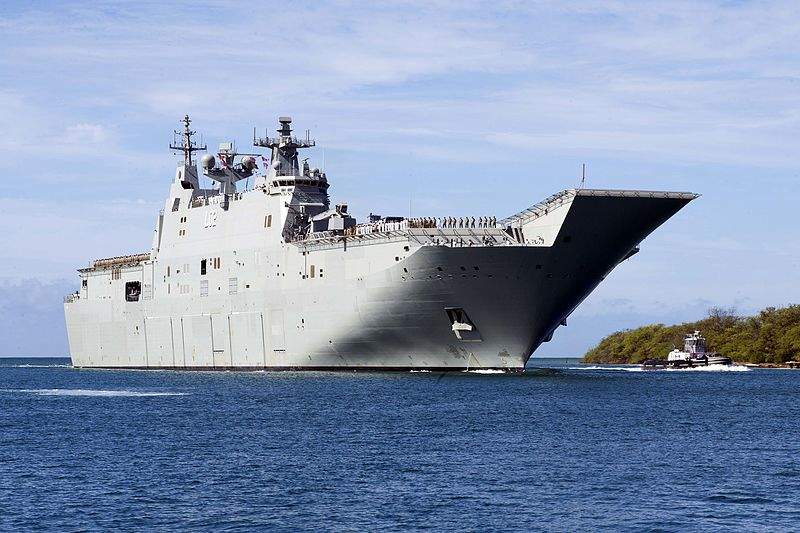
Researchers are testing corrosion-resistant coatings on the Royal Australian Navy’s (RAN) Canberra-class landing helicopter dock ship, HMAS Canberra.
Researchers from Swinburne University of Technology are carrying out the study in collaboration with experts from the Defence Materials Technology Centre, MacTaggart Scott Australia, United Surface Technologies and Defence Science and Technology.
Go deeper with GlobalData


Discover B2B Marketing That Performs
Combine business intelligence and editorial excellence to reach engaged professionals across 36 leading media platforms.
The study is focused on advancing the corrosion-resistant technology that has so far halved the build-up of algae and barnacles on ship hydraulic components.
Coatings will help address the issue of corrosion and biofouling, where tiny marine plants and animals accumulate on ship hulls, anchors and piers that are constantly immersed in water.
Currently, the team is trialling a single layer of carbide-based coating treatment on vessel parts that require very smooth surfaces.
One of the lead scientists on the team, Dr Andrew Ang said: “We have developed new materials and used a supersonic combustion flame jet, i.e a ‘flamethrower’, to coat hydraulic machinery parts, and found these new protective coatings reduce biofouling by roughly 50% compared to current standard coatings.”
Though the treatment is expected to be expensive to be used on entire ship hulls, it can be effectively used for critically important machinery on a navy vessel that helps provide propulsion or heavy lifting capabilities.
According to Defence Science and Technology researcher Dr Richard Piola, the protective surface coating is expected to make a significant difference to the operational availability of the Australian Navy ships, while slashing maintenance and repairs costs.
Piola said: “If the coating can double the length of time a ship can be at sea or available to be deployed, before it needs to be docked and cleaned, it could save costs and also increase operational readiness for the defence force.”
From 2015 to 2017, the team tested corrosion-resistant coatings on more than 100 test samples, immersing them in seawater at three field sites across the country.



