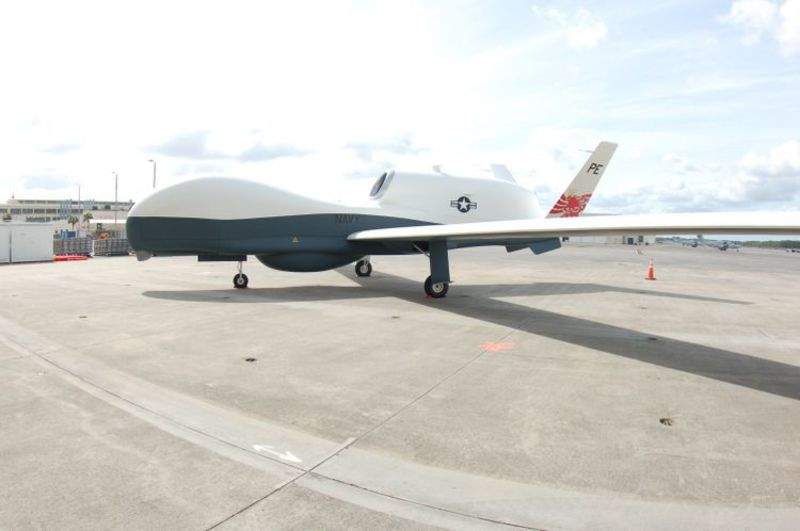

The US Navy's MQ-4C Triton unmanned aerial vehicle (UAV) has successfully completed the formal lab and first flight testing of an upgraded software suite.
The software enhancement will help improve the operational capabilities of the MQ-4C Triton UAV, which was built by Northrop Grumman.
Go deeper with GlobalData


Discover B2B Marketing That Performs
Combine business intelligence and editorial excellence to reach engaged professionals across 36 leading media platforms.
It is also intended to facilitate the UAV’s early operational capability (EOC) deployment early next year.
The software upgrade is designed to improve MQ-4C Triton’s capabilities and includes a traffic alert and collision avoidance system (TCAS), multi-aircraft control and additional multi-function active sensor (MFAS) radar modes.
Northrop Grumman Triton Programmes vice-president Doug Shaffer said: “The integration of this enhanced software suite expands Triton’s operational maritime intelligence, surveillance, reconnaissance, and targeting capabilities and moves it that much closer to qualification for operational missions in the pacific theatre.
“These flight tests further demonstrate the value and vast potential of this system.”
The US Navy’s MQ-4C Triton UAV is a forward-deployed, land-based system that is operated autonomously and primarily used for surveillance operations.
The UAV offers a persistent maritime intelligence, surveillance and reconnaissance (ISR) capability via a multi-sensor mission payload (radar, electro-optical / infra-red / electronic support measures).
It also provides ISR capabilities such as tracking, vessel detection, and classification over vast ocean and coastal regions.
The aircraft is equipped with a robust mission sensor suite, facilitating unprecedented persistent 360° maritime domain awareness.
Additionally, MQ-4C Triton can fly for up to 24 hours at altitudes reaching 56,500ft with an operational range of 8,200nm, and is capable of monitoring one million square miles of ocean in a single flight.
Image: The US Navy's autonomous unmanned aircraft, MQ-4C Triton. Photo: courtesy of Northrop Grumman Corporation.



