
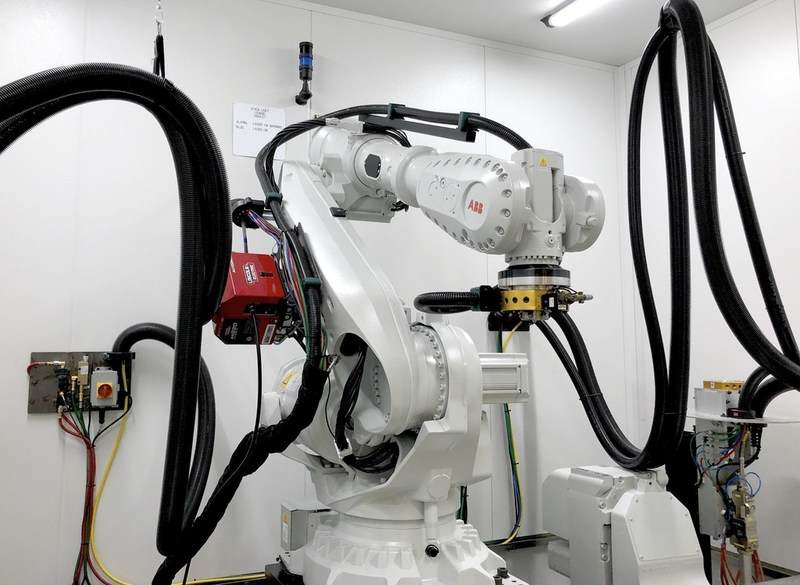
The US Navy has awarded a new contract to Lockheed Martin to conduct studies and customise multi-axis robots that use laser beams to deposit material and produce metal components.
In collaboration with the US Navy’s Office of Naval Research, the company is exploring opportunities to apply artificial intelligence (AI) for training robots to independently oversee and optimise additive manufacturing of complex parts.
Go deeper with GlobalData


Discover B2B Marketing That Performs
Combine business intelligence and editorial excellence to reach engaged professionals across 36 leading media platforms.
Under the two-year, $5.8m contract, a team led by Lockheed’s Advanced Technology Centre will be responsible for the development of new software models and sensor modifications that would enable the multi-axis robots to 3D print improved components.
Lockheed Martin Additive Manufacturing fellow Zach Loftus said: “When you can trust a robotic system to make a quality part, that opens the door to who can build usable parts and where you build them.
“Think about sustainment and how a maintainer can print a replacement part at sea, or a mechanic print a replacement part for a truck deep in the desert. This takes 3D printing to the next, big step of deployment.”
Researchers involved in the study will apply machine learning techniques to additive manufacturing to allow machines to decide how to optimise structures based on previously verified analysis.
US Tariffs are shifting - will you react or anticipate?
Don’t let policy changes catch you off guard. Stay proactive with real-time data and expert analysis.
By GlobalDataThe verified analysis and integration into a 3D printing robotic system will form the major scope of the work to be carried out under the current contract.
Lockheed Martin project manager Brian Griffith said: “We will research ways machines can observe, learn and make decisions by themselves to make better parts that are more consistent, which is crucial as 3D printed parts become more and more common.
“Machines should monitor and make adjustments on their own during printing to ensure that they create the right material properties during production.”



