
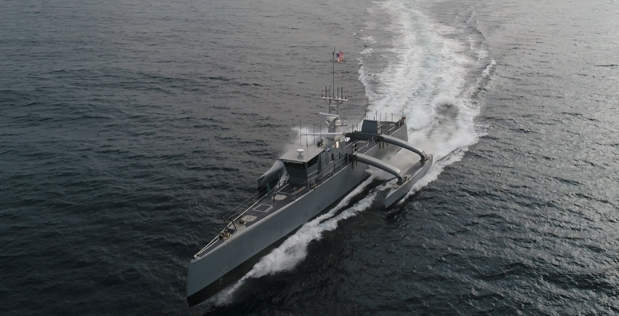
DARPA has successfully completed its Anti-Submarine Warfare (ASW) Continuous Trail Unmanned Vessel (ACTUV) programme.
It has officially transferred Sea Hunter—the vessel demonstrating the autonomous technology—to the Office of Naval Research (ONR) for continued development of the prototype as the Medium Displacement Unmanned Surface Vehicle (MDUSV).

Discover B2B Marketing That Performs
Combine business intelligence and editorial excellence to reach engaged professionals across 36 leading media platforms.
Sea Hunter is the first of what could become an entirely new class of ocean-going vessels able to traverse thousands of kilometres over open seas for months at a time and without a single crew member on board.
Widespread and successful deployment of the autonomous technology could save costs on manpower and eliminate risk to human life on military missions.
“ACTUV’s move from DARPA to ONR marks a significant milestone in developing large-scale USV technology and autonomy capabilities,” said Alexander Walan, a programme manager in DARPA’s Tactical Technology Office (TTO).
“Our collaboration with ONR has brought closer to reality a future fleet in which both manned warships and capable large unmanned vessels complement each other to accomplish diverse, evolving missions.”
Collaboration between the agencies started in September 2014. Sea Hunter was christened in April 2016, with operational testing commencing in October 2016.
“ONR appreciates the truly impressive work by DARPA in advancing this technology, and the strong partnership we’ve had on ACTUV over the years,” said Robert Brizzolara, ONR programme officer for MDUSV.
“As ACTUV transfers from DARPA to ONR, ONR is looking forward to continuing and capitalizing on the science and technology work. In particular, we are already working on autonomous control, a challenging area that is key to maturing MDUSV and delivering it to the fleet.”
Sea Hunter has been through extensive tests over the last two years. In October 2016, DARPA and ONR began at-sea testing of Sea Hunter’s sensing and autonomy suites. Between February and September 2017, the vessel passed three progressively challenging tests to integrate the suites and use them to comply with International Regulations for Preventing Collisions at Sea (COLREGS) in operationally realistic scenarios.
The ONR plans additional at-sea tests to further develop ACTUV/MDUSV technologies, including automating payload and sensor data processing, rapidly developing new mission-specific autonomous behaviours, and exploring autonomous coordination among multiple USVs.
Successful results could see the MDUSV transition to US Navy operations by 2018.


